DSSSB Optometrist Ophthalmic Instrumentation MCQs with Answers
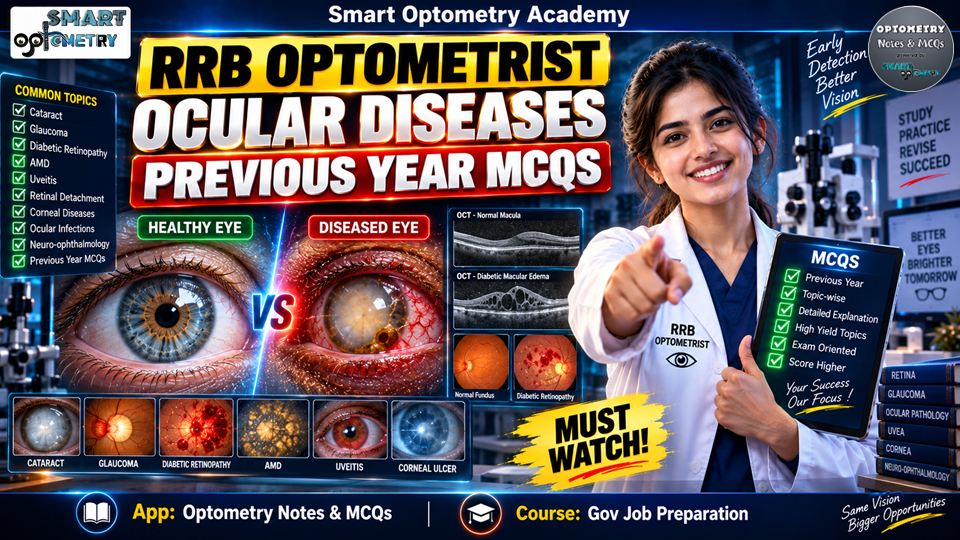
6 high-yield Instrumentation MCQs from the DSSSB 2019 & 2024 Previous Year Papers — covering Retinoscope types, OCT, Slit-lamp techniques, Visual Evoked Potentials, and Indirect Ophthalmoscopy. Click any option for the instant answer and clinical explanation.
📅 Years: 2019 & 2024❓ Questions: 6 (Free Preview)🔒 Full Set: Course Access📌 Exam: DSSSB 2026 Post 09/26
▶ Watch: DSSSB Optometrist Instrumentation MCQs — by Samir Sutradhar Sir | Smart Optometry Academy
This blog is part of the DSSSB Subject-Wise MCQ Series by Smart Optometry Academy — where we pick the highest-yield questions from each subject and give you a free preview. Ophthalmic Instrumentation is one of the highest-scoring subjects in DSSSB, consistently appearing across both 2019 and 2024 papers with 10+ questions.
Attempt all 6 questions below, then scroll down to see the full list of topics from this subject that appear in the complete course — and enrol to access all of them.
🎯 Your Score
0 / 0
Answer Q1 to begin tracking →
Q-1
How many types of retinoscopes are available in the Indian market?
DSSSB 2024Ophthalmic Instrumentation
AFour
BThree
CTwo
DOne
👆 Click an option to reveal the answer
✓ Correct Answer: C. Two
There are two types of retinoscopes used in clinical optometry: (1) Streak retinoscope — projects a linear streak of light; preferred because the streak orientation helps identify the astigmatic axis easily; (2) Spot retinoscope — projects a circular spot of light; older design. The streak retinoscope (e.g., Copeland, Welch Allyn) is the standard instrument in India. Working principle: the plane mirror retinoscope uses the principle of the plane mirror, and the concave mirror retinoscope uses a concave mirror. Working distance is typically 66 cm (1.5D) or 50 cm (2D).
Q-2
Which imaging technique is non-invasive and used to study different layers of the retina?
DSSSB 2019Ophthalmic Instrumentation
AFluorescein angiography
BPachymetry
CFundus photography
DOCT
👆 Click an option to reveal the answer
✓ Correct Answer: D. OCT
Optical Coherence Tomography (OCT) uses low-coherence interferometry with near-infrared light to create high-resolution cross-sectional images of individual retinal layers — completely non-invasive, no dye, no radiation. Gold standard for: macular pathology (AMD, DME, ERM), glaucoma (NFL thickness), retinal detachment monitoring. Why not others? Fluorescein angiography requires IV dye injection (invasive). Pachymetry measures only corneal thickness. Fundus photography provides a 2D surface image — cannot show individual retinal layer architecture.
Q-3
Which structure CANNOT be examined with a slit-lamp without an additional aid?
DSSSB 2019Ophthalmic Instrumentation
ACornea
BAnterior chamber
CIris and pupil
DMacula
👆 Click an option to reveal the answer
✓ Correct Answer: D. Macula
A standard slit-lamp is designed for anterior segment examination — cornea, anterior chamber (cells, flare), iris, pupil, crystalline lens — all accessible without any additional lens. The macula and posterior segment cannot be focused upon directly because the eye’s own optics (+60D converging power of the phakic eye) diverge the slit-lamp beam before it reaches the retina. Additional aids needed: Non-contact — 90D or 78D Volk lens. Contact — Goldmann 3-mirror lens, Superfield lens. These lenses neutralize the eye’s power, allowing posterior segment imaging via the slit-lamp.
🏆 Trusted by 20,000+ Optometry Students
20K+Total Students
40+AIIMS CBT Passes
4.7★Google Play
150+Course Enrollments
40+ students cleared the AIIMS CBT exam · 9 selected for final seat allocation · 4.7★ rated app on Google Play. Join India’s most trusted government optometry exam preparation platform.
Which electrophysiological tool is essential for the diagnosis of acute demyelinating optic neuritis?
DSSSB 2024Ophthalmic Instrumentation
AVisual Evoked Potentials (VEPs)
BElectrooculogram (EOG)
CElectrovomerography (EVG)
DElectroarteriography (EAG)
👆 Click an option to reveal the answer
✓ Correct Answer: A. Visual Evoked Potentials (VEPs)
VEPs measure the electrical response of the occipital visual cortex to light stimulation. In demyelinating optic neuritis (e.g., in multiple sclerosis), myelin loss along the optic nerve slows conduction velocity, resulting in a prolonged P100 latency — the hallmark finding even after symptoms resolve. VEP is the most sensitive test for subclinical optic nerve damage. EOG tests RPE/photoreceptor function (Arden ratio). ERG tests photoreceptor-to-bipolar cell function. EVG and EAG are not established clinical tests — distractors here.
Q-5
Which slit-lamp illumination technique is used to diagnose blepharitis?
DSSSB 2024Ophthalmic Instrumentation
ADiffuse illumination
BOptic section
CBroad beam
DSpecular reflection
👆 Click an option to reveal the answer
✓ Correct Answer: A. Diffuse illumination
Diffuse illumination uses a wide, defocused beam (with a ground glass diffuser) to provide broad, even lighting across the entire anterior segment and periocular structures. It is ideal for examining gross ocular adnexa — eyelid margins, lash follicles, and meibomian gland orifices in blepharitis. Slit-lamp illumination techniques summary: Diffuse: broad overview, adnexa. Optic section: narrow beam — corneal thickness, layer-by-layer analysis. Broad beam: overview of cornea/anterior chamber. Specular reflection: corneal endothelium, tear film. Sclerotic scatter: corneal opacities. Retro-illumination: corneal vascularisation, lens opacities.
Q-6
With regard to indirect ophthalmoscopy, which of the following is NOT correct?
DSSSB 2019Ophthalmic Instrumentation
AMagnification is 15 times
BWider field of view
CImage is real and inverted
DPeripheral retina can be seen
👆 Click an option to reveal the answer
✓ Correct Answer: A — “15 times” is NOT correct for indirect
15× magnification = Direct ophthalmoscopy — NOT indirect. Indirect ophthalmoscopy provides only 2x to 5x magnification depending on the condensing lens used (20D lens → ~3x, 28D → ~2x). The trade-off is a much wider field of view (25°–40°), making it ideal for peripheral retina, retinal detachment surgery, and screening. Comparison table: Direct → 15× magnification · narrow field · virtual upright image. Indirect → 2–5× magnification · wide field · real, inverted image · stereoscopic · binocular. Options B, C, D are ALL true for indirect.
🔒 Course-Exclusive Content
More Instrumentation Topics from DSSSB 2019 & 2024 — Available in the Course
You’ve practised 6 questions. The complete Instrumentation module in the Gov Job Preparation course covers 10+ topics from both papers. Here’s what you’re missing:
🔒
DSSSB 2019Wavefront Analysis — What is NOT true? (LASIK & Aberrometry)
🔒
DSSSB 2019CT Scan — NOT an indication (Pregnancy & Radiation)
🔒
DSSSB 2019MRI — NOT an indication (Metallic Foreign Body)
🔒
DSSSB 2019OCT — NOT correct statement (Bronchial Asthma trap)
How many Instrumentation questions appear in DSSSB Optometrist exam? ▼
Ophthalmic Instrumentation is one of the highest-scoring subjects in DSSSB Optometrist exams. In the 2019 paper, approximately 9–10 questions were from Instrumentation. In 2024, it continued to be heavily tested. Key topics: retinoscope types, OCT, slit-lamp illumination techniques, perimetry instruments, fundus cameras, VEP, keratoscopy, and focimeter.
What is the difference between direct and indirect ophthalmoscopy? ▼
Direct ophthalmoscopy: 15× magnification · narrow field (~5°) · virtual, upright image · monocular · no condensing lens needed · used for detailed disc/macula examination. Indirect ophthalmoscopy: 2–5× magnification · wide field (25–40°) · real, inverted image · binocular (stereoscopic) · condensing lens required · used for peripheral retina, RD screening, and intraoperative fundus examination.
What are the slit-lamp illumination techniques I need to know for DSSSB? ▼
Is there negative marking in DSSSB Optometrist exam? ▼
DSSSB examinations typically follow a 1/4 negative marking scheme for wrong answers. This means for every incorrect response, 0.25 marks are deducted. It is important to avoid guessing on questions you are unsure about. Practising PYQs and subject-wise MCQs (as in the Gov Job Preparation course) helps build the confidence to attempt questions accurately.