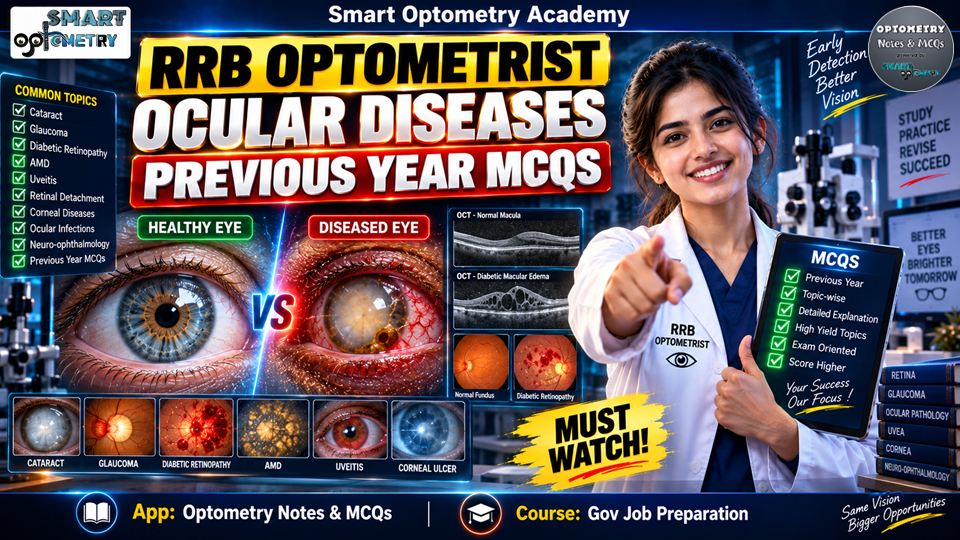

RRB Optometrist Previous Year MCQs on Ophthalmic Instrumentation
Master High-Yield RRB Optometry PYQs & Answer for CBT Success A thorough understanding of clinical tools is essential for securing a top rank in the Railway Recruitment Board paramedical examination. This focused collection of RRB Optometrist Previous Year MCQs zeroes in on the core principles, standard testing distances, and clinical applications of essential diagnostic devices directly mapped to the official syllabus.
Key Clinical Concepts Covered in These RRB PYQs
- Diagnostic capabilities of the slit-lamp biomicroscope, ophthalmoscope, and fundal camera.
- Objective refractive error measurement utilizing retinoscopy.
- Ocular alignment and binocular vision evaluation through the Cover Test and Hirschberg test.
- Electrophysiological retinal assessment using the Electroretinogram (ERG).
- Standard protocols for color vision screening using Pseudoisochromatic plates.
- Quantitative tear production assessment via the Schirmer test.
- Limitations of ophthalmophakometry in axial length measurement.
Review each authentic RRB Optometry PYQs & Answer below. Every question features a concise rationale designed to strengthen your instrumentation knowledge, prevent negative marking, and boost your CBT performance.
Practice RRB Optometrist Previous Year MCQs on “Ophthalmic Instrumentation”:
Q-1: An _______ is a recording of the electrical response of the retina to light stimulus, which may be a flash of light or a light pattern.(RRB Optometrist Previous Year MCQs 2019)
A) Retinal degenerations
B) Retinitis Pigmentosa
C) Electroretinogram
D) Phototransduction
Click “Show more” to see the answer and explanation.
Answer: C) Electroretinogram
The electroretinogram (ERG) is an objective electrophysiological test that measures the summed electrical responses of retinal cells to light stimulation. It is essential for diagnosing retinal dystrophies and assessing overall photoreceptor and inner retinal function.
Q-2: The factor that cannot be determined by Ophthalmophakometry is _______. (RRB Optometrist Year Question & Answer 2019)
A) The relative position of the cornea
B) Radii of curvature
C) Axial length
D) Crystalline lens surface
.
.
Q-3: Pseudoisochromatic plates, which use the principle of color camouflage, are used to detect: (RRB Optometrist Previous Year MCQs 2019)
A) Color deficiency
B) Working of a visual system
C) Optic nerve disease
D) Retinal inflammation
Click “Show more” to see the answer and explanation.
Answer: A) Color deficiency
Pseudoisochromatic plates (e.g., Ishihara) are designed with colored dots that camouflage a pattern, revealing it only to those with normal color vision. They are the standard screening tool for congenital and acquired color vision defects.
Master Your Govt Job Preparation
Join our most successful flagship course on the Optometry Notes & MCQs App. Follow our proven 4-step sequence to crack the Railway Recruitment Board CBT exam.
Our Proven Success Sequence
Theory Notes
Build your foundation with subject-wise clinical & optical theory.
Premium Lectures
Deepen understanding with fundamental optometry video lectures.
Subject-wise MCQs
Test accuracy and speed by practicing topic-specific question banks.
Previous Year MCQs
Master actual CBT exam patterns with completely solved PYQs.
Q-4: Pseudoisochromatic plates should be held at _______ from the patient at a right angle to the line of vision. (RRB Optometrist Year Question & Answer 2019)
A) 60 cm
B) 65 cm
C) 75 cm
D) 80 cm
Click “Show more” to see the answer and explanation.
Answer: C) 75 cm
A standardized viewing distance of 75 cm ensures proper angular subtense and consistent illumination for accurate color discrimination. This distance minimizes luminance and glare artifacts that could affect test reliability.
.
.
Q-5: Which test assesses dry eyes before fitting contact lenses? (RRB Optometrist Previous Year MCQs 2019)
A) Bruckner test
B) Retinoscopy
C) Cover test
D) Schirmer test
Click “Show more” to see the answer and explanation.
Answer: D) Schirmer test
The Schirmer test uses filter paper strips placed in the inferior conjunctival fornix to quantify tear production over 5 minutes. A wetting of less than 10 mm indicates aqueous tear deficiency, which is a relative contraindication for contact lens wear.
Q-6: What is the primary purpose of the Cover Test? (RRB Optometrist Year Question & Answer 2025)
A) To measure intraocular pressure
B) To assess refractive error
C) To evaluate ocular motility and binocular vision
D) To check visual acuity
Click “Show more” to see the answer and explanation.
Answer: C) To evaluate ocular motility and binocular vision
The Cover Test objectively detects heterotropia and heterophoria by observing compensatory eye movements when fixation is interrupted. It is the cornerstone clinical procedure for diagnosing strabismus and assessing binocular alignment.
.
.
Q-7: What does a fundal camera capture? (RRB Optometrist Previous Year MCQs 2025)
A) Cornea
B) Lens
C) Iris
D) Retina
Click “Show more” to see the answer and explanation.
Answer: D) Retina
A fundal camera is a specialized retinal imaging device that photographs the optic disc, macula, vasculature, and peripheral retina. These images are critical for documenting and monitoring diabetic retinopathy, glaucoma, and macular degeneration.
Q-8: Which instrument examines the anterior eye segment? (RRB Optometrist PYQs 2025)
A) Autorefractor
B) Retinoscope
C) Ophthalmoscope
D) Slit-lamp biomicroscope
Click “Show more” to see the answer and explanation.
Answer: D) Slit-lamp biomicroscope
The slit-lamp provides high‑magnification, stereoscopic, and illuminated views of the cornea, conjunctiva, anterior chamber, iris, and lens. It is the primary instrument for anterior segment pathology assessment and contact lens evaluation.
.
.
Q-9: What does a slit lamp examine? (RRB Optometrist Previous Year MCQs 2025)
A) Retina
B) Optic nerve
C) Visual field
D) Anterior segment
Click “Show more” to see the answer and explanation.
Answer: D) Anterior segment
The slit lamp’s adjustable illumination and magnification are specifically optimized for detailed assessment of the anterior segment structures. It also allows visualization of the vitreous and fundus with auxiliary lenses.
.
Q-10: What is an ophthalmoscope’s primary use? (RRB Optometrist PYQs 2025)
A) IOP measurement
B) Corneal assessment
C) Retinal examination
D) Visual acuity testing
Click “Show more” to see the answer and explanation.
Answer: C) Retinal examination
The ophthalmoscope illuminates and magnifies the internal ocular structures, enabling direct visualization of the retina, optic disc, and retinal vessels. It is indispensable for detecting papilledema, hemorrhages, and other fundus pathologies.
Q-11: [Paste Your Question Here]
A) Option 1
B) Option 2
C) Correct Option
D) Option 4
Explanation: [Paste your detailed explanation here so Google can index it.]
Q-12: [Paste Your Question Here]
A) Option 1
B) Correct Option
C) Option 3
D) Option 4
Unlock the Full Question Bank
Get access to all remaining premium MCQs, detailed explanations, and complete subject notes. Enroll in our Govt Job Preparation Course to secure your success.
RRB Optometrist 2026
Complete Previous Year MCQs (All Subjects Solved)
Master Your Govt Job Preparation
Join our most successful flagship course on the Optometry Notes & MCQs App. Follow our proven 4-step sequence to crack the Railway Recruitment Board CBT exam.
Our Proven Success Sequence
Theory Notes
Build your foundation with subject-wise clinical & optical theory.
Premium Lectures
Deepen understanding with fundamental optometry video lectures.
Subject-wise MCQs
Test accuracy and speed by practicing topic-specific question banks.
Previous Year MCQs
Master actual CBT exam patterns with completely solved PYQs.
The RRB Optometrist recruitment conducted under the Ministry of Railways offers a prime opportunity for eye care professionals targeting a secure RRB Optometry Govt Job. Candidates preparing for an upcoming RRB Optometrist Vacancy can review the standardized eligibility norms, pay scale, and exam structure below to streamline their preparation for this sought-after RRB Optometrist govt job.
Key Job Parameters
- Post Title: Optometrist.
- Pay Scale: Level 4 of the 7th CPC Pay Matrix, featuring an initial basic pay of ₹25,500 plus applicable allowances.
- Educational Qualification: B.Sc in Optometry or a Diploma in Ophthalmic Technique/Technician (with a course duration of 3 to 4 years) from a recognized university or institution, along with valid registration with the relevant Council or Licensing body.
- Age Limit: 18 to 33/36 years, with standard category-based upper age relaxations applicable for OBC, SC, ST, PwBD, and Ex-Servicemen.
- Medical Fitness Standard: B-1 Standard, which requires sound distance and near vision along with intact colour, binocular, night, and mesopic vision. Candidates who have undergone LASIK or any other refractive surgery are not eligible for posts with the B-1 medical standard.
CBT Examination Pattern & Scheme The selection process consists of a Single-Stage Computer Based Test (CBT), followed by Document Verification (DV) and the Railway Medical Examination.
- Exam Duration and Structure: The CBT lasts for 90 minutes (120 minutes for eligible PwBD candidates using a scribe) and consists of 100 objective-type multiple-choice questions (MCQs) for a total of 100 marks.
- Marking Scheme: Each correct response earns 1 mark, with a strict negative marking deduction of 1/3 mark for every incorrect answer.
- Professional Ability (70 Marks): This core technical segment consists of 70 questions and tests optometry domains such as Physical & Visual Optics, Ocular Anatomy & Physiology, Refraction, Contact Lenses, Binocular Vision, Dispensing Optics, Optometric Instruments, and Ocular Pathology.
- General Awareness (10 Marks): Comprises 10 questions covering current affairs, history, polity, and related topics.
- General Arithmetic, Intelligence & Reasoning (10 Marks): Comprises 10 questions testing quantitative and analytical aptitude.
- General Science (10 Marks): Comprises 10 questions covering basic Physics, Chemistry, and Life Sciences.