
RRB Optometrist Previous Year MCQs on Binocular Vision
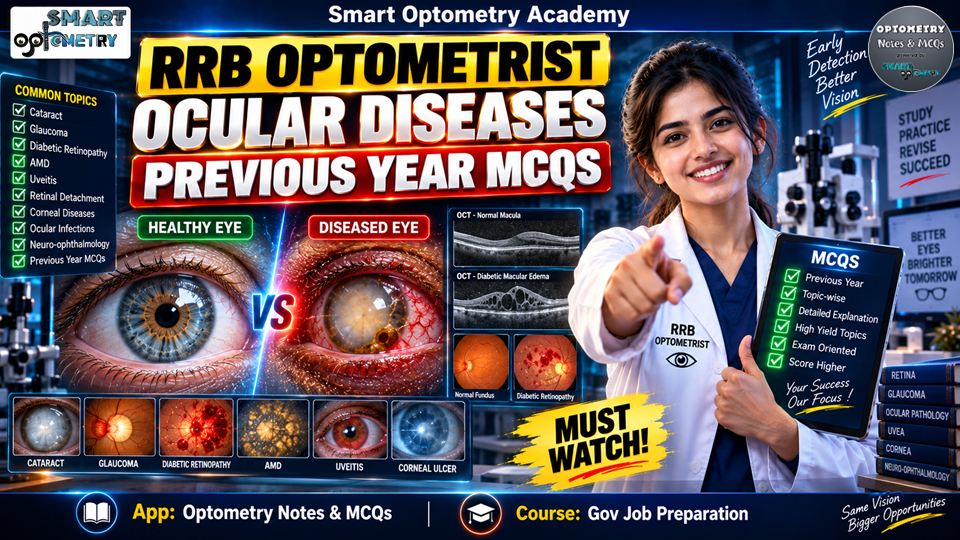
Master High-Yield RRB Optometry PYQs & Answer for CBT Success Mastering ocular motility and alignment is vital for securing a top rank in the Railway Recruitment Board paramedical examination. This targeted collection of RRB Optometrist Previous Year MCQs focuses on clinical binocular assessments and neuromuscular dynamics directly mapped to the official syllabus.
Key Clinical Concepts Covered in These RRB PYQs
- Mechanisms of accommodation and near-object focusing
- Ocular alignment evaluation using the Cover Test and Hirschberg test
- Diagnosing the clinical signs and symptoms of convergence insufficiency
- Extraocular muscle function and Oculomotor (III) nerve innervation
- Differentiating uniocular movements (ductions) from binocular coordination
- Clinical implications of anisometropia on binocular fusion
Review each authentic RRB Optometry PYQs & Answer below. Every question includes a concise rationale designed to strengthen your clinical knowledge, prevent negative marking, and boost your CBT performance.
Practice RRB Optometrist Previous Year MCQs on “Binocular Vision”:
Q-1: The ability of the eye to change power and bring near objects into focus on the retina is called: (RRB Optometrist Previous Year MCQs 2019)
A) Contraction
B) Configuration
C) Accommodation
D) Concentration
Click “Show more” to see the answer and explanation.
Answer: C) Accommodation
Accommodation is the dynamic process by which the ciliary muscle contracts to increase lens curvature for focusing on near objects. This function is essential for clear near vision and is a key component of the binocular vision system.
Q-2: Which of the following medical indications exist when there is a difference in the refraction of more than 2 diopters between two eyes? (RRB Optometrist Year Question & Answer 2019)
A) Nystagmus
B) Anisometropia
C) Keratoconus
D) Cosmesis
Click “Show more” to see the answer and explanation.
Answer: B) Anisometropia
Anisometropia is defined as a significant interocular refractive difference exceeding 2 diopters, which often disrupts binocular vision and may lead to amblyopia or diplopia. This condition requires careful optical correction to restore comfortable single binocular vision.
.
.
Q-3: What is the primary purpose of the Cover Test? (RRB Optometrist Previous Year MCQs 2025)
A) To measure intraocular pressure
B) To assess refractive error
C) To evaluate ocular motility and binocular vision
D) To check visual acuity
Click “Show more” to see the answer and explanation.
Answer: C) To evaluate ocular motility and binocular vision
The Cover Test is a fundamental binocular vision assessment that detects strabismus and phorias by observing eye movement responses when one eye is occluded. It provides critical information about ocular alignment and fusion ability.
Master Your Govt Job Preparation
Join our most successful flagship course on the Optometry Notes & MCQs App. Follow our proven 4-step sequence to crack the Railway Recruitment Board CBT exam.
Our Proven Success Sequence
Theory Notes
Build your foundation with subject-wise clinical & optical theory.
Premium Lectures
Deepen understanding with fundamental optometry video lectures.
Subject-wise MCQs
Test accuracy and speed by practicing topic-specific question banks.
Previous Year MCQs
Master actual CBT exam patterns with completely solved PYQs.
Q-4: What does the Hirschberg test assess? (RRB Optometrist Year Question & Answer 2025)
A) Retinal detachment
B) Corneal light reflex position
C) Color vision
D) Visual acuity
Click “Show more” to see the answer and explanation.
Answer: B) Corneal light reflex position
The Hirschberg test objectively evaluates ocular alignment by comparing the corneal light reflex positions in both eyes. Asymmetric reflections indicate strabismus, with each millimeter of deviation approximating 7 degrees of misalignment.
.
.
Q-5: Which cranial nerve controls eye movement? (RRB Optometrist Previous Year MCQs 201259)
A) Trigeminal (V)
B) Facial (VII)
C) Oculomotor (III)
D) Optic (II)
Click “Show more” to see the answer and explanation.
Answer: C) Oculomotor (III)
The oculomotor nerve innervates the superior, inferior, and medial rectus muscles, along with the inferior oblique, controlling most extraocular movements and eyelid elevation. Its proper function is essential for coordinated binocular eye movements.
Q-6: What is accommodation in the eye? (RRB Optometrist Year Question & Answer 2025)
A) Distance vision clarity
B) Depth perception
C) Near object focusing
D) Color detection
Click “Show more” to see the answer and explanation.
Answer: C) Near object focusing
Accommodation is the physiological process of increasing the refractive power of the lens to bring near objects into sharp focus on the retina. This mechanism is driven by ciliary muscle contraction and is integral to binocular vision.
.
.
Q-7: Which finding suggests convergence insufficiency? (RRB Optometrist Previous Year MCQs 2025)
A) Distance diplopia
B) Exotropia
C) Near-vision strain
D) Normal convergence
Click “Show more” to see the answer and explanation.
Answer: C) Near-vision strain
Convergence insufficiency typically presents with asthenopia, blurred vision, and diplopia during near tasks due to inadequate inward eye movement. Patients often report headaches and visual discomfort after prolonged reading.
Q-8: What does extraocular motility testing assess? (RRB Optometrist PYQs 2025)
A) Corneal health
B) Muscle function
C) Retinal integrity
D) Lens clarity
Click “Show more” to see the answer and explanation.
Answer: B) Muscle function
Extraocular motility testing evaluates the function and coordination of the six extraocular muscles by tracking eye movements in nine cardinal gaze positions. This assessment helps identify palsies, restrictions, or supranuclear gaze disorders.
.
.
Q-9: What is uniocular movement? (RRB Optometrist Previous Year MCQs 2025)
A) Pupil constriction
B) Single-eye motion
C) Eyelid blinking
D) Both eyes moving
Click “Show more” to see the answer and explanation.
Answer: B) Single-eye motion
Uniocular movement, or duction, refers to the independent movement of a single eye in any direction. Testing ductions helps localize neuromuscular deficits affecting individual extraocular muscles or their innervating cranial nerves.
.
Q-10: What defines convergence insufficiency? (RRB Optometrist PYQs 2025)
A) Outward movement failure
B) Excessive tearing
C) No binocular involvement
D) Impaired inward focus
Click “Show more” to see the answer and explanation.
Answer: D) Impaired inward focus
Convergence insufficiency is a binocular vision disorder characterized by the inability to sustain adequate convergence for near fixation, causing asthenopia and intermittent diplopia. This condition is commonly managed with vision therapy and prismatic correction.
Q-11: [Paste Your Question Here]
A) Option 1
B) Option 2
C) Correct Option
D) Option 4
Explanation: [Paste your detailed explanation here so Google can index it.]
Q-12: [Paste Your Question Here]
A) Option 1
B) Correct Option
C) Option 3
D) Option 4
Unlock the Full Question Bank
Get access to all remaining premium MCQs, detailed explanations, and complete subject notes. Enroll in our Govt Job Preparation Course to secure your success.
RRB Optometrist 2026
Complete Previous Year MCQs (All Subjects Solved)
Master Your Govt Job Preparation
Join our most successful flagship course on the Optometry Notes & MCQs App. Follow our proven 4-step sequence to crack the Railway Recruitment Board CBT exam.
Our Proven Success Sequence
Theory Notes
Build your foundation with subject-wise clinical & optical theory.
Premium Lectures
Deepen understanding with fundamental optometry video lectures.
Subject-wise MCQs
Test accuracy and speed by practicing topic-specific question banks.
Previous Year MCQs
Master actual CBT exam patterns with completely solved PYQs.
The RRB Optometrist recruitment conducted under the Ministry of Railways offers a prime opportunity for eye care professionals targeting a secure RRB Optometry Govt Job. Candidates preparing for an upcoming RRB Optometrist Vacancy can review the standardized eligibility norms, pay scale, and exam structure below to streamline their preparation for this sought-after RRB Optometrist govt job.
Key Job Parameters
- Post Title: Optometrist.
- Pay Scale: Level 4 of the 7th CPC Pay Matrix, featuring an initial basic pay of ₹25,500 plus applicable allowances.
- Educational Qualification: B.Sc in Optometry or a Diploma in Ophthalmic Technique/Technician (with a course duration of 3 to 4 years) from a recognized university or institution, along with valid registration with the relevant Council or Licensing body.
- Age Limit: 18 to 33/36 years, with standard category-based upper age relaxations applicable for OBC, SC, ST, PwBD, and Ex-Servicemen.
- Medical Fitness Standard: B-1 Standard, which requires sound distance and near vision along with intact colour, binocular, night, and mesopic vision. Candidates who have undergone LASIK or any other refractive surgery are not eligible for posts with the B-1 medical standard.
CBT Examination Pattern & Scheme The selection process consists of a Single-Stage Computer Based Test (CBT), followed by Document Verification (DV) and the Railway Medical Examination.
- Exam Duration and Structure: The CBT lasts for 90 minutes (120 minutes for eligible PwBD candidates using a scribe) and consists of 100 objective-type multiple-choice questions (MCQs) for a total of 100 marks.
- Marking Scheme: Each correct response earns 1 mark, with a strict negative marking deduction of 1/3 mark for every incorrect answer.
- Professional Ability (70 Marks): This core technical segment consists of 70 questions and tests optometry domains such as Physical & Visual Optics, Ocular Anatomy & Physiology, Refraction, Contact Lenses, Binocular Vision, Dispensing Optics, Optometric Instruments, and Ocular Pathology.
- General Awareness (10 Marks): Comprises 10 questions covering current affairs, history, polity, and related topics.
- General Arithmetic, Intelligence & Reasoning (10 Marks): Comprises 10 questions testing quantitative and analytical aptitude.
- General Science (10 Marks): Comprises 10 questions covering basic Physics, Chemistry, and Life Sciences.