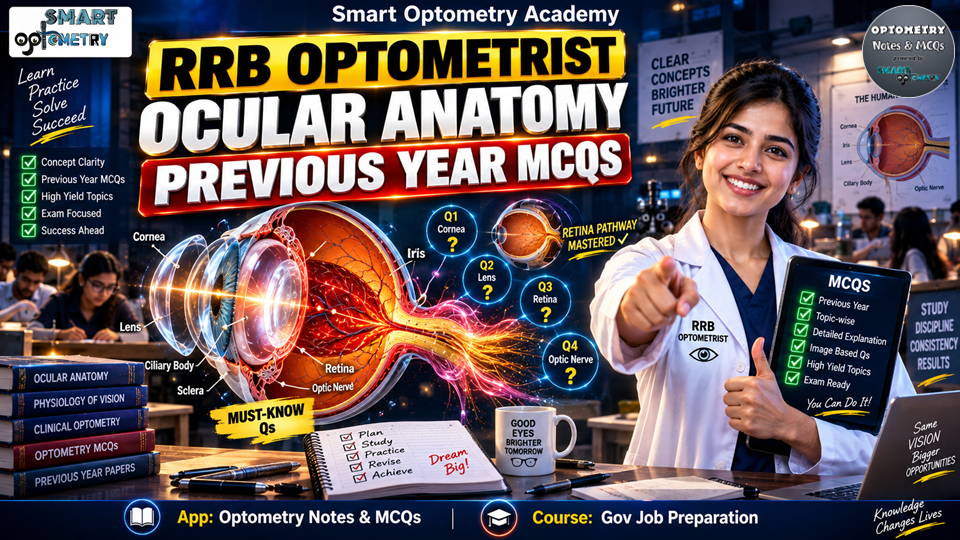
RRB Optometrist Previous Year MCQs on Ocular Anatomy
Master High-Yield RRB Optometry PYQs & Answer for CBT Success Welcome to Smart Optometry Academy. A precise understanding of ocular and orbital anatomy is essential for securing a top rank in the Railway Recruitment Board paramedical examination. This focused collection of RRB Optometrist Previous Year MCQs zeroes in on the structural framework of the eye, directly mapped to the official syllabus.
Key Clinical Concepts Covered in These RRB PYQs
- Anteroposterior eyeball growth milestones from birth to childhood
- Structural dimensions of the cornea and the regenerative properties of Descemet’s membrane
- Efficiency of hexagonal endothelial cells in maintaining the corneal barrier
- Anatomy of the ciliary body and the choroidal blood supply
- Osteology of the orbit, including the 7 composing bones, the delicate lamina papyracea, and the inferior orbital fissure
- Mechanisms of enophthalmos in orbital floor blowout fractures
- Cranial nerve III (Oculomotor) innervation of extraocular muscles
Review each authentic RRB Optometry PYQs & Answer below. Every question includes a concise clinical rationale designed to strengthen your anatomical knowledge, prevent negative marking, and boost your overall CBT performance.
Practice RRB Optometrist Previous Year MCQs on “Ocular Anatomy”:
Q-1: Ante-posterior length of the eyeball at birth is 17.3 mm. What is the size of the eyeball at 7 to 8 years? (RRB Optometrist Previous Year MCQs 2019)
A) 23 mm
B) 24 mm
C) 23.5 mm
D) 24.5 mm
Q-2: Which has the smallest diameter with respect to the cornea? (RRB Optometrist Year Question & Answer 2019)
A) Anterior horizontal diameter
B) Posterior horizontal diameter
C) Anterior vertical diameter
D) Posterior vertical diameter
Click “Show more” to see the answer and explanation.
Answer: C) Anterior vertical diameter
The anterior vertical diameter of the cornea is slightly smaller than the horizontal diameters, reflecting its oval or ellipsoid shape. This anatomical asymmetry is clinically relevant for contact lens fitting and surgical planning.
.
.
Q-3: A strong membrane that helps in regeneration after injury is: (RRB Optometrist Previous Year MCQs 2019)
A) Epiretinal membrane
B) Descemet’s membrane
C) Bowman’s membrane
D) Conjunctiva membrane
Click “Show more” to see the answer and explanation.
Answer: B) Descemet’s membrane
Descemet’s membrane is the thick, elastic basement membrane of the corneal endothelium that has remarkable regenerative capacity after injury. Its robust structure supports endothelial cell function and maintains corneal hydration.
Master Your Govt Job Preparation
Join our most successful flagship course on the Optometry Notes & MCQs App. Follow our proven 4-step sequence to crack the Railway Recruitment Board CBT exam.
Our Proven Success Sequence
Theory Notes
Build your foundation with subject-wise clinical & optical theory.
Premium Lectures
Deepen understanding with fundamental optometry video lectures.
Subject-wise MCQs
Test accuracy and speed by practicing topic-specific question banks.
Previous Year MCQs
Master actual CBT exam patterns with completely solved PYQs.
Q-4: All of the following are true about choroids except: (RRB Optometrist Year Question & Answer 2019)
A) 10 numbers of short posterior ciliary arteries
B) 2 numbers of long posterior ciliary arteries
C) 7 numbers of anterior ciliary arteries
D) 4 numbers of long posterior ciliary arteries
Click “Show more” to see the answer and explanation.
Answer: A) 10 numbers of short posterior ciliary arteries
The choroid is supplied by approximately 20 short posterior ciliary arteries, not 10, making this statement false. The long posterior ciliary arteries are two in number, and anterior ciliary arteries are typically seven.
.
.
Q-5: How many lamellae are distributed throughout the stroma and lie parallel to the corneal surface? (RRB Optometrist Previous Year MCQs 2019)
A) 400-500
B) 200-300
C) 300-400
D) 100-200
Q-6: Which cranial nerve controls eye movement? (RRB Optometrist Year Question & Answer 2025)
A) Trigeminal (V)
B) Facial (VII)
C) Oculomotor (III)
D) Optic (II)
Click “Show more” to see the answer and explanation.
Answer: C) Oculomotor (III)
The oculomotor nerve (CN III) innervates the superior, inferior, and medial recti, along with the inferior oblique and levator palpebrae superioris. It is the primary motor nerve for most extraocular movements and eyelid elevation.
.
.
Q-7: Which structure is key to aqueous humor outflow in glaucoma? (RRB Optometrist Previous Year MCQs 2025)
A) Vitreous body
B) Zonules of Zinn
C) Iris root
D) Schlemm’s canal
Click “Show more” to see the answer and explanation.
Answer: D) Schlemm’s canal
Schlemm’s canal is a circular endothelial-lined channel at the limbus that collects aqueous humor from the trabecular meshwork and drains it into the venous system. Impaired outflow through this structure is the primary mechanism in open-angle glaucoma.
Q-8: What most commonly causes enophthalmos in orbital fractures? (RRB Optometrist PYQs 2025)
A) Zygomatic arch fracture
B) Medial wall fracture with muscle entrapment
C) Superior orbital fissure syndrome
D) Orbital floor fracture with fat herniation
Click “Show more” to see the answer and explanation.
Answer: D) Orbital floor fracture with fat herniation
Orbital floor blowout fractures allow orbital fat to herniate into the maxillary sinus, decreasing orbital volume and causing the globe to sink posteriorly (enophthalmos). This can also lead to vertical diplopia due to inferior rectus restriction.
.
.
Q-9: A 4-month-old infant presents with congenital ptosis and absent superior levator muscle function. What is the likely cause? (RRB Optometrist Previous Year MCQs 2025)
A) Marcus Gunn jaw-winking syndrome
B) Congenital Horner’s syndrome
C) Blepharophimosis syndrome
D) Congenital aponeurotic ptosis
Click “Show more” to see the answer and explanation.
Answer: D) Congenital aponeurotic ptosis
Congenital aponeurotic ptosis arises from improper development or thinning of the levator palpebrae superioris aponeurosis, leading to poor eyelid elevation. Surgical correction is often required to prevent amblyopia and restore binocular function.
.
Q-10: The orbital plate of the ethmoid is called _______. (RRB Optometrist PYQs 2019)
A) Lamina propria
B) Lamina terminalis
C) Orbital lamina
D) Lamina papyracea
Click “Show more” to see the answer and explanation.
Answer: D) Lamina papyracea
The lamina papyracea is the paper-thin orbital plate of the ethmoid bone that forms the major part of the medial orbital wall. It separates the orbit from the ethmoid air sinuses and is prone to fracture.
Q-11: [Paste Your Question Here]
A) Option 1
B) Option 2
C) Correct Option
D) Option 4
Explanation: [Paste your detailed explanation here so Google can index it.]
Q-12: [Paste Your Question Here]
A) Option 1
B) Correct Option
C) Option 3
D) Option 4
Unlock the Full Question Bank
Get access to all remaining premium MCQs, detailed explanations, and complete subject notes. Enroll in our Govt Job Preparation Course to secure your success.
RRB Optometrist 2026
Complete Previous Year MCQs (All Subjects Solved)
Master Your Govt Job Preparation
Join our most successful flagship course on the Optometry Notes & MCQs App. Follow our proven 4-step sequence to crack the Railway Recruitment Board CBT exam.
Our Proven Success Sequence
Theory Notes
Build your foundation with subject-wise clinical & optical theory.
Premium Lectures
Deepen understanding with fundamental optometry video lectures.
Subject-wise MCQs
Test accuracy and speed by practicing topic-specific question banks.
Previous Year MCQs
Master actual CBT exam patterns with completely solved PYQs.
The RRB Optometrist recruitment conducted under the Ministry of Railways offers a prime opportunity for eye care professionals targeting a secure RRB Optometry Govt Job. Candidates preparing for an upcoming RRB Optometrist Vacancy can review the standardized eligibility norms, pay scale, and exam structure below to streamline their preparation for this sought-after RRB Optometrist govt job.
Key Job Parameters
- Post Title: Optometrist.
- Pay Scale: Level 4 of the 7th CPC Pay Matrix, featuring an initial basic pay of ₹25,500 plus applicable allowances.
- Educational Qualification: B.Sc in Optometry or a Diploma in Ophthalmic Technique/Technician (with a course duration of 3 to 4 years) from a recognized university or institution, along with valid registration with the relevant Council or Licensing body.
- Age Limit: 18 to 33/36 years, with standard category-based upper age relaxations applicable for OBC, SC, ST, PwBD, and Ex-Servicemen.
- Medical Fitness Standard: B-1 Standard, which requires sound distance and near vision along with intact colour, binocular, night, and mesopic vision. Candidates who have undergone LASIK or any other refractive surgery are not eligible for posts with the B-1 medical standard.
CBT Examination Pattern & Scheme The selection process consists of a Single-Stage Computer Based Test (CBT), followed by Document Verification (DV) and the Railway Medical Examination.
- Exam Duration and Structure: The CBT lasts for 90 minutes (120 minutes for eligible PwBD candidates using a scribe) and consists of 100 objective-type multiple-choice questions (MCQs) for a total of 100 marks.
- Marking Scheme: Each correct response earns 1 mark, with a strict negative marking deduction of 1/3 mark for every incorrect answer.
- Professional Ability (70 Marks): This core technical segment consists of 70 questions and tests optometry domains such as Physical & Visual Optics, Ocular Anatomy & Physiology, Refraction, Contact Lenses, Binocular Vision, Dispensing Optics, Optometric Instruments, and Ocular Pathology.
- General Awareness (10 Marks): Comprises 10 questions covering current affairs, history, polity, and related topics.
- General Arithmetic, Intelligence & Reasoning (10 Marks): Comprises 10 questions testing quantitative and analytical aptitude.
- General Science (10 Marks): Comprises 10 questions covering basic Physics, Chemistry, and Life Sciences.