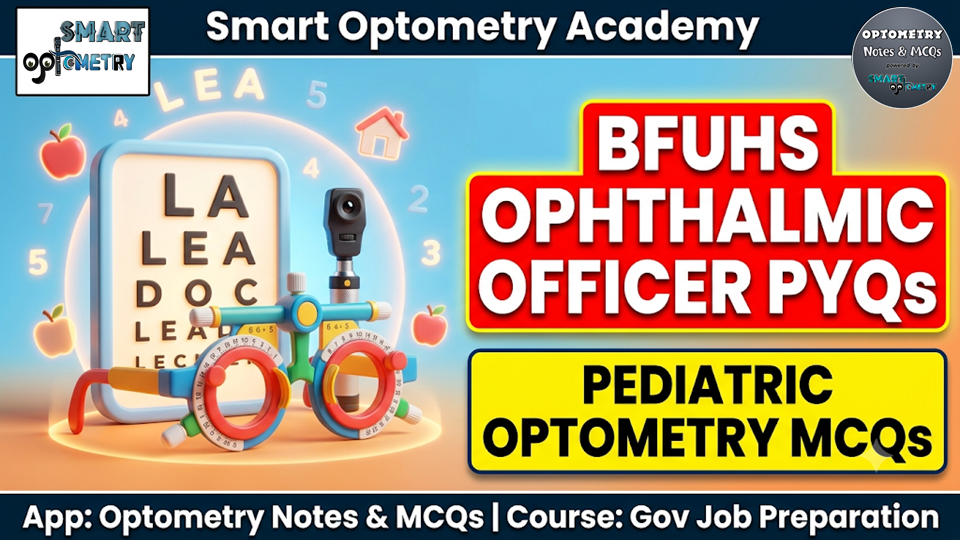
Practice top Pediatric Optometry MCQs for BFUHS Ophthalmic Officer & AIIMS Optometry exams with detailed explanations. Solve 10 free interactive PYQs online below. 4 bonus MCQs are locked inside the app.
🎥 Watch: Video Breakdown & Detailed Solution
📌 Test your knowledge directly using the real-time interactive quiz section below. Instant explanations are provided for every question!
📋 Interactive Practice Questions (Free Set)
Q1. A 12-year-old boy brought to the clinic with gradual decreased vision in both eyes. His uncorrected vision is 20/50 and improved with pinhole to 20/20. What is the most likely diagnosis?
💡 Explanation (Answer: C)
Vision improvement with a pinhole indicates a refractive error, specifically myopia in this case. The pinhole eliminates peripheral light rays and corrects the refractive error, confirming the diagnosis.
Q2. A one-month-old baby is brought with complaints of photophobia and watering. Clinical examination shows normal tear passages and clear but large cornea. The most likely diagnosis is:
💡 Explanation (Answer: D)
Congenital glaucoma presents with the classic triad of photophobia, epiphora (watering), and buphthalmos (enlarged cornea). The clear but enlarged cornea with normal tear passages points toward this diagnosis.
🚀 Govt Job Preparation – Full Course
Gain immediate access to premium learning materials tailored perfectly for upcoming state & central-level Optometry Government Exams. Let’s make learning highly systematic.
Q3. A 12-year-old boy brought to the clinic with decreased vision in the right eye. His best-corrected vision is 20/80 and shows no improvement with pinhole. Right eye retinoscopy shows +8.00 DS error. Left eye unaided visual acuity is 20/20. What is the most likely diagnosis?
💡 Explanation (Answer: D)
The significant refractive difference between the two eyes (+8.00 in one eye and normal in the other) causes anisometropic amblyopia. The brain suppresses the blurred image from the affected eye, leading to reduced best-corrected vision.
Q4. Accommodation is maximum at the age of:
💡 Explanation (Answer: D)
The maximum amplitude of accommodation is observed in early childhood, peaking around 5 years of age. It gradually declines with age due to natural loss of lens elasticity.
📚 Everything You Need for Optometry Exams
Secure high scores in clinical, optical, and anatomical domains. Our mock trials and detailed syllabus-mapped notes keep your preparation organized.
Q5. Accommodative esotropia is usually associated with:
💡 Explanation (Answer: B)
In uncorrected hypermetropia, the eye must accommodate strongly to focus on distant objects and even more for near objects. This excessive accommodation triggers excessive convergence (a part of the near reflex), leading to an inward turning of the eye known as esotropia.
Q6. Infants are born with:
💡 Explanation (Answer: B)
Infants are typically born with physiological hypermetropia of approximately +2.00 to +3.00 D. This refractive state gradually decreases with axial elongation as the eye grows towards emmetropia.
Q7. High AC/A ratio causes:
💡 Explanation (Answer: B)
A high AC/A ratio leads to excessive convergence relative to accommodation, resulting in convergent squint (esotropia). This is commonly seen in accommodative esotropia in children.
Q8. Amblyopia is most common in:
💡 Explanation (Answer: B)
Hypermetropia is the refractive error most commonly associated with amblyopia, particularly when uncorrected in childhood. The blurred retinal image in hypermetropia can lead to amblyopia if not corrected early.
Q9. Roving ring scotoma is seen after correction of Aphakia by:
💡 Explanation (Answer: A)
Correcting aphakia with high-plus power spectacle lenses introduces significant optical aberrations. The prismatic effect at the periphery of these thick lenses creates a blind area called a “ring scotoma” that moves as the patient moves their head.
Q10. Treatment of amblyopia is:
💡 Explanation (Answer: B)
Occlusion therapy (patching the better eye) is the gold standard treatment for amblyopia. It forces the amblyopic eye to work, improving visual acuity when initiated early in childhood.
🔒 Bonus MCQs – App Exclusive
Unlock these 4 exclusive premium questions + all 15 clinical subjects in the BFUHS Ophthalmic Officer & Govt Job Preparation course.
Q11. Which is incorrect for paediatric spectacle prescription?
Q12. What is the normal visual acuity of a newborn?
Q13. In which condition is retinoscopy indicated under atropine cycloplegia?
Q14. The most common cause of leucocoria in a child is:
🎯 Accelerate Your Optometry Exam Prep
Access high-yield study resources, smart mock tests, and a high-performance community.
🎯 Enroll in Full Govt Job Preparation Course