🎯 Your Score
✥ drag to move
0
/
0
Start answering!
📋 DSSSB Optometrist 2026 · Post Code 09/26
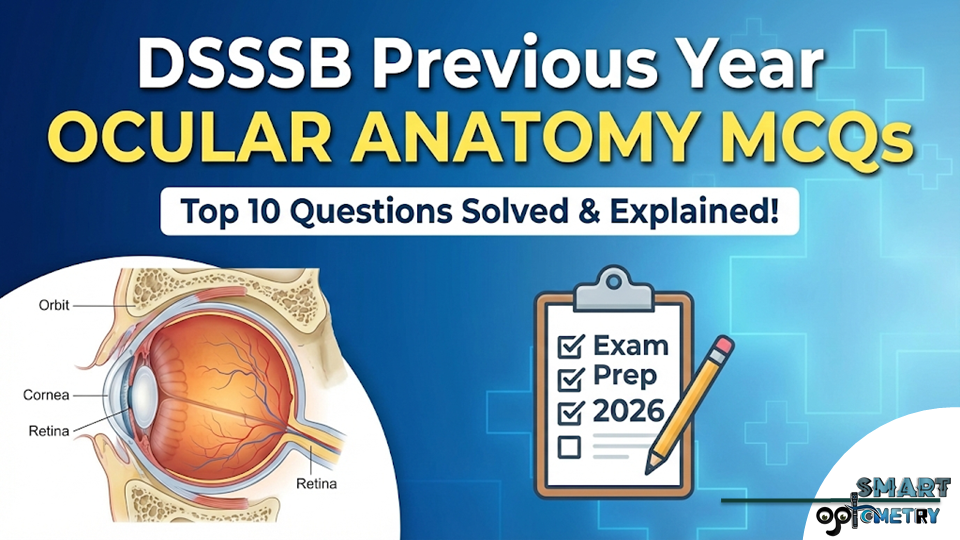
DSSSB Previous Year MCQs:
Ocular Anatomy
Actual questions from DSSSB 2019 & 2024 — click an option to reveal the answer and explanation.
📅 Source: DSSSB 2019 & 2024
❓ Questions: 10 MCQs
🎯 Subject: Ocular Anatomy
📌 Vacancies: 15 Posts
Ocular Anatomy is consistently tested in the DSSSB Optometrist exam. From the 2019 and 2024 papers, anatomy questions have covered bony orbit, corneal dimensions, retinal layers, embryology, and extraocular muscles.
How to use this quiz: Read each question → click the option you think is correct → the answer and explanation will appear instantly. Your score is tracked at the top and in the floating card on the right.
📑 Questions in This Blog
- Q1 — Bones of the Bony Orbit
- Q2 — Volume of Adult Bony Orbit
- Q3 — Structures through Superior Orbital Fissure
- Q4 — Opening of Nasolacrimal Duct
- Q5 — Corneal Dimensions in Adults
- Q6 — Layers of Neurosensory Retina
- Q7 — Suspensory Ligament of Lockwood
- Q8 — Number of Extraocular Muscles
- Q9 — Day of Optic Pit Formation
- Q10 — Development of Iris Stroma
🎯 Your Score
0 / 0
Answer your first question to begin →
Q-1
Which of the following bones do NOT make up the bony orbit? (DSSSB Optometrist Previous Year Question Paper)
A Maxilla
B Frontal
C Zygomatic
D Parietal
👆 Click an option to check your answer
✓ Correct Answer: D. Parietal
The bony orbit is composed of seven bones: Maxilla, Frontal, Zygomatic, Ethmoid, Lacrimal, Sphenoid, and Palatine. The Parietal bone forms the upper-lateral vault of the cranium and does not extend into the orbital cavity.
Q-2
The volume of an adult bony orbit is: (DSSSB Optometrist Previous Year Question Paper)
A 30 ml
B 50 ml
C 70 ml
D 60 ml
👆 Click an option to check your answer
✓ Correct Answer: A. 30 ml
The average volume of a fully developed human bony orbit is approximately 30 millilitres. This compact space houses the globe, extraocular muscles, orbital fat, and neurovascular structures. Options B, C, and D are all too large — a common exam trap.
⏰ Application Deadline: 28 March 2026
DSSSB Optometrist 2026 — Only 15 Posts. Thousands of Applicants.
The last date to apply is 28 March 2026. With only 15 vacancies across all categories, every mark in Section B counts. Start your structured preparation today with Samir Sir’s “Gov Job Preparation” course.
🎓 Enroll Before It’s Too Late →
Q-3
The structures passing through the superior orbital fissure are: (DSSSB Optometrist Previous Year Question Paper)
A CN III, IV & ophthalmic artery
B CN III, IV & superior ophthalmic vein
C CN II, VI & superior ophthalmic vein
D CN III, VI & ophthalmic artery and vein
👆 Click an option to check your answer
✓ Correct Answer: B
The superior orbital fissure transmits: CN III (oculomotor), CN IV (trochlear), CN VI (abducens), the ophthalmic branch of V1, and the superior ophthalmic vein. The ophthalmic artery does NOT pass here — it enters through the optic canal with CN II.
Q-4
The opening of the nasolacrimal duct in the nose is at: (DSSSB Optometrist Previous Year Question Paper)
A Middle meatus
B Inferior meatus
C Lacrimal sac
D Above the middle meatus
👆 Click an option to check your answer
✓ Correct Answer: B. Inferior meatus
The nasolacrimal duct drains tears from the lacrimal sac into the nasal cavity. It terminates beneath the inferior nasal concha, in the area called the inferior meatus. The middle meatus drains the paranasal sinuses — a common confusion.
🏆 Proven Track Record
9AIIMS CRE 2025 Selections
5000+Subject-wise MCQs
1000+Previous Year MCQs
9 Students from Our Course Made It to AIIMS CRE 2025 Final List
Same course, same materials, same Samir Sir — now tailored for DSSSB 2026. Join “Gov Job Preparation” and prepare the way toppers do.
📱 Download App & Enroll Now →
Q-5
The vertical and horizontal anterior diameter, respectively, of cornea in adults is: (DSSSB Optometry MCQs with Answers)
A About 11 and 12 mm
B About 12 and 11 mm
C About 12 and 13 mm
D About 11 and 13 mm
👆 Click an option to check your answer
✓ Correct Answer: A. About 11 and 12 mm
The adult cornea is slightly elliptical. Vertical diameter ≈ 11 mm, Horizontal diameter ≈ 12 mm. The cornea is wider horizontally. Option B reverses the values — the most common trap in this question.
Q-6
How many layers are there in the neurosensory retina? (DSSSB Optometry MCQs with Answers)
A 9 layers
B 10 layers
C 11 layers
D 12 layers
👆 Click an option to check your answer
✓ Correct Answer: A. 9 layers
Total retina = 10 layers. The outermost is the Retinal Pigment Epithelium (RPE). The remaining 9 inner layers = neurosensory retina. When the question specifically asks “neurosensory retina,” the answer is 9, not 10.
📚 Everything in One Course
Complete DSSSB 2026 Preparation — All Subjects Covered
📖 Subject Notes
❓ 5000+ MCQs
📜 PYQs 2019 & 2024
🧪 Mock Tests
⚡ Last Min Revision
🎥 Video Lectures
💬 Live Support
📢 Group Updates
The “Gov Job Preparation” course covers ALL subjects for DSSSB Section B — Ocular Anatomy, Refractive Errors, Contact Lens, Binocular Vision, Instrumentation and more.
🎓 Explore the Course →
Q-7
Which tissue of the eye is called the suspensory ligament of Lockwood? (DSSSB Optometry MCQs with Answers)
A Fascia bulbi
B Optic nerve
C Descemet’s membrane
D Aqueous layer
👆 Click an option to check your answer
✓ Correct Answer: A. Fascia bulbi
The suspensory ligament of Lockwood is a hammock-like structure derived from the lower part of the fascia bulbi (Tenon’s capsule). It provides structural support to the globe, preventing inferior displacement of the eye within the orbit.
Q-8
How many extraocular muscles are present in the human eye? (DSSSB Optometrist Solved Papers PDF)
A Four
B Six
C Two
D Nine
👆 Click an option to check your answer
✓ Correct Answer: B. Six
Each eye has 6 extraocular muscles: 4 rectus muscles (superior, inferior, medial, lateral) and 2 oblique muscles (superior oblique and inferior oblique). All 6 produce coordinated, precise eye movements.
🚨 Important for DSSSB 2026
These Are the EXACT Questions That Appeared in DSSSB — Similar Questions Will Come in 2026
Our analysis of the 2019 and 2024 DSSSB papers shows Ocular Anatomy appeared in both exams. Bony orbit, corneal dimensions, retinal layers, and extraocular muscles are repeat favourites. Candidates not using actual PYQs are leaving marks on the table.
📲 Start Preparing Smartly →
Q-9
On which day do the optic pits form in a developing embryo? (DSSSB Optometrist Solved Papers PDF)
A Day 27
B Day 33
C Day 17
D Day 22
👆 Click an option to check your answer
✓ Correct Answer: D. Day 22
Optic pits are the earliest precursors of the eye, forming on Day 22 of embryonic development. They invaginate → optic vesicles → optic cups → retina and other ocular structures. This embryology topic appeared NEW in the DSSSB 2024 paper.
Q-10
Where do the stroma and blood vessels of the iris develop from? (DSSSB Optometrist Solved Papers PDF)
A Visceral mesoderm
B Neural ectoderm
C Anterior epithelium
D Vascular mesenchyme
👆 Click an option to check your answer
✓ Correct Answer: D. Vascular mesenchyme
The stroma and blood vessels of the iris develop from vascular mesenchyme (neural crest cells). The neural ectoderm contributes to the pigmented layers. This iris embryology topic was new in the 2024 DSSSB paper — expect similar questions in 2026.
👨🏫 Expert Guidance
Prepare Under Samir Sutradhar Sir — India’s Trusted Optometry Exam Coach
✅ DSSSB-specific Notes
✅ PYQs 2019 & 2024
✅ Subject Mock Tests
✅ Last Min Revision MCQs
✅ 12 months access
✅ Live doubt-clearing
Samir Sir has helped optometry graduates crack AIIMS, RRB, GSSSB, DHS, and now DSSSB. The “Gov Job Preparation” course is built from real exam analysis and updated for DSSSB 2026.
🎓 Join the Gov Job Preparation Course →
📚 More DSSSB & Optometry Govt Exam PYQs
-
AIIMS Previous Year MCQs — Community Ophthalmology
PYQs with answers for AIIMS Optometry exam preparation -
BFUHS Ophthalmic Officer Previous Year MCQs — Geometrical Optics
Solved with explanations for government exam prep
Smart Optometry Academy | smartoptometryacademy.com
📱 Download Optometry Notes & MCQs app · Course: Gov Job Preparation
MCQs sourced from actual DSSSB Optometrist examination papers (2019 & 2024). For preparation purposes only.