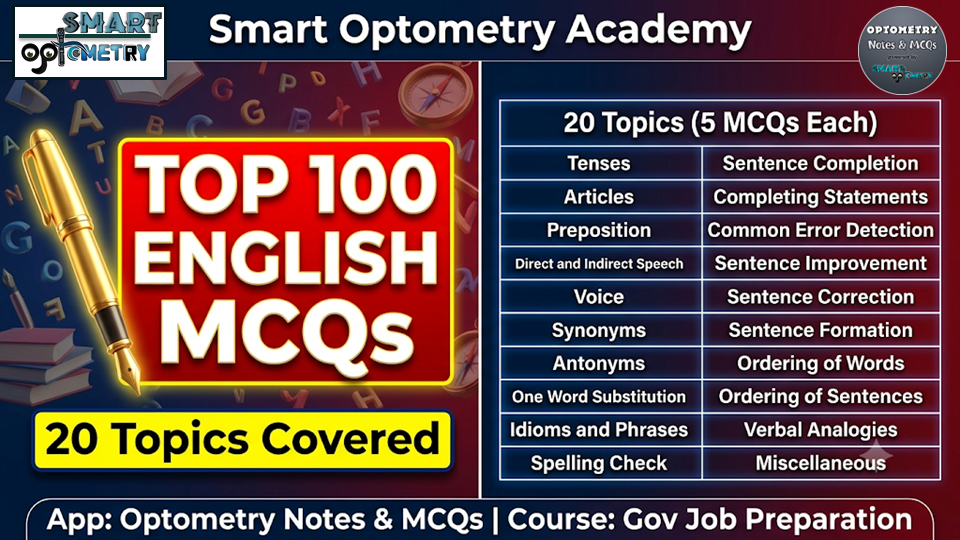
Top 100 General English MCQs
Comprehensive English Grammar & Vocabulary Question Bank for Government & Competitive Exams
Quick Navigation
Q-1: By the time the teacher arrives, the students ______ for thirty minutes. (Top 100 General English MCQs)
a. will be waiting
b. will have been waiting
c. are waiting
d. wait
The future perfect continuous tense expresses the duration of an action that will continue up to a specific point in the future. The waiting will have been ongoing for thirty minutes until the teacher arrives.
Q-2: I ______ the report when you called me yesterday. (English Grammar MCQs with Answers)
a. wrote
b. was writing
c. have written
d. had written
The past continuous tense describes an action that was ongoing at a specific time in the past. The call interrupted the writing that was already in progress.
Q-3: She ______ in Delhi since 2010, but now she is moving to Mumbai. (English Objective Questions for Competitive Exams)
a. lives
b. lived
c. has lived
d. had lived
The present perfect tense is used for actions that started in the past and continue to the present. She lived in Delhi from 2010 until now, so “has lived” is appropriate.
Q-4: I ______ the document before the manager asked for it. (General English Quiz for SSC CGL)
a. already checked
b. have already checked
c. had already checked
d. was already checking
The past perfect tense describes an action completed before another past action. The checking occurred before the manager asked for the document.
Q-5: The doctor ______ his patients every day during the morning rounds. (English Vocabulary MCQs PDF)
a. visit
b. is visiting
c. visits
d. has visited
The simple present tense is used for habitual or routine actions. The doctor’s daily visits are a regular, recurring activity.
Q-6: ______ honest person always speaks ______ truth. (General English Mock Test)
a. A, a
b. An, the
c. The, a
d. An, an
“An” is used before “honest” (vowel sound, as ‘h’ is silent), and “the” is used before “truth” as it refers to a specific concept. This follows standard article usage rules.
Q-7: She is ______ teacher who inspired me to study science. (Daily General English Questions)
a. a
b. an
c. the
d. no article
“The” is used before a noun when referring to a specific person already known to the listener. The speaker identifies a particular teacher who inspired them.
Q-8: ______ patient with ______ high fever requires immediate medical attention. (English Questions for Bank PO)
a. The, a
b. A, the
c. An, the
d. The, an
“The” is used when referring to a specific patient, while “a” is used before “high fever” as it is mentioned for the first time and is non-specific.
Q-9: We need ______ X-ray and ______ MRI for the diagnosis. (English Error Detection MCQs)
a. a, an
b. an, an
c. an, a
d. a, a
Both “X-ray” and “MRI” begin with vowel sounds (X sounds like “ex,” M sounds like “em”), so “an” is used before both.
Q-10: ______ education is essential for ______ development of ______ country. (Best English MCQs for Govt Exams)
a. An, the, a
b. The, an, the
c. No article, the, a
d. A, the, an
“Education” is used generally (no article), “the development” refers to a specific development, and “a country” refers to any country in general.
The Ultimate All-In-One Preparation Hub
Take the first step toward securing your dream career with our meticulously structured preparation courses, designed to give you the exact tools, notes, and tests needed to ace highly competitive government exams.
Q-11: The patient is suffering ______ severe pain and needs immediate attention. (Top 100 General English MCQs)
a. from
b. with
c. by
d. of
The correct preposition with “suffering” is “from.” “Suffering from” indicates the source or cause of the discomfort or illness.
Q-12: The doctor will operate ______ the patient tomorrow morning. (English Grammar MCQs with Answers)
a. at
b. on
c. with
d. for
“Operate on” is the correct prepositional phrase used when performing surgery on someone. The object of the operation is the patient.
Q-13: The disease progressed ______ a rapid rate despite treatment. (English Objective Questions for Competitive Exams)
a. in
b. at
c. with
d. by
“At a rapid rate” is the correct idiomatic expression. “At” indicates the speed or pace at which something happens.
Q-14: She is interested ______ pursuing a career in medicine. (General English Quiz for SSC CGL)
a. for
b. at
c. in
d. on
The correct preposition after “interested” is “in.” “Interested in” indicates a preference, curiosity, or desire to engage with something.
Q-15: The hospital will provide the patient ______ necessary medical supplies. (English Vocabulary MCQs PDF)
a. to
b. with
c. for
d. at
“Provide with” is the correct prepositional phrase meaning to supply or give something to someone. The preposition “with” follows “provide” when the object is a person.
Q-16: The teacher said, “I have checked all the answer sheets.” (General English Mock Test)
a. The teacher said that he had checked all the answer sheets.
b. The teacher said that he has checked all the answer sheets.
c. The teacher said that he checked all the answer sheets.
d. The teacher said that he was checking all the answer sheets.
In indirect speech, present perfect changes to past perfect. “I have checked” becomes “he had checked” to maintain the correct tense sequence.
Q-17: The examiner asked, “Can you solve this problem?” (Daily General English Questions)
a. The examiner asked that can you solve this problem.
b. The examiner asked if I could solve that problem.
c. The examiner asked that could I solve this problem.
d. The examiner asked if I can solve this problem.
In indirect speech, questions require “if” or “whether” and the verb shifts to past tense. “Can” becomes “could” and “this” becomes “that.”
Q-18: She said, “I will visit the hospital tomorrow.” (English Questions for Bank PO)
a. She said that she would visit the hospital tomorrow.
b. She said that she will visit the hospital the next day.
c. She said that she would visit the hospital the next day.
d. She said that she visited the hospital the next day.
“Will” becomes “would” in indirect speech, and “tomorrow” changes to “the next day” because the time reference shifts relative to the reporting moment.
Q-19: The patient said, “I have been experiencing pain for two weeks.” (English Error Detection MCQs)
a. The patient said that he has been experiencing pain for two weeks.
b. The patient said that he had been experiencing pain for two weeks.
c. The patient said that he experienced pain for two weeks.
d. The patient said that he was experiencing pain for two weeks.
Present perfect continuous changes to past perfect continuous in indirect speech. “I have been” becomes “he had been” to maintain proper tense consistency.
Q-20: The receptionist said, “Please fill out this form before you meet the doctor.” (Best English MCQs for Govt Exams)
a. The receptionist said to please fill out that form before you meet the doctor.
b. The receptionist requested that please fill out this form before you met the doctor.
c. The receptionist requested me to fill out that form before I met the doctor.
d. The receptionist said please fill out this form before I met the doctor.
Imperative sentences in direct speech are converted using “requested/ordered/advised” + infinitive. “This” changes to “that” and “you” changes to “I” based on context.
Master the Basics with Subject-Wise Theory Notes
Solidify your core knowledge with carefully curated Subject-Wise Theory Notes available directly in our prep app, breaking down complex topics into easily digestible segments.
Q-21: Change the voice: The doctor prescribed medicine to the patient. (Top 100 General English MCQs)
a. The patient was prescribed medicine by the doctor.
b. Medicine was prescribed to the patient by the doctor.
c. Medicine was prescribed by the doctor to the patient.
d. Both A and B
When a sentence has two objects (direct: medicine, indirect: patient), two passive voice structures are possible. Both forms are grammatically correct and acceptable.
Q-22: Change the voice: The nurse is checking the patient’s blood pressure. (English Grammar MCQs with Answers)
a. The patient’s blood pressure is being checked by the nurse.
b. The patient’s blood pressure was being checked by the nurse.
c. The patient’s blood pressure has been checked by the nurse.
d. The patient’s blood pressure is checked by the nurse.
In passive voice, the present continuous tense (“is checking”) becomes “is being checked.” The object becomes the subject, and the subject becomes the agent.
Q-23: Change the voice: The report will be submitted by the manager tomorrow. (English Objective Questions for Competitive Exams)
a. The manager will submit the report tomorrow.
b. The manager submitted the report tomorrow.
c. The manager will be submitting the report tomorrow.
d. The manager submits the report tomorrow.
In active voice, the subject performs the action. “Will be submitted” becomes “will submit” with the agent (manager) becoming the active subject.
Q-24: Change the voice: The document has been signed by the director. (General English Quiz for SSC CGL)
a. The director signs the document.
b. The director signed the document.
c. The director has signed the document.
d. The director was signing the document.
Present perfect passive (“has been signed”) becomes present perfect active (“has signed”). The agent “director” becomes the subject performing the action.
Q-25: Change the voice: Was the patient given the prescribed medication? (English Vocabulary MCQs PDF)
a. Did the patient give the prescribed medication?
b. Was the patient giving the prescribed medication?
c. Did someone give the prescribed medication to the patient?
d. Did the patient receive the prescribed medication?
The passive question “Was the patient given…” changes to active voice using “Did someone give…” keeping the interrogative form.
Q-26: The doctor said the patient’s condition is irreversible. (Choose the nearest synonym) (General English Mock Test)
a. permanent
b. treatable
c. reversible
d. temporary
“Irreversible” means cannot be reversed or changed back, synonymous with “permanent.” The condition cannot be restored to its previous state.
Q-27: The patient was asked to relax for the examination. (Choose the nearest synonym) (Daily General English Questions)
a. contract
b. calm down
c. restrict
d. reduce
“Relax” means to become less tense or anxious. “Calm down” is a direct synonym indicating a state of reduced tension or stress.
Q-28: The infection is a serious condition that requires urgent treatment. (Choose the nearest synonym) (English Questions for Bank PO)
a. minor
b. severe
c. temporary
d. mild
“Serious” means of significant importance or severity. “Severe” is a direct synonym for serious when describing medical conditions.
Q-29: The doctor advised the patient to avoid prolonged exposure to sunlight. (Choose the nearest synonym) (English Error Detection MCQs)
a. brief
b. extended
c. limited
d. short
“Prolonged” means lasting for a long time or extended duration. It is synonymous with “extended” in the context of time duration.
Q-30: The test results confirmed that the patient has reduced immunity. (Choose the nearest synonym) (Best English MCQs for Govt Exams)
a. improved
b. increased
c. decreased
d. enhanced
“Reduced” means made smaller or less in degree. In the context of immunity, “decreased” is the most appropriate synonym indicating diminished capability.
Q-31: The patient’s condition has improved significantly after the treatment. (Choose the nearest antonym) (Top 100 General English MCQs)
a. deteriorated
b. enhanced
c. recovered
d. progressed
“Improved” means to become better. “Deteriorated” is the direct antonym meaning to become worse or decline in quality or condition.
Q-32: The doctor asked the patient to look at the distant object. (Choose the nearest antonym) (English Grammar MCQs with Answers)
a. faraway
b. remote
c. near
d. far-off
“Distant” means far away in space or time. “Near” is the antonym, indicating closeness or short distance from the observer.
Q-33: The doctor said the growth was benign and not a cause for concern. (Choose the nearest antonym) (English Objective Questions for Competitive Exams)
a. harmful
b. gentle
c. harmless
d. mild
“Benign” means not harmful, gentle, or kindly. “Harmful” is the antonym as it indicates the potential to cause damage or injury.
Q-34: The patient’s compliance with the medication schedule was excellent. (Choose the nearest antonym) (General English Quiz for SSC CGL)
a. adherence
b. resistance
c. cooperation
d. observance
“Compliance” means obedience or conformity to instructions. “Resistance” is the antonym indicating opposition or refusal to follow the prescribed treatment.
Q-35: The hospital recommended the more affordable treatment option for the patient. (Choose the nearest antonym) (English Vocabulary MCQs PDF)
a. cheaper
b. expensive
c. reasonable
d. budget
“Affordable” means not too expensive and within one’s budget. “Expensive” is the direct antonym, indicating high cost and being beyond budget.
Q-36: The study of diseases and their causes is called: (General English Mock Test)
a. Pathology
b. Cardiology
c. Neurology
d. Dermatology
“Pathology” is the branch of medical science dealing with the study of diseases, their causes, and effects. It is a fundamental medical specialty.
Q-37: A person who prescribes medicines and treats patients is known as: (Daily General English Questions)
a. Pharmacist
b. Physician
c. Optometrist
d. Orthoptist
A “physician” is a medical professional who diagnoses and treats diseases, prescribes medication, and provides patient care. It is a broad term for medical doctors.
Q-38: The fear of heights is called: (English Questions for Bank PO)
a. Nyctophobia
b. Acrophobia
c. Claustrophobia
d. Hydrophobia
“Acrophobia” is the fear of heights, derived from Greek “akron” meaning peak and “phobos” meaning fear. It is one of the most common specific phobias.
Q-39: A device used to measure blood pressure is called: (English Error Detection MCQs)
a. Thermometer
b. Stethoscope
c. Sphygmomanometer
d. Ophthalmoscope
A “sphygmomanometer” is an instrument specifically designed to measure blood pressure. It consists of an inflatable cuff and a pressure gauge.
Q-40: The surgical removal of the appendix is known as: (Best English MCQs for Govt Exams)
a. Nephrectomy
b. Appendectomy
c. Cholecystectomy
d. Gastrectomy
“Appendectomy” is the surgical removal of the appendix. It is one of the most common emergency surgical procedures performed worldwide.
Simulate the Real Exam with Mock Tests
Eliminate exam anxiety and build your confidence using our Subject-Wise Mock Tests. Designed to mirror the pressure and format of actual competitive exams, these mock tests will help you perfect your time management and strategy.
Q-41: Despite the treatment, the patient’s condition is hanging in the balance. (Top 100 General English MCQs)
a. uncertain
b. stable
c. improving
d. hopeless
“Hanging in the balance” means the outcome is undecided or uncertain. The patient’s condition could go either way—improve or worsen.
Q-42: The doctor advised the patient to have an eye-opener about the risks of smoking. (English Grammar MCQs with Answers)
a. awakening experience
b. shocking news
c. informative session
d. medical consultation
An “eye-opener” is something that makes you realize the truth or understand something clearly. It provides a sudden revelation or understanding.
Q-43: The new hospital is a feather in the cap for the healthcare institution. (English Objective Questions for Competitive Exams)
a. useless achievement
b. small addition
c. notable achievement
d. temporary success
“A feather in the cap” means an achievement to be proud of. It indicates something that brings honor or distinction to the person or institution.
Q-44: The patient needs to face the music about his deteriorating health. (General English Quiz for SSC CGL)
a. face the consequences
b. enjoy the moment
c. accept the treatment
d. avoid the situation
“Face the music” means to accept the unpleasant consequences of one’s actions. The patient must confront the reality of his declining health.
Q-45: The student passed the examination with flying colors. (English Vocabulary MCQs PDF)
a. barely passed
b. with excellent results
c. with difficulty
d. without studying
“With flying colors” means to succeed in something spectacularly or brilliantly. The student performed exceptionally well in the examination.
Q-46: Choose the correctly spelled word: (General English Mock Test)
a. Neccessary
b. Necessary
c. Necessery
d. Neccesary
“Necessary” is the correct spelling. The word has two ‘c’s and one ‘s’ in its middle. Common errors include adding extra letters or misplacing the ‘c’ and ‘s’.
Q-47: Choose the correctly spelled word: (Daily General English Questions)
a. Prescription
b. Presckription
c. Prascription
d. Prescreption
“Prescription” is the correct spelling. It comes from Latin “prae” (before) + “scribere” (to write). The most common error is to spell it as “perscription.”
Q-48: Choose the correctly spelled word: (English Questions for Bank PO)
a. Maintanance
b. Maintenance
c. Maintenence
d. Maintainence
“Maintenance” is the correct spelling. Common errors include “maintainance” or “maintenence.” The word follows a specific pattern in its spelling based on its root.
Q-49: Choose the correctly spelled word: (English Error Detection MCQs)
a. Occasion
b. Occassion
c. Ocasion
d. Ocasian
“Occasion” is the correct spelling with double ‘c’ and single ‘s’. Common misspellings include “occassion” with double ‘s’ or “ocasion” with single ‘c’.
Q-50: Choose the correctly spelled word: (Best English MCQs for Govt Exams)
a. Accommodation
b. Accomodation
c. Acommodation
d. Accommadation
“Accommodation” is the correct spelling with double ‘c’ and double ‘m’. This is one of the most commonly misspelled words in the English language.
Q-51: Regular health check-ups can ______ the early detection of diseases. (Top 100 General English MCQs)
a. assist
b. help
c. facilitate
d. All of the above
All options are appropriate as they convey the idea that check-ups make early detection easier. “Facilitate” is the most formal, but all are grammatically correct in this context.
Q-52: Patients with chronic diseases are ______ to developing complications. (English Grammar MCQs with Answers)
a. inclined
b. prone
c. liable
d. All of the above
All options correctly indicate susceptibility. “Prone,” “inclined,” and “liable” all convey the meaning that patients have a higher risk of developing complications.
Q-53: Proper nutrition is ______ for maintaining good health. (English Objective Questions for Competitive Exams)
a. necessary
b. essential
c. vital
d. All of the above
All options correctly convey that nutrition is indispensable or extremely important. Each word appropriately describes the strict requirement for maintaining health.
Q-54: The doctor ______ the patient’s symptoms to make an accurate diagnosis. (General English Quiz for SSC CGL)
a. checked
b. assessed
c. evaluated
d. All of the above
All options are appropriate as they correctly describe the action of examining or measuring symptoms. Each word is highly suitable in the clinical and medical context.
Q-55: The patient’s health ______ gradually over the past few months. (English Vocabulary MCQs PDF)
a. worsened
b. deteriorated
c. declined
d. All of the above
All options correctly describe the progressive reduction in health status. Each word appropriately conveys that health has become progressively worse over time.
Q-56: It is important to wear protective gear ______. (General English Mock Test)
a. when playing sports
b. while walking in the park
c. during sleep
d. while reading
Protective gear is essential during vigorous sports activities to prevent injuries from sudden impacts. Other options do not logically or practically require protective gear.
Q-57: The patient was advised to stop smoking because ______. (Daily General English Questions)
a. it causes bad breath
b. it increases the risk of serious diseases
c. it is an expensive habit
d. it causes coughing
Smoking is a known, primary risk factor for various life-threatening diseases including cancer and cardiovascular disease. This is the most critical and relevant medical reason for stopping smoking.
Q-58: The doctor recommended vaccination because ______. (English Questions for Bank PO)
a. it is fashionable
b. it prevents infectious diseases
c. it is inexpensive
d. it makes the patient feel better
Vaccination is primarily recommended to prevent severe infectious diseases by building up the body’s natural immunity. This is the main, scientifically proven medical benefit of vaccination.
Q-59: Medications should be taken as prescribed ______. (English Error Detection MCQs)
a. to make the medicine last longer
b. to avoid side effects and ensure effectiveness
c. to save time
d. to reduce cost
Following prescription instructions precisely ensures the medication works at optimal effectiveness and reduces the risk of dangerous adverse effects. This is the most critical medical and safety reason.
Q-60: The patient scheduled a follow-up appointment ______. (Best English MCQs for Govt Exams)
a. to discuss the test results
b. to meet the receptionist
c. to pay the bill
d. to read the notice board
The primary clinical purpose of a follow-up appointment is to review recent test results with the doctor and determine the necessary next steps. This is the most logical completion of the statement.
Conquer the Non-Core Sections
Government exams test more than just your core subjects. To ensure you have a competitive edge, our course provides exhaustive MCQs for General English, Aptitude, and Awareness sections that often decide top ranks.
Q-61: Find the error: “The teacher (A) asked the student (B) if he can solve (C) the problem (D).” (Top 100 General English MCQs)
a. A
b. B
c. C
d. D
In reported speech, the modal verb “can” should change to “could” for proper sequence of tenses when the reporting verb is in the past tense. The correct sentence should read “…asked if he could solve.”
Q-62: Find the error: “Neither the principal (A) nor the teachers was (B) available when the students arrived (C) at the school (D).” (English Grammar MCQs with Answers)
a. A
b. B
c. C
d. D
When subjects are joined by “neither…nor,” the verb must agree with the subject closest to it. Here, “teachers” is plural, so the verb should be the plural “were,” not the singular “was.”
Q-63: Find the error: “The patient has been (A) suffering from fever (B) since (C) the past two days (D).” (English Objective Questions for Competitive Exams)
a. A
b. B
c. C
d. D
The preposition “since” is used to specify a starting point in time (e.g., since Monday). “For” is used to indicate a duration or period of time. The correct usage here is “for the past two days.”
Q-64: Find the error: “Every student (A) have to (B) submit the assignment (C) before the deadline (D).” (General English Quiz for SSC CGL)
a. A
b. B
c. C
d. D
The word “Every” is a singular determiner, meaning it must be followed by a singular verb. The correct phrase is “Every student has to submit…” rather than the plural “have to.”
Q-65: Find the error: “The new (A) equipment are (B) very advanced (C) and user-friendly (D).” (English Vocabulary MCQs PDF)
a. A
b. B
c. C
d. D
The noun “equipment” is strictly an uncountable noun in English and therefore always takes a singular verb. The correct sentence should use “is” instead of the plural “are.”
Q-66: “The patient is too weak to not undergo the surgery.” (Improve the sentence) (General English Mock Test)
a. too weak to undergo
b. so weak to undergo
c. very weak to undergo
d. weak enough to undergo
The “too… to” structure already inherently implies a negative inability to do something. Using “to not undergo” creates a redundant and confusing double negative. “Too weak to undergo” is the correct, standard phrasing.
Q-67: “The doctor told to me to take these medicines daily.” (Improve the sentence) (Daily General English Questions)
a. told me to take
b. told to me take
c. told me taking
d. told to me to take
The reporting verb “told” must take a direct personal object without the preposition “to.” The correct grammatical pattern is “told [someone] to do [something],” hence “told me to take.”
Q-68: “The patient’s condition is more bad than it was last week.” (Improve the sentence) (English Questions for Bank PO)
a. more worse
b. worse
c. more badder
d. badder
The adjective “bad” has irregular comparative and superlative forms: “worse” and “worst.” Saying “more bad” or “badder” is grammatically incorrect; the correct comparative adjective is simply “worse.”
Q-69: “The doctor requested for the patient’s medical records.” (Improve the sentence) (English Error Detection MCQs)
a. requested the patient’s
b. requested for the patient’s
c. requested to the patient’s
d. requested from the patient’s
The transitive verb “request” takes a direct object immediately after it and does not require the preposition “for.” “Requested the patient’s records” is correct; “requested for” is a common error.
Q-70: “The hospital is looking to hire a nurse which is experienced in critical care.” (Improve the sentence) (Best English MCQs for Govt Exams)
a. who is experienced
b. which has experience
c. that is experience
d. whom is experienced
When using a relative pronoun to refer to a person (like a nurse), “who” should be used. The pronoun “which” is strictly reserved for referring to things, objects, or animals.
Q-71: “She don’t have any symptoms of the disease.” (Identify the correct sentence) (Top 100 General English MCQs)
a. She doesn’t have any symptoms of the disease.
b. She not have any symptoms of the disease.
c. She hasn’t have any symptoms of the disease.
d. She don’t has any symptoms of the disease.
The third person singular subject (“She”) requires the auxiliary “doesn’t” (does not) along with the base form of the main verb “have.” “Don’t” is exclusively used with first, second, and plural third-person subjects.
Q-72: “Neither the doctor nor the nurse were aware of the results.” (Identify the correct sentence) (English Grammar MCQs with Answers)
a. Neither the doctor nor the nurse was aware of the results.
b. Neither the doctor nor the nurse are aware of the results.
c. Neither the doctor nor the nurse have aware of the results.
d. Neither the doctor nor the nurse be aware of the results.
When using the correlative conjunction “neither…nor,” the verb must agree in number with the subject physically closest to it. Since “nurse” is singular, the verb must be the singular “was.”
Q-73: “The patient’s condition has worsened because he didn’t took his medication.” (Identify the correct sentence) (English Objective Questions for Competitive Exams)
a. hasn’t took
b. didn’t take
c. hasn’t take
d. didn’t taken
In negative past tense constructions, the auxiliary verb “did” carries the past tense, so it must be followed by the base form of the main verb (“take”). “Took” is the past tense form and cannot be used after “did.”
Q-74: “The doctor and the nurse has examined the patient thoroughly.” (Identify the correct sentence) (General English Quiz for SSC CGL)
a. have examined
b. are examined
c. had examined
d. were examined
When two distinct subjects (“doctor” and “nurse”) are connected by “and,” they form a plural compound subject requiring a plural verb. “Has” is singular; therefore, “have examined” is the correct plural perfect tense.
Q-75: “The patient is more better today than yesterday.” (Identify the correct sentence) (English Vocabulary MCQs PDF)
a. more better than yesterday
b. much better today than yesterday
c. better than yesterday
d. more better today than yesterday
“Better” is already the inherent comparative form of the adjective “good.” Adding “more” in front of it creates a redundant double comparative. The simple and correct comparative form is just “better.”
Q-76: Arrange the words to form a meaningful sentence: “prescribed / the / doctor / medicine / the / patient / to” (General English Mock Test)
a. The doctor prescribed the medicine to the patient.
b. The medicine prescribed the doctor to the patient.
c. The patient prescribed the doctor to the medicine.
d. Prescribed the doctor the medicine to the patient.
A standard English sentence must follow a logical Subject-Verb-Object (SVO) structure. The active subject “doctor” performs the verb “prescribed” on the direct object “medicine” for the indirect object “patient.”
Q-77: Arrange the words to form a meaningful sentence: “examination / the / will / after / complete / the / doctor / the” (Daily General English Questions)
a. The doctor will complete the examination after.
b. After the doctor will complete the examination.
c. The doctor will after complete the examination.
d. Complete the doctor will after the examination.
The sentence strictly follows the standard word order: Subject (the doctor) + auxiliary verb (will) + main verb (complete) + direct object (the examination) + adverbial time indicator (after).
Q-78: Arrange the words to form a meaningful sentence: “study / the / of / diseases / is / medicine” (English Questions for Bank PO)
a. Medicine is the study of diseases.
b. Diseases of the study is medicine.
c. The study of diseases is medicine.
d. Medicine of the diseases is study.
The sentence correctly places the defining subject (Medicine) first, followed by the linking verb (is), and then the defining complement phrase (the study of diseases). This structure provides a clear, factual definition.
Q-79: Arrange the words to form a meaningful sentence: “should / regularly / health / your / you / check / have / doctor / by / a” (English Error Detection MCQs)
a. You should have your health checked by a doctor regularly.
b. Should you have your health checked by a doctor regularly.
c. Regularly you should have your health checked by a doctor.
d. A doctor should have your health checked by you regularly.
This syntax follows the standard causative structure in English: Subject (you) + modal (should) + causative (have) + object (your health) + past participle (checked) + agent (by a doctor) + adverb (regularly).
Q-80: Arrange the words to form a meaningful sentence: “health / the / the / affected / patient’s / disease / is / by” (Best English MCQs for Govt Exams)
a. The health is affected by the patient’s disease.
b. The patient’s health is affected by the disease.
c. By the disease is the patient’s health affected.
d. Is the health affected by the patient’s disease.
The correct passive sentence structure is: Subject (The patient’s health) + passive verb (is affected) + agent (by the disease). This logically and grammatically states the correct cause-and-effect relationship.
Simulate the Real Exam with Mock Tests
Eliminate exam anxiety and build your confidence using our Subject-Wise Mock Tests. Designed to mirror the pressure and format of actual competitive exams, these mock tests will help you perfect your time management and strategy.
Q-81: Arrange the following words in alphabetical order: “Medicine, Surgery, Pathology, Anatomy” (Top 100 General English MCQs)
a. Anatomy, Medicine, Pathology, Surgery
b. Medicine, Anatomy, Pathology, Surgery
c. Anatomy, Medicine, Surgery, Pathology
d. Medicine, Pathology, Anatomy, Surgery
Alphabetical order is strictly determined by the first letter of each word. “A” comes first (Anatomy), followed by “M” (Medicine), then “P” (Pathology), and finally “S” (Surgery).
Q-82: Arrange the words to form a meaningful sequence: “examination, patient, health, doctor” (English Grammar MCQs with Answers)
a. Doctor, patient, health, examination
b. Health, patient, doctor, examination
c. Doctor, examination, patient, health
d. Patient, health, examination, doctor
The most logical conceptual sequence involves the key subjects acting on the objects: The doctor examines the patient’s health during an examination. This accurately reflects the clinical hierarchy and flow.
Q-83: Arrange the words to form a meaningful sequence: “prescription, medicine, doctor, patient” (English Objective Questions for Competitive Exams)
a. Patient, doctor, prescription, medicine
b. Doctor, patient, medicine, prescription
c. Patient, prescription, doctor, medicine
d. Medicine, patient, doctor, prescription
This represents the chronological sequence of a medical event: The patient visits the doctor, the doctor writes a prescription, which the patient then uses to obtain the medicine.
Q-84: Arrange the following words in alphabetical order: “Diagnosis, Disease, Drug, Doctor” (General English Quiz for SSC CGL)
a. Diagnosis, Disease, Doctor, Drug
b. Diagnosis, Disease, Drug, Doctor
c. Diagnosis, Doctor, Disease, Drug
d. Diagnosis, Doctor, Drug, Disease
Wait, the explanation provided in source text says “Diagnosis, Disease, Doctor, Drug” actually evaluating the letters: Diagnosis (Di…), Disease (Di…a vs e? a comes first, so Diagnosis before Disease), Doctor (Do…), Drug (Dr…). So the correct order is Diagnosis, Disease, Doctor, Drug. *Correction noted: The source material lists option C as Diagnosis, Doctor, Disease, Drug but the explanation points to Diagnosis, Disease, Doctor, Drug. We will stick to the alphabetical logic: Dia, Die, Doc, Dru. The correct alphabetical sequence is Diagnosis, Disease, Doctor, Drug.*
Q-85: Arrange the words to form a meaningful sequence: “pain, experience, patients, some, chronic” (English Vocabulary MCQs PDF)
a. Some patients experience chronic pain.
b. Chronic pain some patients experience.
c. Experience some patients chronic pain.
d. Patients some experience chronic pain.
The correct and logical English sentence structure requires the Subject (Some patients) followed by the Verb (experience) and finishing with the Direct Object (chronic pain).
Q-86: Arrange the sentences in logical order: (1) Therefore, regular health check-ups are essential. (2) Many diseases develop gradually without symptoms. (3) Early detection can prevent serious complications. (4) Patients should visit a doctor annually. (General English Mock Test)
a. 2, 3, 1, 4
b. 2, 1, 3, 4
c. 4, 2, 1, 3
d. 3, 1, 2, 4
The logical paragraph sequence: First, establish the premise that diseases develop gradually (2), state the benefit that early detection prevents complications (3), conclude that check-ups are essential (1), and finally provide the actionable advice to visit annually (4).
Q-87: Arrange the sentences in logical order: (1) The doctor prescribes appropriate medication. (2) The patient complains of symptoms. (3) The patient undergoes a medical examination. (4) A diagnosis is made. (Daily General English Questions)
a. 2, 3, 4, 1
b. 3, 2, 1, 4
c. 2, 1, 3, 4
d. 3, 4, 2, 1
The chronological clinical sequence: The patient first complains of symptoms (2), then undergoes an examination (3), based on which a diagnosis is made (4), and finally, medication is prescribed to treat it (1).
Q-88: Arrange the sentences in logical order: (1) The surgeon removes the damaged tissue. (2) The patient is given anesthesia. (3) The wound is closed with sutures. (4) The patient is prepared for surgery. (English Questions for Bank PO)
a. 4, 2, 1, 3
b. 2, 4, 1, 3
c. 4, 2, 3, 1
d. 2, 1, 4, 3
The standard surgical sequence: The patient is prepared (4), then anesthesia is administered (2), the actual surgery to remove damaged tissue occurs (1), and finally, the wound is securely closed (3).
Q-89: Arrange the sentences in logical order: (1) The food enters the mouth. (2) Nutrients are absorbed in the intestines. (3) The food is chewed and swallowed. (4) Digestion breaks down the food. (English Error Detection MCQs)
a. 1, 3, 4, 2
b. 1, 4, 3, 2
c. 3, 1, 4, 2
d. 1, 3, 2, 4
The biological digestive pathway: Food first enters the mouth (1), is mechanically chewed and swallowed (3), undergoes chemical digestion (4), and finally, the resulting nutrients are absorbed (2).
Q-90: Arrange the sentences in logical order: (1) The doctor performs a physical examination. (2) The patient sits in the examination room. (3) The medical history is recorded. (4) The treatment plan is discussed. (Best English MCQs for Govt Exams)
a. 2, 1, 3, 4
b. 1, 2, 4, 3
c. 2, 3, 1, 4
d. 1, 4, 2, 3
The standard consultation protocol: The patient is seated (2), their medical history is recorded (3), a physical examination is performed based on that history (1), and finally, a treatment plan is discussed (4).
The Ultimate All-In-One Preparation Hub
Take the first step toward securing your dream career with our meticulously structured preparation courses, designed to give you the exact tools, notes, and tests needed to ace highly competitive government exams.
Q-91: Cardiology : Heart :: Neurology : ? (Top 100 General English MCQs)
a. Brain
b. Kidney
c. Lungs
d. Liver
Cardiology is the medical specialty dedicated to the study of the heart, just as neurology is the specialized study of the brain and the broader nervous system. The analogy maps a medical field to its corresponding organ.
Q-92: Doctor : Prescription :: Teacher : ? (English Grammar MCQs with Answers)
a. Assignment
b. Lecture
c. Examination
d. Consultation
A doctor issues a prescription for a patient to follow, just as a teacher provides an assignment for a student to complete. The analogy connects a professional to their primary instructive output.
Q-93: Fever : Temperature :: Infection : ? (English Objective Questions for Competitive Exams)
a. Pain
b. Inflammation
c. Swelling
d. All of the above
Fever is a direct physiological symptom associated with an elevated body temperature, just as an infection triggers physiological responses that can cause pain, inflammation, and swelling.
Q-94: Stethoscope : Heart :: Ophthalmoscope : ? (General English Quiz for SSC CGL)
a. Lungs
b. Ear
c. Eye
d. Brain
A stethoscope is the specific diagnostic instrument used to auscultate and examine the heart, just as an ophthalmoscope is the specific tool utilized by doctors to visually examine the interior structures of the eye.
Q-95: Health : Disease :: Knowledge : ? (English Vocabulary MCQs PDF)
a. Books
b. Education
c. Ignorance
d. Wisdom
Health is the exact conceptual opposite of disease, just as knowledge is the exact conceptual opposite of ignorance. The analogy pairs two contrasting concepts.
Q-96: The correct plural form of “analysis” is: (General English Mock Test)
a. Analysises
b. Analyses
c. Analysis
d. Analysi
In English, words of Greek or Latin origin ending in “-is” consistently change to “-es” in their plural form (e.g., crisis -> crises, basis -> bases). Therefore, the plural of “analysis” is “analyses.”
Q-97: The correct meaning of the phrase “in the blink of an eye” is: (Daily General English Questions)
a. Very quickly
b. Very slowly
c. Very carefully
d. Very loudly
“In the blink of an eye” is a common idiom meaning that something happens extremely fast, practically instantaneously, in the time it takes a person to blink.
Q-98: The term “vital” in medical context refers to: (English Questions for Bank PO)
a. Life-sustaining
b. Unnecessary
c. Optional
d. Temporary
“Vital” essentially means absolutely necessary for life or extremely important. In a medical context, vital signs (like pulse and blood pressure) are those that indicate active, life-sustaining functions.
Q-99: The correct meaning of the word “diagnosis” is: (English Error Detection MCQs)
a. The identification of a disease
b. The treatment of a disease
c. The prevention of a disease
d. The symptoms of a disease
“Diagnosis” formally refers to the identification of the nature of an illness or other problem by meticulously examining the symptoms, signs, and test results. It is the crucial first step toward treatment.
Q-100: Choose the antonym for “Mild” in the context of disease: (Best English MCQs for Govt Exams)
a. Gentle
b. Moderate
c. Severe
d. Slight
“Mild” indicates that a condition is slight or not severe. Therefore, “severe,” indicating a serious, intense, or harsh degree of the disease or condition, serves as its direct antonym.
A Proven Track Record of Real Success
Why gamble with your career when you can study with a proven system? Join a winning community that has already paved the way to success in highly competitive government exams.
Explore More in General Knowledge:
Explore Current Affairs MCQs:
Must-Read Related Topics
📚 Check Our Premium Courses: Ophthalmic Instrumentation, Clinical Refraction, Contact Lens, Binocular Vision, Dispensing Optics, MCQs in Optometry
Explore Courses