Master Ocular Anatomy: DSSSB Optometrist Previous Year MCQs & Solutions
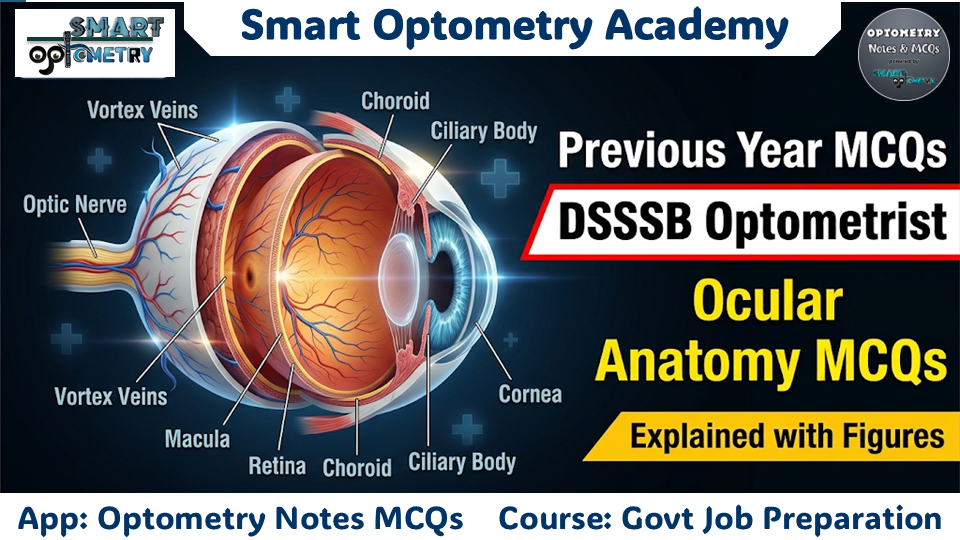
Strengthen your Section-B technical preparation with this high-yield compilation of DSSSB Optometrist Previous Year MCQs focused on Ocular Anatomy and Embryology. This solved question set breaks down the core anatomical structures and clinical landmarks frequently tested by the examination board.
Key concepts covered in this guide include:
- Bony orbit composition, orbital volume, and structures traversing the superior orbital fissure
- Corneal dimensions, nasolacrimal duct anatomy, and the suspensory ligament of Lockwood
- Retinal layer organization and extraocular muscle structures
- Essential ocular embryology milestones, including optic pit emergence and iris development
Practicing authentic DSSSB Optometrist PYQs is the most reliable way to identify recurring test trends, eliminate conceptual confusion, and sharpen your answering speed. Review these solved multiple-choice questions with detailed anatomical rationales to reinforce your subject foundation and maximize your score in the domain-specific technical paper.
Practice DSSSB Optometrist Previous Year MCQs on “Ocular Anatomy”:
Q-1: Which of the following bones do NOT make up the bony orbit? (DSSSB Optometrist Previous Year MCQs 2019)
a. Maxilla
b. Frontal
c. Zygomatic
d. Parietal
Click “Show more” to see the answer and explanation.
Answer: d. Parietal
The bony orbit is composed of seven specific cranial and facial bones: the maxilla, frontal, zygomatic, ethmoid, lacrimal, sphenoid, and palatine bones. The parietal bone forms the upper-lateral vault of the cranium and does not extend into the orbital cavity.
Struggling with your optometry government job preparation? Let Samir Sir, the founder of Smart Optometry, guide you to success. Enroll in our “Gov Job Preparation” course, and we’ll provide the roadmap. Your dream job at BFUHS Ophthalmic Officer, GSSSB, AIIMS, RRB, or DHS is within reach!
Q-2: The volume of an adult bony orbit is: (DSSSB Optometrist PYQs 2019)
a. 30 ml
b. 50 ml
c. 70 ml
d. 60 ml
Click “Show more” to see the answer and explanation.
Answer: a. 30 ml
The average volume of a fully developed human bony orbit is approximately 30 milliliters. This compact space is designed to protect and house the globe of the eye, along with the extraocular muscles, orbital fat, and necessary neurovascular structures.
.
.
Q-3: The structures passing from the superior orbital fissure are: (DSSSB Optometrist Previous Year MCQs 2019)
a. III, IV, ophthalmic artery
b. III, IV, superior ophthalmic Vein
c. II, VI, superior ophthalmic Vein
d. III, VI, ophthalmic artery and vein
Click “Show more” to see the answer and explanation.
Answer: b. III, IV, superior ophthalmic V
The superior orbital fissure is a critical cranial gateway that transmits cranial nerves III (oculomotor), IV (trochlear), and VI (abducens), along with the ophthalmic division of the trigeminal nerve (V1) and the superior ophthalmic vein. The ophthalmic artery does not pass through this fissure; instead, it enters the orbit through the optic canal with the optic nerve (CN II).
Unlock your potential with our “Gov Job Preparation” course. Gain access to a massive library of 5000+ subject-wise MCQs, 1000+ previous year questions, detailed notes, and video lectures. Everything you need for exams like BFUHS Ophthalmic Officer, AIIMS, GSSSB, PSC, and DMER is in one place.
Q-4: The opening of the nasolacrimal duct in the nose is at: (DSSSB Optometrist PYQs 2019)
a. Middle meatus
b. Inferior meatus
c. Lacrimal sac
d. Above the middle meatus
Click “Show more” to see the answer and explanation.
Answer: b. Inferior meatus
The tear drainage system channels fluid from the eye into the lacrimal sac, which then empties into the nasolacrimal duct. This duct courses downwards and terminates in the nasal cavity beneath the inferior nasal concha, an anatomical space referred to as the inferior meatus.
.
.
Q-5: The vertical and horizontal anterior diameter, respectively, of cornea in adults is: (DSSSB Optometrist Previous Year MCQs 2019)
a. About 11 and 12 mm
b. About 12 and 11 mm
c. About 12 and 13 mm
d. About 11 and 13 mm
Click “Show more” to see the answer and explanation.
Answer: a. About 11 and 12 mm
The adult cornea is not perfectly spherical; it takes on a slightly elliptical shape when viewed from the front. Its anterior vertical diameter is typically about 11 mm, while the horizontal diameter is slightly wider, measuring approximately 12 mm.
Prepare for a full year of opportunities! Our “Gov Job Preparation” course gives you 12 months of access to top-quality materials and support. Cover all major exams like BFUHS Ophthalmic Officer, GSSSB, AIIMS, RRB, Ophthalmic Officer without buying multiple courses. It’s the smartest investment for your career.
Q-6: How many layers are there in the neurosensory retina? (DSSSB Optometrist PYQs 2024)
a. 9
b. 10
c. 11
d. 12
Click “Show more” to see the answer and explanation.
Answer: a. 9
The human retina is classically described as having 10 distinct anatomical layers. The outermost layer is the retinal pigment epithelium (RPE), and the remaining 9 inner layers collectively form the neurosensory retina, which is responsible for capturing light and initiating the visual signal cascade.
.
.
Q-7: Which tissue of the eye is called the suspensory ligament of Lockwood? (DSSSB Optometrist Previous Year MCQs 2024)
a. Fascia bulbi
b. Optic nerve
c. Descemet’s membrane
d. Aqueous layer
Click “Show more” to see the answer and explanation.
Answer: a. Fascia bulb
The suspensory ligament of Lockwood is a hammock-like structure derived from the lower part of the fascia bulbi, also known as Tenon’s capsule. It provides critical structural support to the globe of the eye, helping maintain its position within the orbit.
Don’t study alone! Our “Gov Job Preparation” course includes group updates and live support to clear all your doubts. With guidance from Samir Sir and a community of fellow aspirants, you’ll stay motivated and on track.
Q-8: How many extraocular muscles are present in the human eye? (DSSSB Optometrist PYQs 2024)
a. Four
b. Six
c. Two
d. Nine
Click “Show more” to see the answer and explanation.
Answer: b. Six
There are six extraocular muscles responsible for controlling the precise movements of each human eye. These consist of four rectus muscles (superior, inferior, medial, lateral) and two oblique muscles (superior, inferior).
.
.
Q-9: On which day do the optic pits form in a developing embryo? (DSSSB Optometrist Previous Year MCQs 2024)
a. Day 27
b. Day 33
c. Day 17
d. Day 22
Click “Show more” to see the answer and explanation.
Answer: d. Day 22
The optic pits, which are the earliest anatomical precursors of the eyes, emerge around day 22 of embryonic development. These pits eventually invaginate to form the optic vesicles, which later develop into the optic cups and contribute to the formation of the retina and other ocular structures.
Ready to secure your government job in optometry? The “Gov Job Preparation” course is your final destination. With a proven success strategy, expert mentorship, and over 6000 MCQs, we make your preparation seamless and effective. Click the link to begin your journey!
.
Q-10: Where do the stroma and blood vessels of the iris develop from? (DSSSB Optometrist PYQs 2024)
a. Visceral mesoderm
b. Neural ectoderm
c. Anterior epithelium
d. Vascular mesenchyme
Click “Show more” to see the answer and explanation.
Answer: d. Vascular mesenchyme
The stroma and blood vessels of the iris develop from vascular mesenchyme, which is derived from neural crest cells. In contrast, the neural ectoderm contributes to the pigmented layers of the iris, while the vascular mesenchyme forms the supportive connective tissue and vascular network.
.
Q-11: [Paste Your Question Here]
A) Option 1
B) Option 2
C) Correct Option
D) Option 4
Explanation: [Paste your detailed explanation here so Google can index it.]
Q-12: [Paste Your Question Here]
A) Option 1
B) Correct Option
C) Option 3
D) Option 4
Unlock the Full Question Bank
Get access to all remaining premium MCQs, detailed explanations, and complete subject notes. Enroll in our Govt Job Preparation Course to secure your success.
.
DSSSB Optometrist Previous Year MCQs
Subject-Wise Solved Papers (PYQs)
Boost your exam preparation by practicing with authentic DSSSB Optometrist Previous Year MCQs. Click on any specific subject above to access highly targeted previous year questions, answers, and detailed explanations directly mapped to the DSSSB exam syllabus.
.
Master Your Gov Job Prep
Join our comprehensive “Gov Job Preparation” course available exclusively on the Optometry Notes & MCQs App.
The Ultimate Success Strategy
Follow this proven sequence to maximize your preparation and secure your goal.
Subjects wise Theory Notes
Build a strong foundation by mastering the core theoretical concepts for each subject.
Premium Lectures & Videos
Deepen your understanding with expert video explanations and fundamental optometry lectures.
Subjects wise MCQs
Test your knowledge and practice applying concepts with targeted multiple-choice questions.
Previous Year MCQs
Familiarize yourself with actual exam patterns and gauge your readiness with past papers.
Ready to Start Your Journey?
.
About the DSSSB Optometrist Recruitment
Are you aiming to crack the DSSSB Optometrist vacancy? The Delhi Subordinate Services Selection Board (DSSSB) regularly conducts exams to recruit qualified professionals for the Health & Family Welfare Department, Govt. of NCT of Delhi. Securing this highly coveted Group ‘C’ government job requires a deep understanding of the official criteria and exam structure.
Here is a complete overview of the DSSSB Optometrist vacancy:
- About DSSSB: The board recruits candidates for various departments under the Government of NCT of Delhi. The Optometrist position falls under the General Central Service, Non-Gazetted, Non-Ministerial category.
- Eligibility Criteria: Candidates must have passed Class 12th in Science from a recognized board and possess a 4-year Degree in Optometry from a recognized university. The standard age limit is between 21 and 30 years, with official age relaxations applicable for reserved categories.
- Exam Pattern: The One Tier (Technical) examination consists of a Computer Based Test (CBT) featuring 200 Multiple Choice Questions (MCQs) worth 200 marks, to be completed in a 2-hour duration. Accuracy is critical, as a negative marking penalty of 0.25 marks applies to every incorrect answer.
- Syllabus Breakdown: The exam is split into two halves. Section-A (100 marks) tests General Awareness, General Intelligence & Reasoning, Arithmetical & Numerical Ability, Hindi Language, and English Language. Section-B (100 marks) is exclusively domain-specific, testing the candidate’s core optometry knowledge based on their prescribed qualification.
- Salary Structure: Selected candidates are placed in Pay Level 5, which offers a highly competitive basic pay scale ranging from ₹29,200 to ₹92,300.
Practicing previous year MCQs is the best way to conquer this syllabus, improve your speed, and successfully secure your spot in the next DSSSB Optometrist vacancy.
👉 View Full Course Overview & Success Stories
📲 Download the Optometry Notes & MCQs App on Google Play Store