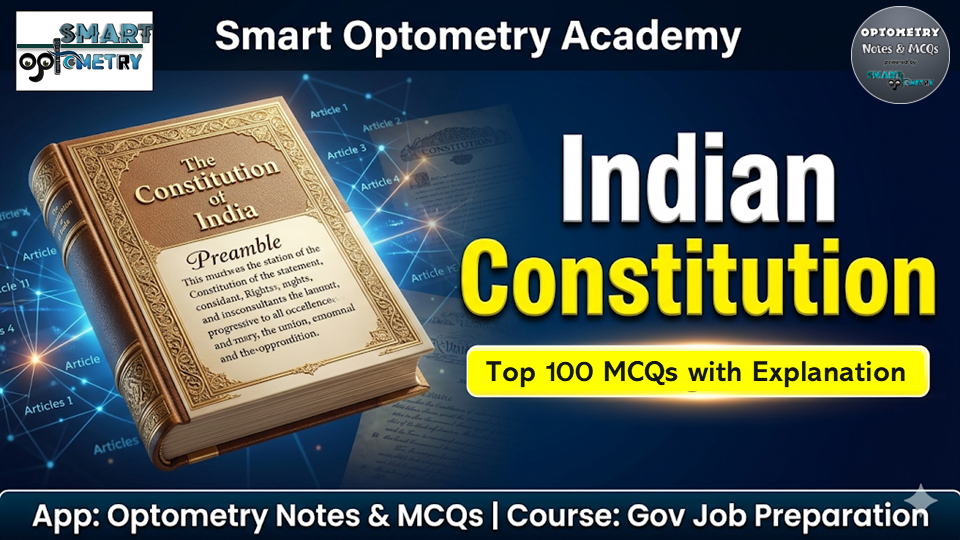
Top 100 Indian Constitution MCQs with Explanation
Comprehensive Indian Constitution & Polity Question Bank for Government & Competitive Exams
Quick Navigation
Q-1: Who was the Constitutional Advisor to the Constituent Assembly during the framing of the Indian Constitution? (Top 100 Indian Constitution MCQs)
a. Dr. B.R. Ambedkar
b. Dr. Rajendra Prasad
c. Sir B.N. Rau
d. K.M. Munshi
Sir B.N. Rau was appointed as the Legal Advisor to the Constituent Assembly in 1946. He was responsible for preparing the initial draft of the Constitution, which was later refined by the Drafting Committee. His expertise in international law was vital in synthesizing various global constitutional features.
Q-2: The ‘Objective Resolution’, which formed the basis of the Preamble, was moved in the Constituent Assembly by whom? (Top 100 Indian Constitution MCQs)
a. Sardar Vallabhbhai Patel
b. Jawaharlal Nehru
c. Dr. B.R. Ambedkar
d. J.B. Kripalani
Jawaharlal Nehru moved the historic Objective Resolution on December 13, 1946. It outlined the fundamental ideals and philosophy that would guide the drafting of the Constitution. This resolution was unanimously adopted on January 22, 1947, and eventually became the Preamble.
Q-3: Which of the following features was borrowed from the Constitution of Ireland? (Top 100 Indian Constitution MCQs)
a. Fundamental Rights
b. Directive Principles of State Policy
c. Parliamentary Government
d. Judicial Review
The Directive Principles of State Policy (DPSP) in Part IV were inspired by the Irish Constitution. Ireland itself had borrowed this concept from the Spanish Constitution. They act as guidelines for the state to establish social and economic democracy.
Q-4: How much time did the Constituent Assembly take to frame the Constitution of India? (Top 100 Indian Constitution MCQs)
a. 2 years, 11 months, 18 days
b. 2 years, 11 months, 17 days
c. 3 years, 1 month, 15 days
d. 2 years, 9 months, 18 days
The Constituent Assembly took exactly 2 years, 11 months, and 17 days to draft the Constitution of India. The assembly held 11 sessions, covering a total of 165 days, finalizing the longest written constitution in the world.
Q-5: The idea of a Constituent Assembly for India was first put forward by? (Top 100 Indian Constitution MCQs)
a. Mahatma Gandhi
b. Jawaharlal Nehru
c. M. N. Roy
d. B. R. Ambedkar
The idea of a Constituent Assembly to frame a Constitution for India was first proposed in 1934 by M. N. Roy, a pioneer of the communist movement in India. It became an official demand of the Indian National Congress in 1935.
Q-6: Under which plan was the Constituent Assembly constituted? (Top 100 Indian Constitution MCQs)
a. Mountbatten Plan
b. Cripps Mission
c. Cabinet Mission Plan
d. Wavell Plan
The Constituent Assembly of India was constituted in November 1946 under the scheme formulated by the Cabinet Mission Plan. The plan laid down the framework for the allocation of seats and the method of election for the assembly.
Q-7: Who was the first temporary President of the Constituent Assembly? (Top 100 Indian Constitution MCQs)
a. Dr. Rajendra Prasad
b. Dr. Sachchidananda Sinha
c. H. C. Mookerjee
d. B. R. Ambedkar
Following the French practice, Dr. Sachchidananda Sinha, the oldest member, was elected as the temporary President of the Assembly for its first meeting on December 9, 1946. Dr. Rajendra Prasad was elected as the permanent President a few days later.
Q-8: Which of the following parts of the Constitution is non-justiciable? (Top 100 Indian Constitution MCQs)
a. Fundamental Rights
b. Directive Principles of State Policy
c. Both a and b
d. Neither a nor b
The Directive Principles of State Policy (DPSP) are non-justiciable, meaning they cannot be legally enforced by the courts for their violation. However, they are fundamental in the governance of the country, and it is the duty of the state to apply them in making laws.
Q-9: What is the primary source of the Indian Constitution? (Top 100 Indian Constitution MCQs)
a. US Constitution
b. British Constitution
c. Government of India Act, 1935
d. Irish Constitution
The Government of India Act, 1935, forms the structural blueprint of the Indian Constitution. More than half of the provisions of the Constitution are identical to or directly derived from this Act, including the federal scheme and administrative details.
Q-10: On which date did the Constituent Assembly adopt the National Flag? (Top 100 Indian Constitution MCQs)
a. 26th January 1950
b. 15th August 1947
c. 22nd July 1947
d. 24th January 1950
The Constituent Assembly adopted the National Flag of India on July 22, 1947, just before India gained independence. It adopted the National Anthem and National Song later on January 24, 1950.
The Ultimate All-In-One Preparation Hub
Take the first step toward securing your dream career with the “Optometry Gov Job Preparation” course, exclusively available on the “Optometry Notes & MCQs” app. This course is meticulously structured to provide an all-inclusive preparation experience, ensuring aspiring optometrists have the exact tools, notes, and tests needed to ace highly competitive government exams.
Q-11: Which article defines ‘State’ for the purposes of Fundamental Rights? (DSSSB Optometrist Constitution MCQs)
a. Article 12
b. Article 13
c. Article 14
d. Article 36
Article 12 of the Constitution defines the term ‘State’ for the application of Part III (Fundamental Rights). It includes the Government and Parliament of India, the Government and Legislature of each of the States, and all local or other authorities within India’s territory.
Q-12: The concept of ‘Equality before Law’ in Article 14 is borrowed from? (DSSSB Optometrist Constitution MCQs)
a. US Constitution
b. British Constitution
c. French Constitution
d. Russian Constitution
Article 14 contains two concepts: “equality before law” (a negative concept borrowed from British common law) and “equal protection of laws” (a positive concept borrowed from the US Constitution). Both aim to establish the rule of law.
Q-13: Article 17 of the Constitution provides for? (DSSSB Optometrist Constitution MCQs)
a. Abolition of Titles
b. Equality of opportunity in public employment
c. Abolition of Untouchability
d. Freedom of Speech
Article 17 explicitly abolishes “untouchability” and forbids its practice in any form. To enforce this, Parliament enacted the Untouchability (Offences) Act, 1955, which was later amended and renamed the Protection of Civil Rights Act, 1955.
Q-14: The Right to Property was removed from Fundamental Rights by which amendment? (DSSSB Optometrist Constitution MCQs)
a. 42nd Amendment, 1976
b. 44th Amendment, 1978
c. 86th Amendment, 2002
d. 73rd Amendment, 1992
The 44th Constitutional Amendment Act of 1978 removed the right to property from the list of Fundamental Rights. It was made a constitutional right under Article 300-A, which states that no person shall be deprived of his property save by authority of law.
Q-15: Which writ literally means ‘to have the body of’? (DSSSB Optometrist Constitution MCQs)
a. Mandamus
b. Quo-Warranto
c. Habeas Corpus
d. Certiorari
Habeas Corpus is a Latin term meaning “to have the body of.” It is an order issued by a court to a person who has detained another, commanding them to produce the detainee before the court to check the legality of the detention.
Q-16: Which Article empowers the Supreme Court to issue writs? (DSSSB Optometrist Constitution MCQs)
a. Article 32
b. Article 226
c. Article 13
d. Article 143
Article 32 provides the right to constitutional remedies. It empowers the Supreme Court to issue writs (Habeas Corpus, Mandamus, Prohibition, Certiorari, and Quo Warranto) for the enforcement of Fundamental Rights. Dr. Ambedkar called it the “heart and soul” of the Constitution.
Q-17: Protection against double jeopardy is guaranteed under which Article? (DSSSB Optometrist Constitution MCQs)
a. Article 19
b. Article 20
c. Article 21
d. Article 22
Article 20(2) states that no person shall be prosecuted and punished for the same offense more than once. This protection against “double jeopardy” ensures fair legal treatment of accused individuals.
Q-18: Which Fundamental Right cannot be suspended even during a National Emergency? (DSSSB Optometrist Constitution MCQs)
a. Article 19
b. Articles 20 and 21
c. Articles 14 and 15
d. Articles 25 and 26
According to the 44th Amendment Act (1978), the President cannot suspend the right to move the court for the enforcement of fundamental rights guaranteed by Articles 20 (protection in respect of conviction) and 21 (protection of life and personal liberty) even during a National Emergency.
Q-19: Right to Education was added as a Fundamental Right by inserting which Article? (DSSSB Optometrist Constitution MCQs)
a. Article 21
b. Article 21A
c. Article 24
d. Article 29
The 86th Constitutional Amendment Act of 2002 inserted Article 21A, which declares that the State shall provide free and compulsory education to all children of the age of six to fourteen years in such manner as the State may determine.
Q-20: Article 23 of the Indian Constitution prohibits? (DSSSB Optometrist Constitution MCQs)
a. Child labour
b. Traffic in human beings and forced labour
c. Untouchability
d. Discrimination on basis of religion
Article 23 prohibits traffic in human beings, begar (forced labor), and other similar forms of forced labor. Any contravention of this provision is an offense punishable in accordance with the law, aiming to protect the dignity of individuals.
Master the Basics with Subject-Wise Theory Notes
Solidify your core optometry knowledge with our carefully curated Subject-Wise Theory Notes. Available directly in the app, these organized notes break down complex topics into easily digestible segments, giving you a crystal-clear understanding of the syllabus required for optometry government and licensing exams.
Q-21: The concept of Fundamental Duties in the Indian Constitution was inspired by? (Important Constitution MCQs for UPSC)
a. US Constitution
b. Japanese Constitution
c. USSR (Soviet) Constitution
d. French Constitution
The Fundamental Duties in Part IV-A of the Constitution were added to remind citizens that while enjoying rights, they must also perform their duties. This concept was deeply inspired by the Constitution of the erstwhile Soviet Union.
Q-22: Which committee recommended the inclusion of Fundamental Duties in the Constitution? (Important Constitution MCQs for UPSC)
a. Swaran Singh Committee
b. Balwant Rai Mehta Committee
c. Sarkaria Commission
d. Kothari Commission
During the Internal Emergency (1975–1977), the Sardar Swaran Singh Committee was formed to make recommendations about fundamental duties. Following its report, the 42nd Amendment Act (1976) introduced Article 51A into the Constitution.
Q-23: How many Fundamental Duties are currently listed in Article 51A? (Important Constitution MCQs for UPSC)
a. 9
b. 10
c. 11
d. 12
Initially, 10 Fundamental Duties were added by the 42nd Amendment in 1976. The 11th duty, which requires parents or guardians to provide opportunities for education to their children between 6 and 14 years, was added by the 86th Amendment Act of 2002.
Q-24: Directive Principles of State Policy (DPSP) are classified into which three categories? (Important Constitution MCQs for UPSC)
a. Social, Political, Economic
b. Socialistic, Gandhian, Liberal-Intellectual
c. Fundamental, Statutory, Executive
d. Religious, Cultural, Educational
Although the Constitution does not formally classify them, for the sake of better understanding, DPSPs are broadly categorized into three ideological groups: Socialistic principles, Gandhian principles, and Liberal-Intellectual principles based on their content and direction.
Q-25: Article 40 of the Constitution deals with? (Important Constitution MCQs for UPSC)
a. Uniform Civil Code
b. Organization of Village Panchayats
c. Right to Work
d. Protection of Monuments
Article 40, a Gandhian Directive Principle, directs the State to take steps to organize village panchayats and endow them with such powers and authority as may be necessary to enable them to function as units of self-government.
Q-26: The idea of ‘Uniform Civil Code’ is mentioned under which Article? (Important Constitution MCQs for UPSC)
a. Article 42
b. Article 43
c. Article 44
d. Article 45
Article 44 states that the State shall endeavor to secure for the citizens a Uniform Civil Code throughout the territory of India. It belongs to the Liberal-Intellectual category of the Directive Principles of State Policy.
Q-27: Which of the following is NOT a Fundamental Duty? (Important Constitution MCQs for UPSC)
a. To abide by the Constitution and respect its ideals
b. To safeguard public property and abjure violence
c. To vote in public elections
d. To protect and improve the natural environment
While the Swaran Singh Committee had recommended that voting in elections should be a duty, it was not included in the final list of Fundamental Duties inserted into the Constitution. Therefore, voting remains a democratic right and civic responsibility, but not a constitutional fundamental duty.
Q-28: Which article directs the state to separate the judiciary from the executive in the public services? (Important Constitution MCQs for UPSC)
a. Article 48
b. Article 49
c. Article 50
d. Article 51
Article 50 of the Constitution directs the State to take steps to separate the judiciary from the executive in the public services of the State. This ensures judicial independence and fairness in the administration of justice.
Q-29: The concept of welfare state finds its clearest expression in? (Important Constitution MCQs for UPSC)
a. Fundamental Rights
b. Directive Principles of State Policy
c. Preamble
d. Seventh Schedule
The Directive Principles of State Policy embody the concept of a welfare state by outlining socio-economic goals. They mandate the state to promote the welfare of the people by securing a social order characterized by justice—social, economic, and political.
Q-30: Which article deals with the promotion of international peace and security? (Important Constitution MCQs for UPSC)
a. Article 49
b. Article 50
c. Article 51
d. Article 51A
Article 51 instructs the State to promote international peace and security, maintain just and honorable relations between nations, foster respect for international law and treaty obligations, and encourage settlement of international disputes by arbitration.
The Ultimate All-In-One Preparation Hub
Take the first step toward securing your dream career with the “Optometry Gov Job Preparation” course, exclusively available on the “Optometry Notes & MCQs” app. This course is meticulously structured to provide an all-inclusive preparation experience, ensuring aspiring optometrists have the exact tools, notes, and tests needed to ace highly competitive government exams.
Q-31: The President of India is elected by an Electoral College consisting of? (Indian Constitution objective questions PDF)
a. All members of Parliament
b. Elected members of Lok Sabha only
c. Elected members of both Houses of Parliament and State Legislative Assemblies
d. All members of Parliament and State Legislative Assemblies
Under Article 54, the Electoral College for the President consists of only the *elected* members of both Houses of Parliament, the *elected* members of the legislative assemblies of the states, and the *elected* members of the legislative assemblies of Delhi and Puducherry. Nominated members do not participate.
Q-32: What is the minimum age prescribed for a person to be eligible for election as President of India? (Indian Constitution objective questions PDF)
a. 25 years
b. 30 years
c. 35 years
d. 40 years
Article 58 of the Constitution lays down the qualifications for election as President. A person must be a citizen of India, have completed 35 years of age, and be qualified for election as a member of the Lok Sabha.
Q-33: Who administers the oath of office to the President of India? (Indian Constitution objective questions PDF)
a. Vice-President
b. Chief Justice of India
c. Prime Minister
d. Speaker of Lok Sabha
According to Article 60, the oath of office to the President is administered by the Chief Justice of India. In his absence, the senior-most Judge of the Supreme Court available administers the oath.
Q-34: In case of impeachment of the President, the charge must be supported by what majority? (Indian Constitution objective questions PDF)
a. Simple majority of members present and voting
b. Two-thirds majority of members present and voting
c. Two-thirds majority of the total membership of the House
d. Absolute majority
Under Article 61, the resolution to impeach the President must be passed by a special majority, specifically not less than two-thirds of the *total membership* of each House of Parliament. This makes impeachment a very stringent process.
Q-35: The Vice-President is elected by an Electoral College consisting of? (Indian Constitution objective questions PDF)
a. Elected members of both Houses of Parliament
b. All members of both Houses of Parliament
c. Elected members of Parliament and State Assemblies
d. Members of Rajya Sabha only
Unlike the Presidential election, the Electoral College for the Vice-President consists of *both elected and nominated* members of both Houses of Parliament. State legislative assembly members do not participate in the Vice-President’s election.
Q-36: Which Article states that there shall be a Council of Ministers with the Prime Minister at the head to aid and advise the President? (Indian Constitution objective questions PDF)
a. Article 74
b. Article 75
c. Article 76
d. Article 78
Article 74(1) mandates the existence of a Council of Ministers headed by the Prime Minister to aid and advise the President, who shall, in the exercise of his functions, act in accordance with such advice.
Q-37: The total number of Ministers, including the Prime Minister, in the Council of Ministers shall not exceed? (Indian Constitution objective questions PDF)
a. 10% of the total members of Lok Sabha
b. 15% of the total members of Lok Sabha
c. 20% of the total members of Parliament
d. 15% of the total members of Parliament
This limit was established by the 91st Constitutional Amendment Act of 2003. It amended Article 75 to cap the size of the Council of Ministers at 15% of the total strength of the Lok Sabha to prevent jumbo cabinets.
Q-38: To whom does the President address his resignation letter? (Indian Constitution objective questions PDF)
a. Chief Justice of India
b. Prime Minister
c. Vice-President
d. Speaker of Lok Sabha
According to Article 56, the President may, by writing under his hand addressed to the Vice-President, resign his office. The Vice-President must then immediately communicate this resignation to the Speaker of the Lok Sabha.
Q-39: Who is the ex-officio Chairman of the NITI Aayog? (Indian Constitution objective questions PDF)
a. President
b. Finance Minister
c. Prime Minister
d. Home Minister
The Prime Minister serves as the ex-officio Chairperson of NITI Aayog, the premier policy ‘Think Tank’ of the Government of India. This ensures that the country’s strategic planning aligns with the vision of the executive head of government.
Q-40: Under which Article does the President possess the ordinance-making power? (Indian Constitution objective questions PDF)
a. Article 123
b. Article 213
c. Article 356
d. Article 360
Article 123 empowers the President to promulgate ordinances during the recess of Parliament if he is satisfied that immediate action is required. An ordinance has the same force as an Act of Parliament but is temporary in nature.
Simulate the Real Exam with Mock Tests
Eliminate exam anxiety and build your confidence using our Subject-Wise Mock Tests. Designed to mirror the pressure and format of actual optometry government exams, these mock exams available in the “Optometry Notes & MCQs” app will help you perfect your time management and strategy.
Q-41: Who presides over a joint sitting of both Houses of Parliament? (Constitution of India MCQs for competitive exams)
a. President of India
b. Vice-President (Chairman of Rajya Sabha)
c. Speaker of Lok Sabha
d. Prime Minister
While the President summons a joint sitting of Parliament under Article 108 to resolve a legislative deadlock over a bill, the joint sitting is explicitly presided over by the Speaker of the Lok Sabha, not the Chairman of the Rajya Sabha.
Q-42: A Money Bill can be delayed by the Rajya Sabha for a maximum period of? (Constitution of India MCQs for competitive exams)
a. 14 days
b. 30 days
c. 1 month
d. 6 months
Under Article 109, the Rajya Sabha has very restricted powers regarding Money Bills. It cannot reject or amend a Money Bill; it can only make recommendations and must return the bill to the Lok Sabha within 14 days, after which it is deemed passed.
Q-43: What is the minimum age required to become a member of the Lok Sabha? (Constitution of India MCQs for competitive exams)
a. 21 years
b. 25 years
c. 30 years
d. 35 years
Article 84 of the Constitution sets the qualifications for membership of Parliament. A person must be a citizen of India and not less than 25 years of age to be elected to the Lok Sabha (House of the People).
Q-44: The ‘Zero Hour’ in the Indian parliamentary system typically starts at what time? (Constitution of India MCQs for competitive exams)
a. 10:00 AM
b. 11:00 AM
c. 12:00 Noon
d. 1:00 PM
Zero Hour is an Indian parliamentary innovation not mentioned in the rule book. It typically begins immediately after the Question Hour at 12 noon. During this time, members can raise matters of urgent public importance without prior notice.
Q-45: Which committee examines the reports of the Comptroller and Auditor General (CAG) of India? (Constitution of India MCQs for competitive exams)
a. Estimates Committee
b. Public Accounts Committee
c. Committee on Public Undertakings
d. Business Advisory Committee
The Public Accounts Committee (PAC) is the oldest parliamentary committee. Its primary function is to examine the annual audit reports of the CAG, which the President lays before the Parliament, ensuring financial accountability of the executive.
Q-46: One-third of the members of the Rajya Sabha retire every? (Constitution of India MCQs for competitive exams)
a. Year
b. Two years
c. Three years
d. Six years
The Rajya Sabha is a permanent body and is not subject to dissolution. However, one-third of its members retire every second year, and their seats are filled up by fresh elections and presidential nominations at the beginning of every third year.
Q-47: A bill is deemed to be a Money Bill if it deals exclusively with matters listed in which Article? (Constitution of India MCQs for competitive exams)
a. Article 108
b. Article 110
c. Article 112
d. Article 117
Article 110 of the Constitution defines a Money Bill as one containing provisions dealing strictly with taxes, government borrowing, or expenditure from the Consolidated Fund of India.
Q-48: Who decides the disqualification of a Member of Parliament under the Anti-Defection Law (10th Schedule)? (Constitution of India MCQs for competitive exams)
a. President
b. Election Commission
c. Presiding Officer of the House (Speaker/Chairman)
d. Supreme Court
Under the Tenth Schedule, the question of disqualification on the ground of defection is decided by the Chairman in the case of the Rajya Sabha and the Speaker in the case of the Lok Sabha.
Q-49: Which is the largest parliamentary committee in terms of membership? (Constitution of India MCQs for competitive exams)
a. Public Accounts Committee
b. Estimates Committee
c. Committee on Public Undertakings
d. Committee on Petitions
The Estimates Committee is the largest parliamentary committee, consisting of 30 members, all of whom are elected solely from the Lok Sabha. Its function is to examine the estimates included in the budget and suggest ‘economies’ in public expenditure.
Q-50: The maximum number of members from Union Territories in the Lok Sabha cannot exceed? (Constitution of India MCQs for competitive exams)
a. 10
b. 15
c. 20
d. 25
Article 81 of the Constitution stipulates that the Lok Sabha shall consist of not more than 530 members chosen by direct election from territorial constituencies in the States, and not more than 20 members to represent the Union Territories.
Start Your Success Journey Today
There is no better time to invest in your future. Download the “Optometry Notes & MCQs” app directly from the Google Play Store today and enroll in the “Gov Job Preparation” course. With complete theory notes, extensive MCQs, realistic mock tests, and a legacy of proven success, Smart Optometry Academy is ready to help you study smartly and secure your government job.
Q-51: The judges of the Supreme Court of India retire at what age? (Indian Constitution questions and answers)
a. 60 years
b. 62 years
c. 65 years
d. 70 years
According to Article 124(2) of the Constitution, a judge of the Supreme Court holds office until they attain the age of 65 years. In contrast, High Court judges retire at the age of 62.
Q-52: Who has the power to increase the number of judges in the Supreme Court? (Indian Constitution questions and answers)
a. President
b. Chief Justice of India
c. Parliament
d. Law Commission
Article 124(1) states that there shall be a Supreme Court of India consisting of a Chief Justice of India and, until Parliament by law prescribes a larger number, of not more than seven other Judges. Parliament has regularly exercised this power to increase the judicial strength.
Q-53: Under which Article can the President seek the advisory opinion of the Supreme Court? (Indian Constitution questions and answers)
a. Article 131
b. Article 136
c. Article 143
d. Article 145
Article 143 confers advisory jurisdiction on the Supreme Court. The President may refer any question of law or fact of public importance to the Supreme Court for its opinion. However, the Court’s opinion is advisory and not binding on the President.
Q-54: The process for the removal of a Supreme Court judge is outlined in the? (Indian Constitution questions and answers)
a. Representation of the People Act, 1951
b. Judges (Inquiry) Act, 1968
c. Supreme Court Rules, 2013
d. Contempt of Courts Act, 1971
While Article 124(4) mentions that a judge can be removed on grounds of “proved misbehaviour or incapacity,” the detailed procedure relating to the investigation and proof of such charges is regulated by the Judges (Inquiry) Act, 1968.
Q-55: Which of the following courts acts as a ‘Court of Record’? (Indian Constitution questions and answers)
a. Only the Supreme Court
b. Only High Courts
c. Both Supreme Court and High Courts
d. District Courts
Both the Supreme Court (Article 129) and the High Courts (Article 215) are courts of record. This means their judgments, proceedings, and acts are recorded for perpetual memory and testimony, and they have the power to punish for their contempt.
Q-56: The power of Judicial Review in India is? (Indian Constitution questions and answers)
a. Expressly mentioned in the Preamble
b. Implicit in various Articles like Article 13 and 32
c. Granted by an Act of Parliament
d. Borrowed from the UK Constitution
While the term ‘Judicial Review’ is not explicitly mentioned in the Constitution, the power is firmly established through various provisions, primarily Article 13, which declares laws inconsistent with fundamental rights as void, and Article 32 regarding constitutional remedies.
Q-57: Original Jurisdiction of the Supreme Court covers disputes between? (Indian Constitution questions and answers)
a. Citizens of different states
b. The Centre and one or more States
c. Two private corporations
d. A citizen and a foreign government
Under Article 131, the Supreme Court has exclusive original jurisdiction in any dispute between the Government of India and one or more States, or between two or more States, ensuring federal disputes are resolved at the highest judicial level.
Q-58: The minimum number of judges required to sit on a Constitution Bench of the Supreme Court is? (Indian Constitution questions and answers)
a. 3
b. 5
c. 7
d. 9
Article 145(3) mandates that the minimum number of Judges who are to sit for the purpose of deciding any case involving a substantial question of law as to the interpretation of the Constitution shall be five (a Constitution Bench).
Q-59: Who appoints the judges of a State High Court? (Indian Constitution questions and answers)
a. Governor of the State
b. Chief Justice of India
c. President of India
d. Chief Minister
Under Article 217, every judge of a High Court is appointed by the President of India under his hand and seal after consultation with the Chief Justice of India, the Governor of the State, and the Chief Justice of the High Court.
Q-60: The concept of Public Interest Litigation (PIL) was spearheaded in India by? (Indian Constitution questions and answers)
a. Justice Y.V. Chandrachud
b. Justice P.N. Bhagwati and Justice V.R. Krishna Iyer
c. Justice H.R. Khanna
d. Justice J.S. Khehar
In the late 1970s and 1980s, Justice V.R. Krishna Iyer and Justice P.N. Bhagwati fundamentally altered the Indian judicial landscape by relaxing the traditional rule of *locus standi*, thereby allowing PILs to bring justice to the marginalized.
Learn from the Past with Previous Year MCQs
Smart studying requires understanding the patterns of the examiners. That is why the “Gov Job Preparation” course includes a dedicated section for “Previous Year MCQs”. By practicing questions that have actually appeared in past optometry government exams, you can anticipate trends and focus on high-yield topics.
Q-61: Which constitutional provision allows the Supreme Court to grant Special Leave to Appeal? (Best Constitution MCQs for State PSC)
a. Article 132
b. Article 134
c. Article 136
d. Article 143
Article 136 grants the Supreme Court discretionary power to grant special leave to appeal from any judgment, decree, or order passed by any court or tribunal in the territory of India, except military tribunals.
Q-62: Who is considered the Executive Head of a State in India? (Best Constitution MCQs for State PSC)
a. Chief Minister
b. Governor
c. Chief Secretary
d. President
According to Article 154, the executive power of the State is vested entirely in the Governor. Like the President at the Centre, the Governor is the constitutional and nominal executive head, operating on the advice of the Chief Minister.
Q-63: Which Article provides for the setting up of an Inter-State Council? (Best Constitution MCQs for State PSC)
a. Article 263
b. Article 265
c. Article 280
d. Article 300
Article 263 allows the President to establish an Inter-State Council to facilitate coordination and resolve disputes between the Union and states, as well as among the states themselves. It promotes cooperative federalism.
Q-64: The ‘Right to Property’ is currently a? (Best Constitution MCQs for State PSC)
a. Fundamental Right
b. Constitutional / Legal Right
c. Moral Right
d. Statutory Right only
Following the 44th Amendment, the Right to Property is no longer a Fundamental Right. It was moved to Article 300A, making it a constitutional right, meaning a person can only be deprived of property by authority of law, not executive fiat.
Q-65: What is the maximum duration an ordinance issued by the President can remain in force after Parliament reconvenes? (Best Constitution MCQs for State PSC)
a. 4 weeks
b. 6 weeks
c. 6 months
d. 3 months
An ordinance issued under Article 123 must be laid before both Houses of Parliament and ceases to operate at the expiration of six weeks from the reassembly of Parliament, unless approved earlier. Its absolute maximum lifespan is six months and six weeks.
Q-66: The concept of a ‘Nominated Member’ to the Rajya Sabha was borrowed from? (Best Constitution MCQs for State PSC)
a. USA
b. Canada
c. Ireland
d. South Africa
The method of nominating esteemed members with special knowledge in arts, literature, science, and social service to the Upper House of Parliament was borrowed from the Irish Constitution.
Q-67: The 73rd Constitutional Amendment Act is related to? (Best Constitution MCQs for State PSC)
a. Panchayati Raj
b. Municipalities
c. Fundamental Duties
d. Anti-Defection
The landmark 73rd Amendment Act (1992) granted constitutional recognition to the Panchayati Raj Institutions. It mandated a three-tier system of local self-government in rural areas and reserved one-third of seats for women.
Q-68: The term of the State Legislative Assembly can be extended during a National Emergency by? (Best Constitution MCQs for State PSC)
a. The Governor
b. The President
c. The Parliament by law
d. The Election Commission
During a proclaimed National Emergency, the Parliament may by law extend the normal five-year term of a State Legislative Assembly for a period not exceeding one year at a time, though this extension cannot outlast six months after the emergency ends.
Q-69: Which Article empowers the Parliament to amend the Constitution? (Best Constitution MCQs for State PSC)
a. Article 356
b. Article 368
c. Article 370
d. Article 395
Article 368 contained in Part XX explicitly outlines the power of the Parliament to amend the Constitution and lays down the specific procedures to do so, though it is subject to the ‘basic structure’ limitation.
Q-70: Who appoints the Chairman of the State Public Service Commission? (Best Constitution MCQs for State PSC)
a. President
b. Prime Minister
c. Governor
d. Chief Minister
While the Governor appoints the Chairman and members of a State Public Service Commission, they can only be formally removed from their office by the President of India, ensuring their independence from state-level political pressure.
Master the Basics with Subject-Wise Theory Notes
Solidify your core optometry knowledge with our carefully curated Subject-Wise Theory Notes. Available directly in the app, these organized notes break down complex topics into easily digestible segments, giving you a crystal-clear understanding of the syllabus required for optometry government and licensing exams.
Q-71: Which Schedule contains the list of recognized languages in the Indian Constitution? (Indian Constitution GK questions in English)
a. 6th Schedule
b. 7th Schedule
c. 8th Schedule
d. 9th Schedule
The Eighth Schedule lists the official languages of the Republic of India. Originally, there were 14 languages, but amendments over the years have increased the number of recognized languages to 22.
Q-72: Which Article deals with the official language of the Union? (Indian Constitution GK questions in English)
a. Article 340
b. Article 343
c. Article 350
d. Article 352
Article 343 declares that the official language of the Union shall be Hindi in Devanagari script. It also provided for the continued use of English for official purposes for 15 years from the commencement of the Constitution.
Q-73: Which part of the Constitution deals with the Official Language? (Indian Constitution GK questions in English)
a. Part XV
b. Part XVI
c. Part XVII
d. Part XVIII
Part XVII of the Constitution (Articles 343 to 351) deals exclusively with the official language of the Union, regional languages, language of the judiciary, and directives for the development of the Hindi language.
Q-74: Who has the power to declare any area as a ‘Scheduled Area’? (Indian Constitution GK questions in English)
a. Parliament
b. Governor
c. President
d. Supreme Court
Under the Fifth Schedule, the President is empowered to declare any area to be a scheduled area. He can also increase or decrease its area, alter its boundary lines, and rescind such designation after consulting the State’s Governor.
Q-75: The Sixth Schedule of the Constitution deals with the administration of tribal areas in which four states? (Indian Constitution GK questions in English)
a. Assam, Meghalaya, Tripura, and Mizoram
b. Assam, Nagaland, Manipur, and Tripura
c. Manipur, Meghalaya, Sikkim, and Arunachal Pradesh
d. Assam, Meghalaya, Nagaland, and Mizoram
The Sixth Schedule contains special provisions for the administration of tribal areas in these four northeastern states (AMTM), creating Autonomous District Councils with significant legislative and judicial autonomy.
Q-76: Which article promotes the formation of Co-operative Societies? (Indian Constitution GK questions in English)
a. Article 39
b. Article 43B
c. Article 48A
d. Article 50
Added by the 97th Amendment Act (2011), Article 43B requires the State to promote voluntary formation, autonomous functioning, democratic control, and professional management of co-operative societies.
Q-77: The concept of ‘Co-operative Federalism’ means? (Indian Constitution GK questions in English)
a. Only states have real power
b. Centre dominates all policies
c. Mutual cooperation and interdependence between Centre and States
d. Complete separation of Centre and State powers
Indian federalism is often described as ‘cooperative federalism’ where the Union and the States are not strictly independent entities but mutually rely on each other to implement policies (e.g., GST Council, NITI Aayog).
Q-78: The Seventh Schedule of the Constitution divides legislative powers into how many lists? (Indian Constitution GK questions in English)
a. 2
b. 3
c. 4
d. 5
Article 246 and the Seventh Schedule distribute legislative powers between the Union and the States through three lists: List I (Union List), List II (State List), and List III (Concurrent List).
Q-79: Residuary powers of legislation (subjects not in any of the three lists) belong to? (Indian Constitution GK questions in English)
a. State Legislatures
b. Parliament
c. Both Parliament and State Legislatures
d. President
Under Article 248 and 250, any matter not enumerated in the Concurrent List or State List (Residuary Powers) falls under the exclusive legislative domain of the Union Parliament.
Q-80: The Inter-State River Water Disputes are adjudicated under which Article? (Indian Constitution GK questions in English)
a. Article 260
b. Article 262
c. Article 263
d. Article 280
Article 262 empowers Parliament to provide for the adjudication of any dispute or complaint regarding the use, distribution, or control of the waters of any inter-state river or river valley via specific tribunals.
Start Your Success Journey Today
There is no better time to invest in your future. Download the “Optometry Notes & MCQs” app directly from the Google Play Store today and enroll in the “Gov Job Preparation” course. With complete theory notes, extensive MCQs, realistic mock tests, and a legacy of proven success, Smart Optometry Academy is ready to help you study smartly and secure your government job.
Q-81: Who can remove the Vice-President from his office? (Previous year Indian Constitution questions)
a. President
b. Supreme Court
c. Rajya Sabha with agreement of Lok Sabha
d. Lok Sabha alone
Under Article 67, the Vice-President can be removed by a resolution of the Rajya Sabha passed by an effective majority and agreed to by the Lok Sabha. Formal impeachment is not required.
Q-82: The power to grant citizenship in India lies with? (Previous year Indian Constitution questions)
a. Ministry of External Affairs
b. Ministry of Home Affairs
c. President of India
d. Supreme Court
Citizenship, naturalization, and aliens are subjects under the Union List. The Ministry of Home Affairs is the executive body responsible for processing applications and granting Indian citizenship under the Citizenship Act, 1955.
Q-83: Which Part of the Constitution deals with Citizenship? (Previous year Indian Constitution questions)
a. Part I
b. Part II
c. Part III
d. Part IV
Part II (Articles 5 to 11) of the Constitution deals with Citizenship at the commencement of the Constitution. It empowered Parliament to enact laws regarding the acquisition and termination of citizenship.
Q-84: The Zonal Councils in India are? (Previous year Indian Constitution questions)
a. Constitutional bodies
b. Statutory bodies
c. Non-statutory advisory bodies
d. Executive bodies
Zonal Councils are not mentioned in the Constitution; they are statutory bodies established by the States Reorganisation Act of 1956 to promote interstate cooperation and integration. The Home Minister chairs them.
Q-85: What is the maximum period within which a state legislature must approve a State Emergency (President’s Rule)? (Previous year Indian Constitution questions)
a. 1 month
b. 2 months
c. 3 months
d. 6 months
A proclamation imposing President’s Rule under Article 356 must be approved by both Houses of Parliament (not the state legislature) within two months from its date of issue. Once approved, it lasts for six months.
Q-86: The doctrine of ‘Pleasure’ applies to which of the following posts? (Previous year Indian Constitution questions)
a. Judge of Supreme Court
b. Chief Election Commissioner
c. Governor of a State
d. Comptroller and Auditor General
Article 156 states that the Governor holds office “during the pleasure of the President.” This means the President can remove the Governor at any time without assigning any reason.
Q-87: Which language was added to the 8th Schedule by the 21st Amendment Act (1967)? (Previous year Indian Constitution questions)
a. Sindhi
b. Konkani
c. Manipuri
d. Nepali
Sindhi was the 15th language to be added to the Eighth Schedule by the 21st Constitutional Amendment Act in 1967. Konkani, Manipuri, and Nepali were added later by the 71st Amendment.
Q-88: Which Article provides for the ‘Exemption of property of the Union from State taxation’? (Previous year Indian Constitution questions)
a. Article 280
b. Article 285
c. Article 289
d. Article 300
Article 285 ensures that the property of the Union shall be exempt from all taxes imposed by a State or by any authority within a State. This protects the fiscal interests of the central government. Similarly, Article 289 provides for the exemption of property and income of a State from Union taxation.
Q-89: The ‘GST Council’ is a constitutional body established under? (Previous year Indian Constitution questions)
a. Article 269A
b. Article 279A
c. Article 280
d. Article 293
The 101st Amendment Act of 2016 added Article 279A, empowering the President to constitute the GST Council. It is chaired by the Union Finance Minister and includes ministers from all states. The Council makes recommendations on GST rates, exemptions, and thresholds, serving as a model of cooperative federalism.
Q-90: Which Article was recently in news in early 2026 regarding ‘Special status for a Matrilineal state’? (Previous year Indian Constitution questions)
a. Article 371A (Nagaland)
b. Article 371B (Assam)
c. Article 371G (Mizoram)
d. Article 371 (Maharashtra/Gujarat)
While the question mentions ‘matrilineal’ (referring to the Meghalaya CJ appointment), Article 371A is the most significant ‘Special Provision’ in the news relating to customary tribal laws. Article 371 to 371J contain special provisions to protect cultural identities and customary laws of various states.
Simulate the Real Exam with Mock Tests
Eliminate exam anxiety and build your confidence using our Subject-Wise Mock Tests. Designed to mirror the pressure and format of actual optometry government exams, these mock exams available in the “Optometry Notes & MCQs” app will help you perfect your time management and strategy.
Q-91: Who was the first Chief Election Commissioner of India? (Constitution and Polity MCQs)
a. V. S. Ramadevi
b. Sukumar Sen
c. T. N. Seshan
d. Sunil Arora
Sukumar Sen was an Indian civil servant who served as the first Chief Election Commissioner of India from 1950 to 1958. He successfully managed the monumental task of organizing independent India’s first two general elections in 1951-52 and 1957.
Q-92: The President’s power to grant pardons is detailed under which Article? (Constitution and Polity MCQs)
a. Article 52
b. Article 61
c. Article 72
d. Article 161
Article 72 vests the President of India with the executive power to grant pardons, reprieves, respites, or remissions of punishment, particularly in cases involving martial courts or the death penalty.
Q-93: Which constitutional amendment made education a fundamental right for children aged 6 to 14? (Constitution and Polity MCQs)
a. 73rd Amendment
b. 86th Amendment
c. 97th Amendment
d. 44th Amendment
The 86th Amendment Act (2002) significantly altered the constitution by inserting Article 21A, ensuring free and compulsory education for all children aged 6-14, making education an enforceable Fundamental Right.
Q-94: How many times has the Preamble of the Indian Constitution been amended? (Constitution and Polity MCQs)
a. Once
b. Twice
c. Thrice
d. Never
The Preamble has only been amended once in history, during the controversial 1976 emergency period by the 42nd Constitutional Amendment Act, which introduced the terms ‘Socialist,’ ‘Secular,’ and ‘Integrity.’
Q-95: What is the maximum possible strength of the Rajya Sabha? (Constitution and Polity MCQs)
a. 245
b. 250
c. 260
d. 238
According to Article 80, the absolute maximum strength of the Rajya Sabha is strictly capped at 250 members, out of which 238 represent states and union territories, and 12 are directly nominated by the President.
Q-96: The concept of PIL (Public Interest Litigation) originated in which country? (Constitution and Polity MCQs)
a. India
b. UK
c. USA
d. Australia
The concept of Public Interest Litigation (PIL) originated in the United States to provide legal representation to unrepresented groups. In India, it was famously popularized and adopted by Justice P.N. Bhagwati and Justice V.R. Krishna Iyer in the 1980s.
Q-97: The Election Commission of India operates under which Article of the Constitution? (Constitution and Polity MCQs)
a. Article 315
b. Article 324
c. Article 340
d. Article 356
Article 324 vests the absolute power of superintendence, direction, and control of all national and state-level elections firmly in an independent body called the Election Commission of India.
Q-98: What is the target depth for the “Matsya-6000” mission scheduled for 2027? (Constitution and Polity MCQs)
a. 1,000 meters
b. 3,000 meters
c. 6,000 meters
d. 10,000 meters
India’s Deep Ocean Mission aims to reach a depth of 6,000 meters using the manned submersible Matsya-6000. Successful completion will make India the sixth nation with this advanced deep-sea capability, driven by the Ministry of Earth Sciences.
Q-99: Which Indian state officially recorded the presence of the rare “Atlas Moth” in early 2026? (Constitution and Polity MCQs)
a. Kerala
b. Karnataka
c. Tamil Nadu
d. Maharashtra
The Atlas Moth, one of the world’s largest insects, was recently documented in the Karwar region of Karnataka. Its presence is a strong indicator of a healthy and diverse tropical forest ecosystem, highlighting the rich biodiversity of the Western Ghats.
Q-100: Who officially inaugurated the “Skyroot Aerospace Infinity Campus” in Hyderabad? (Constitution and Polity MCQs)
a. ISRO Chairman
b. Prime Minister Narendra Modi
c. President of India
d. Defense Minister
The campus is India’s largest private integrated rocket design and manufacturing facility. During the visit, the PM also unveiled the “Vikram-I” orbital rocket, marking a massive structural milestone for private sector participation in India’s space policies.
Start Your Success Journey Today
There is no better time to invest in your future. Download the “Optometry Notes & MCQs” app directly from the Google Play Store today and enroll in the “Gov Job Preparation” course. With complete theory notes, extensive MCQs, realistic mock tests, and a legacy of proven success, Smart Optometry Academy is ready to help you study smartly and secure your government job.
Explore More in Current Affairs:
Must-Read Related Topics
📚 Check Our Premium Courses: Ophthalmic Instrumentation, Clinical Refraction, Contact Lens, Binocular Vision, Dispensing Optics, MCQs in Optometry
Explore Courses