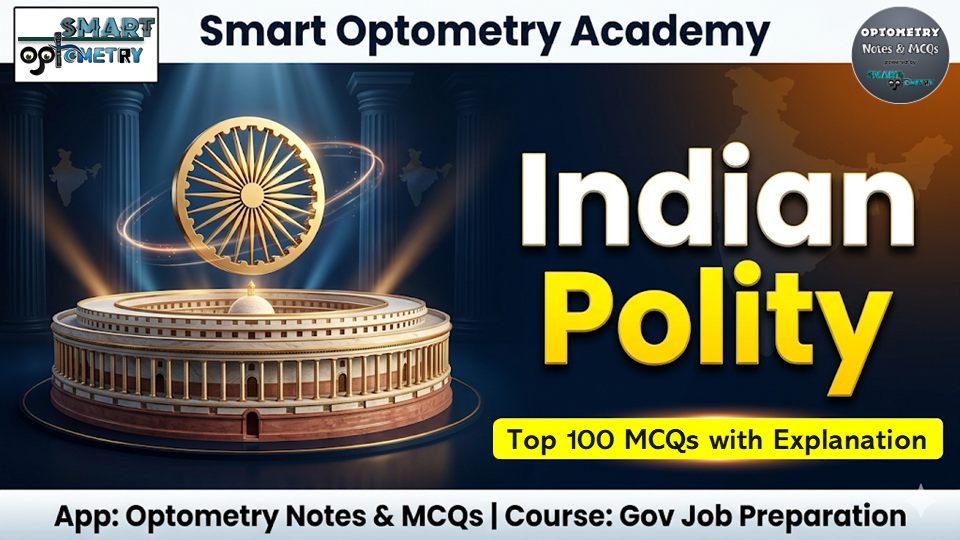
Top 100 Indian Polity MCQs with Explanation
Comprehensive Indian Constitution & Polity Question Bank for Government & Competitive Exams
Quick Navigation
Q-1: Who was appointed as the 53rd Chief Justice of India (CJI) in November 2025? (Top 100 Indian Polity MCQs)
a. Justice B. R. Gavai
b. Justice Surya Kant
c. Justice Vikram Nath
d. Justice Sanjiv Khanna
Justice Surya Kant assumed office following the recommendation of outgoing CJI B. R. Gavai. His tenure began on 24th November 2025, marking a significant transition in the Indian judiciary. He is expected to lead the Supreme Court through several major constitutional bench hearings during his term.
Q-2: In January 2026, who became the first woman to be sworn in as the Chief Justice of the Meghalaya High Court? (Top 100 Indian Polity MCQs)
a. Justice Sunita Agarwal
b. Justice Revati Mohite Dere
c. Justice Ritu Bahri
d. Justice Bela Trivedi
Justice Revati Mohite Dere made history as the first female head of the judiciary in the state of Meghalaya. Her appointment is a landmark for gender representation in the higher judiciary, especially in the North Eastern region. The oath was administered by the Governor at Lok Bhavan in Shillong.
Q-3: The Bombay High Court recently reiterated that which of the following cannot be used as a prefix or suffix to a person’s name? (Top 100 Indian Polity MCQs)
a. Military Ranks
b. Academic Degrees
c. Bharat Ratna and Padma Awards
d. Religious Titles
The Court clarified that while these are the highest civilian honors, they are not “titles” under Article 18 of the Constitution. Therefore, using them as prefixes or suffixes violates constitutional principles. Article 18 expressly abolishes all titles except military and academic ones.
Q-4: Who was the Chairman of the Drafting Committee of the Constituent Assembly? (Top 100 Indian Polity MCQs)
a. Jawaharlal Nehru
b. Dr. B. R. Ambedkar
c. Sardar Vallabhbhai Patel
d. Dr. Rajendra Prasad
Dr. B. R. Ambedkar, recognized as the “Father of the Indian Constitution,” was the Chairman of the Drafting Committee. The committee was responsible for preparing the first draft of the Constitution. His unparalleled legal expertise heavily shaped the framework of modern Indian democracy.
Q-5: The concept of ‘Judicial Review’ in the Indian Constitution is borrowed from which country? (Top 100 Indian Polity MCQs)
a. United Kingdom
b. United States of America
c. Canada
d. Ireland
The principle of Judicial Review, which allows the judiciary to invalidate laws and executive orders that violate the Constitution, was adopted from the USA. Along with it, India also borrowed the concepts of Fundamental Rights and the independence of the judiciary from the American Constitution.
Q-6: Which part of the Indian Constitution deals with Fundamental Rights? (Top 100 Indian Polity MCQs)
a. Part I
b. Part II
c. Part III
d. Part IV
Part III of the Indian Constitution (Articles 12 to 35) guarantees Fundamental Rights to its citizens. These rights act as limitations on the arbitrary powers of the State and protect the liberties of individuals. They are considered the “Magna Carta” of India.
Q-7: The Preamble of the Indian Constitution was amended by which Constitutional Amendment Act? (Top 100 Indian Polity MCQs)
a. 44th Amendment
b. 42nd Amendment
c. 42nd Amendment (Correct: 42nd Amendment 1976)
d. 73rd Amendment
The 42nd Constitutional Amendment Act of 1976 amended the Preamble for the first and only time. It added three new words: “Socialist,” “Secular,” and “Integrity.” This amendment was enacted during the National Emergency under Prime Minister Indira Gandhi.
Q-8: Which Article of the Indian Constitution ensures ‘Equality before the Law’? (Top 100 Indian Polity MCQs)
a. Article 14
b. Article 15
c. Article 16
d. Article 17
Article 14 of the Constitution provides that “the State shall not deny to any person equality before the law or the equal protection of the laws within the territory of India.” It applies to both citizens and foreigners, establishing the bedrock principle of the Rule of Law.
Q-9: The provision for the ‘Abolition of Untouchability’ is found in which Article? (Top 100 Indian Polity MCQs)
a. Article 15
b. Article 16
c. Article 17
d. Article 18
Article 17 abolishes “untouchability” and forbids its practice in any form. The enforcement of any disability arising out of untouchability is an offense punishable in accordance with the law, highlighting India’s commitment to social justice.
Q-10: How many fundamental duties were originally present in the Constitution when Part IVA was added? (Top 100 Indian Polity MCQs)
a. 8
b. 10
c. 11
d. 12
When Part IVA (Article 51A) was added by the 42nd Amendment in 1976 on the recommendation of the Swaran Singh Committee, it contained exactly 10 Fundamental Duties. The 11th duty, relating to education for children, was added later by the 86th Amendment Act in 2002.
The Ultimate All-In-One Preparation Hub
Take the first step toward securing your dream career with the “Optometry Gov Job Preparation” course, exclusively available on the “Optometry Notes & MCQs” app. This course is meticulously structured to provide an all-inclusive preparation experience, ensuring aspiring optometrists have the exact tools, notes, and tests needed to ace highly competitive government exams.
Q-11: Directive Principles of State Policy (DPSP) are borrowed from the constitution of which country? (Indian Constitution MCQs for UPSC)
a. USSR
b. Ireland
c. Australia
d. Japan
The concept of Directive Principles of State Policy was borrowed from the Irish Constitution (which had copied it from the Spanish Constitution). These principles act as moral guidelines for the state to promote a welfare society and socio-economic justice.
Q-12: Which Article of the Constitution deals with the ‘Uniform Civil Code’? (Indian Constitution MCQs for UPSC)
a. Article 40
b. Article 42
c. Article 44
d. Article 48
Article 44, a Directive Principle of State Policy, states that the State shall endeavor to secure for the citizens a Uniform Civil Code throughout the territory of India. It aims to replace personal laws based on the scriptures and customs of each major religious community with a common set governing every citizen.
Q-13: Who is the ex-officio Chairman of the Rajya Sabha? (Indian Constitution MCQs for UPSC)
a. President of India
b. Vice President of India
c. Prime Minister of India
d. Leader of Opposition
According to Article 64 of the Constitution, the Vice-President of India acts as the ex-officio Chairman of the Rajya Sabha (Council of States). He presides over the upper house and regulates its proceedings similarly to the Speaker of the Lok Sabha.
Q-14: What is the maximum gap allowed between two sessions of Parliament? (Indian Constitution MCQs for UPSC)
a. 3 months
b. 4 months
c. 6 months
d. 12 months
Article 85 of the Indian Constitution mandates that the President shall summon each House of Parliament at such time and place as he thinks fit, but six months shall not intervene between its last sitting in one session and the date appointed for its first sitting in the next session.
Q-15: Which body recommends the distribution of taxes between the Centre and the States? (Indian Constitution MCQs for UPSC)
a. NITI Aayog
b. Finance Commission
c. Reserve Bank of India
d. Election Commission
The Finance Commission, constituted under Article 280, is a constitutional body that recommends the distribution of the net proceeds of taxes between the Union and the States. It ensures vertical and horizontal equity in fiscal federalism.
Q-16: The power to issue writs for the enforcement of Fundamental Rights resides with? (Indian Constitution MCQs for UPSC)
a. Supreme Court only
b. High Courts only
c. Both Supreme Court and High Courts
d. Parliament
Article 32 empowers the Supreme Court to issue writs (Habeas Corpus, Mandamus, Prohibition, Certiorari, and Quo Warranto) for the enforcement of Fundamental Rights. Article 226 empowers High Courts to issue writs for the enforcement of Fundamental Rights as well as for other legal rights.
Q-17: Which Constitutional Amendment Act lowered the voting age from 21 to 18 years? (Indian Constitution MCQs for UPSC)
a. 42nd Amendment
b. 44th Amendment
c. 61st Amendment
d. 73rd Amendment
The 61st Constitutional Amendment Act of 1988 lowered the voting age for elections to the Lok Sabha and the Legislative Assemblies of States from 21 years to 18 years. It was an effort to encourage youth participation in the democratic process.
Q-18: The President of India can be removed from office by impeachment on the grounds of? (Indian Constitution MCQs for UPSC)
a. Violation of the Constitution
b. Proved misbehaviour
c. Incapacity
d. Criminal conspiracy
Under Article 61, the President can only be impeached for “violation of the Constitution.” The term “violation of the Constitution,” however, is not explicitly defined within the Constitution itself. The process requires a two-thirds majority in both Houses of Parliament.
Q-19: Who appoints the Chief Election Commissioner of India? (Indian Constitution MCQs for UPSC)
a. Prime Minister
b. President
c. Chief Justice of India
d. Parliament
The Chief Election Commissioner and other Election Commissioners are appointed by the President of India. They oversee the free and fair conduct of elections to the Parliament and State Legislatures under the authority of the Election Commission of India.
Q-20: Which schedule of the Constitution deals with the Panchayati Raj institutions? (Indian Constitution MCQs for UPSC)
a. 9th Schedule
b. 10th Schedule
c. 11th Schedule
d. 12th Schedule
The 11th Schedule was added by the 73rd Constitutional Amendment Act of 1992. It contains 29 functional items regarding the powers, authority, and responsibilities of Panchayats, empowering rural local self-government in India.
Master the Basics with Subject-Wise Theory Notes
Solidify your core optometry knowledge with our carefully curated Subject-Wise Theory Notes. Available directly in the app, these organized notes break down complex topics into easily digestible segments, giving you a crystal-clear understanding of the syllabus required for optometry government and licensing exams.
Q-21: The concept of ‘Concurrent List’ in the Indian Constitution is borrowed from the constitution of? (Indian Polity questions and answers for competitive exams)
a. Canada
b. Australia
c. USA
d. Japan
The Concurrent List, which includes subjects on which both the Union and the State governments can legislate, is borrowed from the Australian Constitution. It fosters cooperative federalism but gives supremacy to Union laws in case of conflict.
Q-22: Under which Article is the President’s Rule imposed in a State? (Indian Polity questions and answers for competitive exams)
a. Article 352
b. Article 356
c. Article 360
d. Article 370
Article 356 empowers the President to impose President’s Rule (State Emergency) if he is satisfied that a situation has arisen wherein the government of the state cannot be carried on in accordance with the provisions of the Constitution.
Q-23: What is the minimum age required to become a member of the Rajya Sabha? (Indian Polity questions and answers for competitive exams)
a. 21 years
b. 25 years
c. 30 years
d. 35 years
To be qualified for membership of the Rajya Sabha (Council of States), a person must be a citizen of India and not less than 30 years of age, as stipulated by Article 84 of the Constitution. For the Lok Sabha, the minimum age is 25 years.
Q-24: Which writ is issued by a higher court to a lower court to transfer a case to itself or squash its order? (Indian Polity questions and answers for competitive exams)
a. Habeas Corpus
b. Mandamus
c. Certiorari
d. Quo Warranto
The writ of ‘Certiorari’ (meaning ‘to be certified’) is issued by a higher court to a lower court or tribunal either to transfer a case pending with the latter to itself or to squash the order of the latter in a case due to excess of jurisdiction or error of law.
Q-25: Who holds the power to create a new All India Service? (Indian Polity questions and answers for competitive exams)
a. Lok Sabha
b. Rajya Sabha
c. President
d. UPSC
Under Article 312, the Rajya Sabha has the exclusive power to authorize the Parliament to create new All India Services common to both the Centre and the States, provided it passes a resolution supported by not less than two-thirds of the members present and voting.
Q-26: The idea of a ‘Welfare State’ in the Indian Constitution is enshrined in? (Indian Polity questions and answers for competitive exams)
a. Preamble
b. Fundamental Rights
c. Directive Principles of State Policy
d. Fundamental Duties
The Directive Principles of State Policy (DPSP) contained in Part IV of the Constitution embody the concept of a “Welfare State.” They direct the government to establish social and economic democracy by ensuring equitable distribution of resources and securing a living wage.
Q-27: Which committee recommended the establishment of the Panchayati Raj System? (Indian Polity questions and answers for competitive exams)
a. Ashok Mehta Committee
b. Balwant Rai Mehta Committee
c. L.M. Singhvi Committee
d. Sarkaria Commission
The Balwant Rai Mehta Committee, appointed in 1957, recommended the establishment of a three-tier Panchayati Raj system—Gram Panchayat at the village level, Panchayat Samiti at the block level, and Zila Parishad at the district level—to ensure democratic decentralization.
Q-28: What is the tenure of the Chief Election Commissioner of India? (Indian Polity questions and answers for competitive exams)
a. 5 years or up to 65 years of age
b. 6 years or up to 65 years of age
c. 5 years or up to 62 years of age
d. 6 years or up to 62 years of age
The Chief Election Commissioner and other Election Commissioners hold office for a term of six years or until they attain the age of 65 years, whichever is earlier. They enjoy the same status and salary as available to Judges of the Supreme Court of India.
Q-29: Which Article of the Constitution guarantees the ‘Right to Freedom of Speech and Expression’? (Indian Polity questions and answers for competitive exams)
a. Article 14
b. Article 19
c. Article 21
d. Article 22
Article 19(1)(a) provides that all citizens shall have the right to freedom of speech and expression. However, this right is not absolute and is subject to “reasonable restrictions” under Article 19(2) in the interest of the sovereignty, integrity, and security of the State.
Q-30: The Comptroller and Auditor General (CAG) of India is appointed by? (Indian Polity questions and answers for competitive exams)
a. Prime Minister
b. Finance Minister
c. President
d. Chief Justice of India
The CAG of India is an independent authority created under Article 148 of the Constitution. Appointed by the President of India, the CAG audits the accounts of the Union and State governments, acting as the guardian of the public purse.
Targeted Practice via Subject-Wise MCQs
Put your knowledge to the test with our extensive library of Subject-Wise MCQs. The “Gov Job Preparation” course allows you to tackle multiple-choice questions chapter by chapter, helping you reinforce your learning, identify weak points, and master every individual subject on the syllabus before exam day.
Q-31: Which writ is issued to secure the release of a person who has been detained unlawfully? (Indian Polity objective questions PDF)
a. Habeas Corpus
b. Mandamus
c. Quo Warranto
d. Prohibition
Habeas Corpus is a Latin term meaning “to have the body of.” It is a powerful writ issued by the Supreme Court or High Courts directing a person or authority who has detained another to produce the detainee before the court to examine the legality of the detention.
Q-32: The idea of Fundamental Duties is derived from the constitution of? (Indian Polity objective questions PDF)
a. USA
b. France
c. USSR (Russia)
d. Germany
The concept of Fundamental Duties (Article 51A) was inspired by the Constitution of the erstwhile USSR. None of the major democratic constitutions like those of the USA, Canada, or France explicitly contain a list of duties for citizens.
Q-33: Who decides whether a bill is a Money Bill or not? (Indian Polity objective questions PDF)
a. President
b. Finance Minister
c. Speaker of Lok Sabha
d. Chairman of Rajya Sabha
Under Article 110 of the Constitution, if any question arises whether a Bill is a Money Bill or not, the decision of the Speaker of the Lok Sabha thereon is final. His decision cannot be questioned in any court or by the President or the Rajya Sabha.
Q-34: In the event of a vacancy in the offices of both the President and Vice-President, who discharges the functions of the President? (Indian Polity objective questions PDF)
a. Prime Minister
b. Chief Justice of India
c. Speaker of Lok Sabha
d. Senior-most Governor
According to the President (Discharge of Functions) Act, 1969, if the offices of both the President and the Vice-President fall vacant, the Chief Justice of India (or in his absence, the senior-most Judge of the Supreme Court) acts as the President.
Q-35: The Constitution of India describes India as a? (Indian Polity objective questions PDF)
a. Federation
b. Union of States
c. Confederation
d. Unitary State
Article 1 of the Constitution clearly states that “India, that is Bharat, shall be a Union of States.” The term ‘Union’ implies that the Indian federation is not the result of an agreement among the states, and no state has the right to secede from the union.
Q-36: Which of the following amendments added the word ‘Secular’ to the Preamble? (Indian Polity objective questions PDF)
a. 42nd Amendment
b. 44th Amendment
c. 86th Amendment
d. 73rd Amendment
The 42nd Constitutional Amendment Act of 1976 added the words ‘Socialist’, ‘Secular’, and ‘Integrity’ to the Preamble. This amendment is often referred to as a “Mini-Constitution” due to the sweeping changes it made during the Emergency era.
Q-37: Who has the final power to interpret the Constitution of India? (Indian Polity objective questions PDF)
a. President
b. Parliament
c. Supreme Court
d. Attorney General
The Supreme Court of India is the ultimate interpreter and guardian of the Constitution. It holds the power of judicial review to ensure that all legislative and executive actions conform strictly to the constitutional provisions.
Q-38: Which schedule of the Constitution contains the provisions regarding Anti-Defection Law? (Indian Polity objective questions PDF)
a. 8th Schedule
b. 9th Schedule
c. 10th Schedule
d. 12th Schedule
The 10th Schedule was added by the 52nd Constitutional Amendment Act in 1985. It lays down the process by which legislators may be disqualified on the grounds of defection by the Presiding Officer of a legislature based on a petition by any other member.
Q-39: The joint sitting of both Houses of Parliament is chaired by? (Indian Polity objective questions PDF)
a. President
b. Vice President
c. Speaker of Lok Sabha
d. Prime Minister
While a joint sitting of Parliament is summoned by the President (under Article 108) to resolve a legislative deadlock, it is always presided over by the Speaker of the Lok Sabha. In his absence, the Deputy Speaker presides.
Q-40: Article 32 of the Indian Constitution is described as the ‘Heart and Soul of the Constitution’ by? (Indian Polity objective questions PDF)
a. Jawaharlal Nehru
b. Dr. B. R. Ambedkar
c. Mahatma Gandhi
d. Sardar Patel
Dr. B. R. Ambedkar referred to Article 32 (Right to Constitutional Remedies) as the “heart and soul” of the Constitution because it provides the mechanism (via writs) to enforce all other Fundamental Rights, making them real and meaningful.
Simulate the Real Exam with Mock Tests
Eliminate exam anxiety and build your confidence using our Subject-Wise Mock Tests. Designed to mirror the pressure and format of actual optometry government exams, these mock exams available in the “Optometry Notes & MCQs” app will help you perfect your time management and strategy.
Q-41: Which of the following states was formed first on a linguistic basis? (Important Indian Polity MCQs for SSC CGL)
a. Andhra Pradesh
b. Gujarat
c. Punjab
d. Haryana
Andhra Pradesh was the first state to be created on a linguistic basis in 1953, separating the Telugu-speaking areas from the Madras State. This followed the prolonged hunger strike and death of Potti Sreeramulu.
Q-42: Who is authorized to dissolve the Lok Sabha before the expiry of its term? (Important Indian Polity MCQs for SSC CGL)
a. Chief Election Commissioner
b. Speaker of Lok Sabha
c. President on the advice of the Prime Minister
d. Supreme Court
The President has the power to dissolve the Lok Sabha before its normal five-year term ends, but this power is exercised only on the binding advice of the Council of Ministers headed by the Prime Minister.
Q-43: What is the maximum number of nominated members in the Lok Sabha? (Important Indian Polity MCQs for SSC CGL)
a. 0 (Zero)
b. 2
c. 12
d. 20
Previously, the President could nominate 2 members from the Anglo-Indian community to the Lok Sabha. However, the 104th Constitutional Amendment Act of 2019 discontinued this provision. Currently, there are zero nominated members in the Lok Sabha.
Q-44: Under which Article can a Financial Emergency be proclaimed by the President? (Important Indian Polity MCQs for SSC CGL)
a. Article 352
b. Article 356
c. Article 360
d. Article 365
Article 360 empowers the President to proclaim a Financial Emergency if he is satisfied that the financial stability or credit of India is threatened. Notably, a Financial Emergency has never been declared in India to date.
Q-45: Which committee is considered the ‘watchdog’ of the public purse in Parliament? (Important Indian Polity MCQs for SSC CGL)
a. Estimates Committee
b. Public Accounts Committee
c. Committee on Public Undertakings
d. Rules Committee
The Public Accounts Committee (PAC) examines the annual audit reports of the Comptroller and Auditor General (CAG) of India. It acts as the ultimate watchdog to ensure that public money is spent effectively and strictly according to parliamentary grants.
Q-46: The concept of ‘Single Citizenship’ in India has been adopted from? (Important Indian Polity MCQs for SSC CGL)
a. USA
b. Britain (UK)
c. Australia
d. France
The Indian Constitution provides for only single citizenship—that is, Indian citizenship—unlike the dual citizenship found in federations like the USA. This concept was adopted from the British unitary constitution to promote a sense of national unity.
Q-47: Which part of the Constitution deals with the relations between the Union and the States? (Important Indian Polity MCQs for SSC CGL)
a. Part X
b. Part XI
c. Part XII
d. Part IX
Part XI of the Indian Constitution (Articles 245 to 263) explicitly deals with the legislative and administrative relations between the Union government and the State governments, outlining the federal structure of Indian polity.
Q-48: Which constitutional body conducts elections to Municipalities and Panchayats? (Important Indian Polity MCQs for SSC CGL)
a. Election Commission of India
b. State Election Commission
c. State Public Service Commission
d. Delimitation Commission
Under Articles 243K and 243ZA, the State Election Commission is solely responsible for the superintendence, direction, and control of the preparation of electoral rolls and the conduct of all elections to the Panchayats and Municipalities.
Q-49: Who administers the oath of office to the Governor of a State? (Important Indian Polity MCQs for SSC CGL)
a. President of India
b. Chief Justice of the respective High Court
c. Chief Minister of the State
d. Chief Justice of India
Although the Governor is appointed by the President of India, the oath of office to the Governor is administered by the Chief Justice of the concerned State High Court, or in their absence, the senior-most judge of that court.
Q-50: Which amendment is related to the Anti-Defection Law? (Important Indian Polity MCQs for SSC CGL)
a. 42nd Amendment
b. 44th Amendment
c. 52nd Amendment
d. 61st Amendment
The 52nd Constitutional Amendment Act of 1985 introduced the Anti-Defection Law by adding the 10th Schedule. It was designed to prevent political defections, where elected members switch parties for personal or political gain, destabilizing governments.
Conquer the Non-Optometry Sections
Government exams are about more than just clinical optometry. To ensure you have a competitive edge over other candidates, our course uniquely provides “Non-Optometry MCQs”. This ensures you are fully prepared to tackle the general aptitude, reasoning, and foundational knowledge sections that are often the deciding factor in securing a top rank.
Q-51: How many members can the President nominate to the Rajya Sabha? (Indian Polity GK questions in English)
a. 2
b. 12
c. 10
d. 15
Under Article 80 of the Constitution, the President can nominate exactly 12 members to the Rajya Sabha. These individuals are selected based on their special knowledge or practical experience in fields such as literature, science, art, and social service.
Q-52: What does the writ of ‘Mandamus’ mean? (Indian Polity GK questions in English)
a. We Command
b. To have the body of
c. By what authority
d. To forbid
Mandamus literally translates to “We Command.” It is an essential judicial writ issued by a higher court ordering a public official, government, or lower court to perform their mandatory statutory or constitutional duties which they have refused to perform.
Q-53: Who is the first Law Officer of the Government of India? (Indian Polity GK questions in English)
a. Chief Justice of India
b. Law Minister
c. Attorney General of India
d. Solicitor General
The Attorney General of India, appointed by the President under Article 76, serves as the primary legal advisor to the government and its chief advocate in the courts. He holds the right of audience in all courts within the territory of India.
Q-54: The original Constitution of India consisted of how many Articles and Schedules? (Indian Polity GK questions in English)
a. 395 Articles and 10 Schedules
b. 395 Articles and 8 Schedules
c. 400 Articles and 12 Schedules
d. 390 Articles and 8 Schedules
When adopted on 26th November 1949, the original Indian Constitution comprised a Preamble, 395 Articles divided into 22 Parts, and exactly 8 Schedules. Various amendments over the decades have significantly expanded these numbers.
Q-55: Which part of the Constitution directs the State to promote international peace and security? (Indian Polity GK questions in English)
a. Fundamental Rights
b. Fundamental Duties
c. Directive Principles of State Policy
d. Emergency Provisions
Article 51, located in Part IV (Directive Principles of State Policy), explicitly directs the State to endeavor to promote international peace and security, maintain just and honorable relations between nations, and foster respect for international law.
Q-56: By which Amendment was the right to property removed from the list of Fundamental Rights? (Indian Polity GK questions in English)
a. 42nd Amendment
b. 44th Amendment
c. 73rd Amendment
d. 86th Amendment
The 44th Constitutional Amendment Act of 1978 deleted the right to property from the list of Fundamental Rights (Article 31). It was instead made a constitutional/legal right under a new Article 300A in Part XII of the Constitution.
Q-57: What is the quorum required to hold a meeting of the Lok Sabha? (Indian Polity GK questions in English)
a. One-tenth of the total membership
b. One-fifth of the total membership
c. One-third of the total membership
d. Half of the total membership
According to Article 100(3), the quorum to constitute a meeting of either House of Parliament is one-tenth of the total number of members of the House. If the quorum is not met, the presiding officer must adjourn or suspend the meeting.
Q-58: The Council of Ministers is collectively responsible to whom? (Indian Polity GK questions in English)
a. President
b. Prime Minister
c. Lok Sabha
d. Parliament
Under Article 75(3), the Council of Ministers is collectively responsible specifically to the House of the People (Lok Sabha). This implies that a government can only remain in power as long as it enjoys the majority support in the Lok Sabha.
Q-59: Who is the Supreme Commander of the Indian Armed Forces? (Indian Polity GK questions in English)
a. Prime Minister
b. Defense Minister
c. Chief of Defence Staff
d. President of India
Article 53(2) of the Constitution vests the supreme command of the Defense Forces of the Union formally in the President of India. However, the exercise of this power is entirely regulated by laws passed by Parliament and the advice of the Cabinet.
Q-60: Which fundamental right is guaranteed only to citizens of India and not to foreigners? (Indian Polity GK questions in English)
a. Equality before law (Art 14)
b. Protection of life and personal liberty (Art 21)
c. Freedom of speech and expression (Art 19)
d. Right against exploitation (Art 23)
Fundamental rights under Articles 15, 16, 19, 29, and 30 are exclusively available only to Indian citizens. Rights such as Equality before law (Art 14) and Protection of life (Art 21) apply universally to both citizens and foreigners within Indian territory.
Learn from the Past with Previous Year MCQs
Smart studying requires understanding the patterns of the examiners. That is why the “Gov Job Preparation” course includes a dedicated section for “Previous Year MCQs”. By practicing questions that have actually appeared in past optometry government exams, you can anticipate trends and focus on high-yield topics.
Q-61: Who has the power to prorogue the Lok Sabha? (Previous year Indian Polity questions)
a. Speaker of the Lok Sabha
b. Prime Minister
c. President
d. Vice President
While the Speaker of the Lok Sabha holds the power to adjourn a sitting, it is exclusively the President of India who has the constitutional authority to prorogue (formally end a session) of the Lok Sabha under Article 85.
Q-62: Which body acts as the guardian of Fundamental Rights in India? (Previous year Indian Polity questions)
a. Judiciary (Supreme Court)
b. Parliament
c. Executive
d. National Human Rights Commission
The Supreme Court of India is constituted as the primary defender and ultimate guarantor of the Fundamental Rights of the citizens. Under Article 32, citizens can directly approach the Supreme Court for their enforcement.
Q-63: What does ‘Panchayati Raj’ fundamentally signify? (Previous year Indian Polity questions)
a. Rule by five elders
b. Democratic decentralization
c. Centralized village governance
d. Financial independence of villages
The establishment of the Panchayati Raj system across India embodies the core democratic principle of “democratic decentralization.” It transfers decision-making power from central and state authorities directly down to grassroots village-level institutions.
Q-64: Which constitutional amendment provided constitutional status to Municipalities? (Previous year Indian Polity questions)
a. 72nd Amendment
b. 73rd Amendment
c. 74th Amendment
d. 75th Amendment
The 74th Constitutional Amendment Act of 1992 formally granted constitutional status to urban local bodies (Municipalities). It added Part IX-A and the 12th Schedule to the Constitution, streamlining urban governance.
Q-65: A Money Bill can only originate in which house? (Previous year Indian Polity questions)
a. Lok Sabha
b. Rajya Sabha
c. State Legislative Assembly
d. Either Lok Sabha or Rajya Sabha
According to Article 109 and Article 110 of the Constitution, a Money Bill can only be introduced in the Lok Sabha (the lower house). The Rajya Sabha possesses highly restricted powers regarding Money Bills and can only delay them for a maximum of 14 days.
Q-66: Who appoints the Governor of an Indian State? (Previous year Indian Polity questions)
a. Prime Minister
b. President of India
c. Chief Minister
d. Chief Justice of India
Under Article 155, the executive power of the State is vested in the Governor, who is directly appointed by the President of India by warrant under his hand and seal. The Governor essentially acts as the representative of the Union government.
Q-67: What is the primary function of the NITI Aayog? (Previous year Indian Polity questions)
a. Allocating financial funds to states
b. Conducting national elections
c. Acting as a policy think-tank for the government
d. Formulating the national budget
Replacing the erstwhile Planning Commission, NITI Aayog (National Institution for Transforming India) serves purely as the premier policy ‘think tank’ for the government. Unlike the Planning Commission, it possesses no financial power to allocate funds to states.
Q-68: Right to Education was added as a Fundamental Right under which Article? (Previous year Indian Polity questions)
a. Article 19
b. Article 21A
c. Article 32
d. Article 45
The 86th Constitutional Amendment Act of 2002 inserted Article 21A, explicitly declaring that the State shall provide free and compulsory education to all children between the ages of six and fourteen years as a Fundamental Right.
Q-69: Which article authorizes the President to declare a National Emergency? (Previous year Indian Polity questions)
a. Article 352
b. Article 356
c. Article 360
d. Article 365
Article 352 empowers the President to proclaim a National Emergency if the security of India or a part of it is fundamentally threatened by war, external aggression, or armed rebellion. It temporarily transforms the federal structure into a unitary one.
Q-70: Who is the Head of the State in India? (Previous year Indian Polity questions)
a. Prime Minister
b. President
c. Chief Justice of India
d. Speaker of Lok Sabha
In the Indian parliamentary system, the President is the formal Head of the State and the nominal executive authority (de jure), while the Prime Minister serves as the Head of the Government and holds the real executive authority (de facto).
Master the Basics with Subject-Wise Theory Notes
Solidify your core optometry knowledge with our carefully curated Subject-Wise Theory Notes. Available directly in the app, these organized notes break down complex topics into easily digestible segments, giving you a crystal-clear understanding of the syllabus required for optometry government and licensing exams.
Q-71: Which part of the Constitution is referred to as the ‘Magna Carta’ of India? (Indian Polity and Constitution MCQs)
a. Part II
b. Part III
c. Part IV
d. Part VI
Part III containing the Fundamental Rights is rightly described as the Magna Carta of India. It contains an exhaustive and highly enforceable list of civil liberties that protect citizens against the arbitrary exercise of state power.
Q-72: What is the maximum strength of the Lok Sabha fixed by the Constitution? (Indian Polity and Constitution MCQs)
a. 545
b. 550
c. 552
d. 543
The maximum constitutional strength of the Lok Sabha was previously 552. However, with the 104th Amendment abolishing the 2 nominated Anglo-Indian seats, the maximum permissible limit of elected representatives is now capped at 550.
Q-73: Which Article provides for the establishment of a Supreme Court in India? (Indian Polity and Constitution MCQs)
a. Article 124
b. Article 136
c. Article 143
d. Article 226
Article 124 of the Constitution explicitly mandates the establishment and constitution of a Supreme Court of India, outlining its structural composition, appointment procedures for judges, and their qualifications.
Q-74: Which feature of the Indian Constitution emphasizes the ‘Rule of Law’? (Indian Polity and Constitution MCQs)
a. Directive Principles
b. Fundamental Rights (Article 14)
c. Preamble
d. Fundamental Duties
Article 14 enshrines the principle of equality before the law, which is the cornerstone of the ‘Rule of Law.’ It essentially ensures that no individual is above the law and everyone is subject equally to the ordinary laws of the land.
Q-75: Who determines the salary and allowances of the Prime Minister and Ministers? (Indian Polity and Constitution MCQs)
a. President
b. Parliament
c. Finance Commission
d. NITI Aayog
Under Article 75(6), the salaries and allowances of the Ministers (including the Prime Minister) are determined entirely by the Parliament by law from time to time, rather than being fixed rigidly in the Constitution itself.
Q-76: The oath to a High Court Judge is administered by whom? (Indian Polity and Constitution MCQs)
a. Chief Justice of India
b. President of India
c. Governor of the State
d. Chief Minister
According to Article 219, before entering office, every person appointed to be a Judge of a High Court must make and subscribe an oath or affirmation before the Governor of the respective state, or some person appointed by him.
Q-77: Which part of the Constitution contains provisions regarding Elections? (Indian Polity and Constitution MCQs)
a. Part XII
b. Part XIV
c. Part XV
d. Part XVIII
Part XV (Articles 324 to 329) of the Constitution is solely dedicated to Elections. It establishes the independent Election Commission and lays down the broad parameters for conducting democratic elections based on universal adult suffrage.
Q-78: The ‘Basic Structure Doctrine’ was propounded by the Supreme Court in which landmark case? (Indian Polity and Constitution MCQs)
a. Golaknath Case
b. Kesavananda Bharati Case
c. Minerva Mills Case
d. Berubari Union Case
In the historic 1973 Kesavananda Bharati vs. State of Kerala case, the Supreme Court ruled that while Parliament has vast amending powers, it absolutely cannot alter or destroy the “basic structure” or fundamental framework of the Constitution.
Q-79: Who acts as the Chairman of the National Development Council (NDC)? (Indian Polity and Constitution MCQs)
a. Finance Minister
b. President
c. Prime Minister
d. RBI Governor
The Prime Minister of India acts as the ex-officio Chairman of the National Development Council. The NDC was traditionally the highest decision-making authority regarding national development planning, involving the chief ministers of all states.
Q-80: The Sarkaria Commission was established to review? (Indian Polity and Constitution MCQs)
a. Electoral Reforms
b. Centre-State Relations
c. Judicial Reforms
d. Financial Decentralization
The Sarkaria Commission was set up by the central government in 1983 to deeply examine and review the working of the existing arrangements between the Union and the States. Its recommendations form the bedrock of modern Indian federalism.
Targeted Practice via Subject-Wise MCQs
Put your knowledge to the test with our extensive library of Subject-Wise MCQs. The “Gov Job Preparation” course allows you to tackle multiple-choice questions chapter by chapter, helping you reinforce your learning, identify weak points, and master every individual subject on the syllabus before exam day.
Q-81: Which constitutional provision allows the Supreme Court to grant Special Leave to Appeal? (Best Indian Polity MCQs for State PSC)
a. Article 132
b. Article 134
c. Article 136
d. Article 143
Article 136 grants the Supreme Court discretionary power to grant special leave to appeal from any judgment, decree, or order passed by any court or tribunal in the territory of India, except military tribunals.
Q-82: Who is considered the Executive Head of a State in India? (Best Indian Polity MCQs for State PSC)
a. Chief Minister
b. Governor
c. Chief Secretary
d. President
According to Article 154, the executive power of the State is vested entirely in the Governor. Like the President at the Centre, the Governor is the constitutional and nominal executive head, operating on the advice of the Chief Minister.
Q-83: Which Article provides for the setting up of an Inter-State Council? (Best Indian Polity MCQs for State PSC)
a. Article 263
b. Article 265
c. Article 280
d. Article 300
Article 263 allows the President to establish an Inter-State Council to facilitate coordination and resolve disputes between the Union and states, as well as among the states themselves. It promotes cooperative federalism.
Q-84: The ‘Right to Property’ is currently a? (Best Indian Polity MCQs for State PSC)
a. Fundamental Right
b. Constitutional / Legal Right
c. Moral Right
d. Statutory Right only
Following the 44th Amendment, the Right to Property is no longer a Fundamental Right. It was moved to Article 300A, making it a constitutional right, meaning a person can only be deprived of property by authority of law, not executive fiat.
Q-85: What is the maximum duration an ordinance issued by the President can remain in force after Parliament reconvenes? (Best Indian Polity MCQs for State PSC)
a. 4 weeks
b. 6 weeks
c. 6 months
d. 3 months
An ordinance issued under Article 123 must be laid before both Houses of Parliament and ceases to operate at the expiration of six weeks from the reassembly of Parliament, unless approved earlier. Its absolute maximum lifespan is six months and six weeks.
Q-86: The concept of a ‘Nominated Member’ to the Rajya Sabha was borrowed from? (Best Indian Polity MCQs for State PSC)
a. USA
b. Canada
c. Ireland
d. South Africa
The method of nominating esteemed members with special knowledge in arts, literature, science, and social service to the Upper House of Parliament was borrowed from the Irish Constitution.
Q-87: The 73rd Constitutional Amendment Act is related to? (Best Indian Polity MCQs for State PSC)
a. Panchayati Raj
b. Municipalities
c. Fundamental Duties
d. Anti-Defection
The landmark 73rd Amendment Act (1992) granted constitutional recognition to the Panchayati Raj Institutions. It mandated a three-tier system of local self-government in rural areas and reserved one-third of seats for women.
Q-88: The term of the State Legislative Assembly can be extended during a National Emergency by? (Best Indian Polity MCQs for State PSC)
a. The Governor
b. The President
c. The Parliament by law
d. The Election Commission
During a proclaimed National Emergency, the Parliament may by law extend the normal five-year term of a State Legislative Assembly for a period not exceeding one year at a time, though this extension cannot outlast six months after the emergency ends.
Q-89: Which Article empowers the Parliament to amend the Constitution? (Best Indian Polity MCQs for State PSC)
a. Article 356
b. Article 368
c. Article 370
d. Article 395
Article 368 contained in Part XX explicitly outlines the power of the Parliament to amend the Constitution and lays down the specific procedures to do so, though it is subject to the ‘basic structure’ limitation.
Q-90: Who appoints the Chairman of the State Public Service Commission? (Best Indian Polity MCQs for State PSC)
a. President
b. Prime Minister
c. Governor
d. Chief Minister
While the Governor appoints the Chairman and members of a State Public Service Commission, they can only be formally removed from their office by the President of India, ensuring their independence from state-level political pressure.
Outstanding Results at AIIMS CRE-2025
We deliver results that speak for themselves! In the highly competitive AIIMS CRE-2025 exams, an incredible 9 students successfully secured their spots in the final seat allocation list using our “Optometry Govt Job Preparation” course. Prepare with the course that creates top-tier achievers!
Q-91: Who was the first Chief Election Commissioner of India? (Indian political system quiz questions)
a. V. S. Ramadevi
b. Sukumar Sen
c. T. N. Seshan
d. Sunil Arora
Sukumar Sen was an Indian civil servant who served as the first Chief Election Commissioner of India from 1950 to 1958. He successfully managed the monumental task of organizing independent India’s first two general elections in 1951-52 and 1957.
Q-92: The President’s power to grant pardons is detailed under which Article? (Indian political system quiz questions)
a. Article 52
b. Article 61
c. Article 72
d. Article 161
Article 72 vests the President of India with the executive power to grant pardons, reprieves, respites, or remissions of punishment, particularly in cases involving martial courts or the death penalty.
Q-93: Which constitutional amendment made education a fundamental right for children aged 6 to 14? (Indian political system quiz questions)
a. 73rd Amendment
b. 86th Amendment
c. 97th Amendment
d. 44th Amendment
The 86th Amendment Act (2002) significantly altered the constitution by inserting Article 21A, ensuring free and compulsory education for all children aged 6-14, making education an enforceable Fundamental Right.
Q-94: How many times has the Preamble of the Indian Constitution been amended? (Indian political system quiz questions)
a. Once
b. Twice
c. Thrice
d. Never
The Preamble has only been amended once in history, during the controversial 1976 emergency period by the 42nd Constitutional Amendment Act, which introduced the terms ‘Socialist,’ ‘Secular,’ and ‘Integrity.’
Q-95: What is the maximum possible strength of the Rajya Sabha? (Indian political system quiz questions)
a. 245
b. 250
c. 260
d. 238
According to Article 80, the absolute maximum strength of the Rajya Sabha is strictly capped at 250 members, out of which 238 represent states and union territories, and 12 are directly nominated by the President.
Q-96: The concept of PIL (Public Interest Litigation) originated in which country? (Indian political system quiz questions)
a. India
b. UK
c. USA
d. Australia
The concept of Public Interest Litigation (PIL) originated in the United States to provide legal representation to unrepresented groups. In India, it was famously popularized and adopted by Justice P.N. Bhagwati and Justice V.R. Krishna Iyer in the 1980s.
Q-97: The Election Commission of India operates under which Article of the Constitution? (Indian political system quiz questions)
a. Article 315
b. Article 324
c. Article 340
d. Article 356
Article 324 vests the absolute power of superintendence, direction, and control of all national and state-level elections firmly in an independent body called the Election Commission of India.
Q-98: What is the target depth for the “Matsya-6000” mission scheduled for 2027? (Indian political system quiz questions)
a. 1,000 meters
b. 3,000 meters
c. 6,000 meters
d. 10,000 meters
India’s Deep Ocean Mission aims to reach a depth of 6,000 meters using the manned submersible Matsya-6000. Successful completion will make India the sixth nation with this advanced deep-sea capability, driven by the Ministry of Earth Sciences.
Q-99: Which Indian state officially recorded the presence of the rare “Atlas Moth” in early 2026? (Indian political system quiz questions)
a. Kerala
b. Karnataka
c. Tamil Nadu
d. Maharashtra
The Atlas Moth, one of the world’s largest insects, was recently documented in the Karwar region of Karnataka. Its presence is a strong indicator of a healthy and diverse tropical forest ecosystem, highlighting the rich biodiversity of the Western Ghats.
Q-100: Who officially inaugurated the “Skyroot Aerospace Infinity Campus” in Hyderabad? (Indian political system quiz questions)
a. ISRO Chairman
b. Prime Minister Narendra Modi
c. President of India
d. Defense Minister
The campus is India’s largest private integrated rocket design and manufacturing facility. During the visit, the PM also unveiled the “Vikram-I” orbital rocket, marking a massive structural milestone for private sector participation in India’s space policies.
Start Your Success Journey Today
There is no better time to invest in your future. Download the “Optometry Notes & MCQs” app directly from the Google Play Store today and enroll in the “Gov Job Preparation” course. With complete theory notes, extensive MCQs, realistic mock tests, and a legacy of proven success, Smart Optometry Academy is ready to help you study smartly and secure your government job.
Explore More in Current Affairs:
Must-Read Related Topics
📚 Check Our Premium Courses: Ophthalmic Instrumentation, Clinical Refraction, Contact Lens, Binocular Vision, Dispensing Optics, MCQs in Optometry
Explore Courses