AIIMS Optometry PYQs- Dispensing Optics
Watch the video explanation, then solve 10 free AIIMS Optometry PYQs on dispensing optics with detailed answers. 5 bonus MCQs are locked inside the app.
🎥 Watch: AIIMS Optometry Dispensing Optics PYQs – Full Breakdown
📌 This video covers the same MCQs. After watching, test yourself with the interactive quiz below.
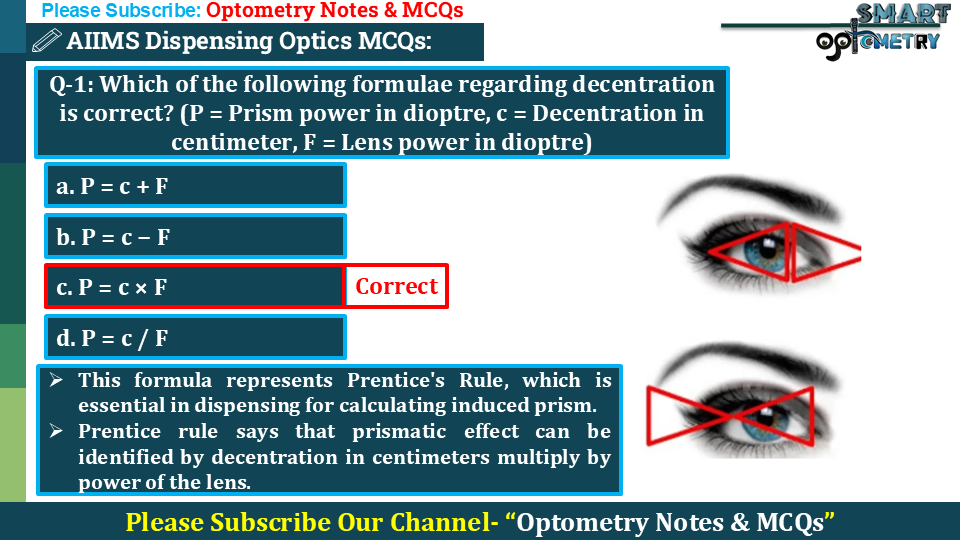
Q-1: Which of the following formulae regarding decentration is correct? (P = Prism power in dioptre, c = Decentration in centimeter, F = Lens power in dioptre)
A P = c + F
B P = c − F
C P = c × F
D P = c / F
💡 Explanation (Answer: C)
This formula represents Prentice’s Rule, which is essential in dispensing for calculating induced prism. It states that the prismatic effect is equal to the product of the decentration distance in centimeters and the dioptric power of the lens.
Q-2: Supra frames are most commonly called ______ frames.
A Full rim
B Rimless
C Double bridge
D Half rim
💡 Explanation (Answer: D)
Supra frames typically feature a rigid rim across the top of the lens and a nylon cord securing the bottom. This design is widely referred to as a half-rim or semi-rimless frame.
Q-3: Which of the following pairs regarding ophthalmic lenses is correct? I. Plus lenses are the combination of prisms base to base. II. Minus lenses are the combination of prisms apex to apex.
A Both I and II
B Neither I nor II
C Only II
D Only I
💡 Explanation (Answer: A)
A convex (plus) lens converges light and can be conceptualized as two prisms joined at their bases. Conversely, a concave (minus) lens diverges light and resembles two prisms joined at their apices.
🚀 Govt Job Preparation – Full Course
Gain immediate access to premium learning materials tailored perfectly for upcoming state & central-level Optometry Government Exams. Let’s make learning highly systematic.
Q-4: The refracting power of a cylindrical lens is at:
A 10°
B 30°
C 45°
D 90°
💡 Explanation (Answer: D)
A cylindrical lens has zero refractive power along its axis meridian. The maximum refractive power is found at the meridian 90 degrees perpendicular to the cylinder axis.
Q-5: Cellulose nitrate is used as a material for spectacle frames. Which of the following characteristics of this material is NOT correct?
A Frames are made from sheets made of this material.
B It is derived from cotton lint.
C It is hard.
D It is non-flammable.
💡 Explanation (Answer: D)
Cellulose nitrate is an older frame material that is chemically unstable and highly flammable. Due to this safety hazard, it has largely been replaced by safer materials like cellulose acetate.
Q-6: Lenses with one segment for near vision and one segment for far vision are called ________.
A Bifocal
B Monofocal
C Concave focal
D Trifocal
💡 Explanation (Answer: A)
Bifocal lenses are designed with two distinct optical powers within a single lens to address presbyopia. One section corrects distance vision, while the other segment aids in near vision tasks.
📚 Everything You Need for Optometry Exams
Secure high scores in clinical, optical, and anatomical domains. Our mock trials and detailed syllabus-mapped notes keep your preparation organized.
Q-7: The approximate power of the lens is given by the algebraical ________ of the front surface power of the lens and the back surface power of the lens.
A Difference
B Summation
C Product
D Division
💡 Explanation (Answer: B)
For a thin lens, the total power is calculated by adding the dioptric power of the front surface to the dioptric power of the back surface. This algebraic summation is a fundamental concept in lens surfacing and design.
Q-8: Which of the following options is not used for correcting unilateral aphakia?
A Anterior chamber intraocular lens
B Posterior chamber intraocular lens
C Contact lens
D Glasses
💡 Explanation (Answer: D)
Spectacles are generally not used for unilateral aphakia because the high plus power causes significant image magnification (aniseikonia). This size difference between the two eyes prevents binocular fusion, unlike contact lenses or IOLs.
Q-9: Which class of lens is used to correct myopia (short-sightedness)?
A Convex lens
B Concave lens
C Bipolar lens
D None of the above
💡 Explanation (Answer: B)
Myopia causes light to focus in front of the retina, requiring a lens that diverges light rays. Concave (minus) lenses push the focal point back onto the retina to restore clear distance vision.
Q-10: What is the purpose of prism correction in eyeglasses for people with diplopia (double vision)?
A To magnify the images seen by both eyes
B To eliminate the need for wearing eyeglasses
C To align the two separate images into one image
D To enhance the brightness and contrast of the images
💡 Explanation (Answer: C)
Prisms in eyeglasses deviate the path of light to compensate for eye misalignment. This helps fuse the two separate images into a single, clear image, thereby eliminating double vision.
🔒 Bonus MCQs – Available in App
Unlock these 5 exclusive premium questions + all 15 clinical subjects in the Govt Job Preparation course.
Q-11: What is the apex angle in degrees of a 10-diopter prism made of glass?
A 10°
B 30°
Q-12: A +10 diopter lens fully corrects hyperopia. If the lens is moved forward 10 mm, what is the new lens power needed to correct the hyperopia?
A +7 Diopters
B +9 Diopters
Q-13: A decentration of 10 mm from the optical center of a +5 diopter lens produces a prismatic effect of:
A 5 prism diopters
B 10 prism diopters
Q-14: Which of these statements does not hold true with regards to the Geneva lens measure?
A It can be used to measure lens thickness
B It can be used to measure the base curve of a lens
Q-15: Which of the following can be done to minimize lens aberrations? I. Correct base curve is selected to ensure a wider field of clear vision. II. Judicious selection of lens material with a higher Abbe value.
A Only II
B Only I
🎯 Accelerate Your Optometry Exam Prep
Access high-yield study resources, smart mock tests, and a high-performance community.
🎯 Enroll in Full Govt Job Preparation Course