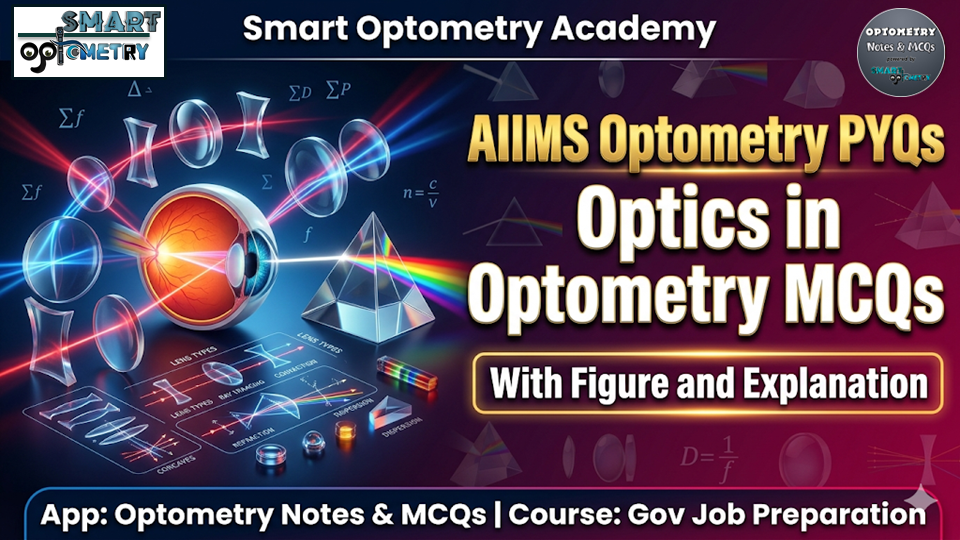
AIIMS Optometry PYQs- Optics in Optometry
Watch the video explanation, then solve 10 free AIIMS Optometry PYQs on optics in optometry with detailed answers. 14 bonus MCQs are locked inside the app.
🎥 Watch: AIIMS Optometry Optics in Optometry PYQs – Full Breakdown
📌 This video covers the same MCQs. After watching, test yourself with the interactive quiz below.
Q1. If a light ray strikes a lens perpendicularly, then: [AIIMS Optometry PYQs]
A No deviation occurs, and speed remains unchanged
B Deviation occurs, but speed remains unchanged
C No deviation occurs, but speed changes
D Deviation occurs, and speed changes
💡 Explanation (Answer: C)
A light ray traveling along the normal to the surface enters the medium without changing its spatial direction or undergoing deviation. However, because the refractive index of the lens material is greater than air, the velocity of the light must decrease.
Q2. The refracting power of a cylindrical lens is at: [AIIMS Optometry PYQs]
A \(10^\circ\)
B \(30^\circ\)
C \(45^\circ\)
D \(90^\circ\)
💡 Explanation (Answer: D)
A cylindrical lens has no refractive power along its axis meridian because the curvature in this direction is completely flat. Consequently, the maximum refracting power is located exactly \(90^\circ\) perpendicular to the cylinder axis.
🚀 Govt Job Preparation – Full Course
Gain immediate access to premium learning materials tailored perfectly for upcoming state & central-level Optometry Government Exams. Let’s make learning highly systematic.
Q3. Why does a stick appear bent when immersed in water? [AIIMS Optometry PYQs]
A Reflection
B Dispersion
C Refraction
D Scattering
💡 Explanation (Answer: C)
Refraction causes light rays coming from the submerged portion of the stick to bend away from the normal as they exit the water into the air. This abrupt change in direction alters the perceived origin of the light, making the stick appear bent at the surface interface.
Q4. The visible spectrum extends from ______ nm: [AIIMS Optometry PYQs]
A 100-200
B 200-500
C 400-700
D 700-1000
💡 Explanation (Answer: C)
The human visual system is sensitive only to a narrow band of electromagnetic radiation known as the visible spectrum. This range extends approximately from 400 nanometers for violet light to 700 nanometers for deep red light.
📚 Everything You Need for Optometry Exams
Secure high scores in clinical, optical, and anatomical domains. Our mock trials and detailed syllabus-mapped notes keep your preparation organized.
Q5. Dispersion can be observed when white light passes through: [AIIMS Optometry PYQs]
A Glass
B Prism
C Water
D None of the above
💡 Explanation (Answer: B)
Dispersion occurs because different wavelengths of light experience slightly different refractive indices and travel at different speeds through a medium. When white light passes through a prism, these varying angles of refraction cause the light to separate into its constituent spectral colors.
Q6. To see a rainbow, the sun should be positioned: [AIIMS Optometry Previous Year MCQs]
A In front of you
B Behind you
C On your left side
D On your right side
💡 Explanation (Answer: B)
To perceive a rainbow, the observer must face the falling rain while the sun is positioned directly behind them. This specific geometry is required so that light entering the water droplets can undergo internal reflection and emerge back toward the observer’s eyes.
🚀 Govt Job Preparation – Full Course
Gain immediate access to premium learning materials tailored perfectly for upcoming state & central-level Optometry Government Exams. Let’s make learning highly systematic.
Q7. Waves at the top of the electromagnetic spectrum are: [AIIMS Optometry Previous Year MCQs]
A Infrared waves
B Gamma rays
C X-rays
D UV rays
💡 Explanation (Answer: A)
In this selection of the electromagnetic spectrum, infrared waves occupy the region with the longest wavelengths and lowest frequencies. In contrast, ionizing radiations such as X-rays and gamma rays have much shorter wavelengths and higher energy levels.
Q8. Which type of lens is used in projectors? [AIIMS Optometry Previous Year MCQs]
A Convex lens
B Concave lens
C Bipolar lens
D Both A & B
💡 Explanation (Answer: A)
Projectors require a convex lens to act as a magnifying system for the slide or display panel. This converging lens projects a highly enlarged, real, and inverted image onto a distant screen.
📚 Everything You Need for Optometry Exams
Secure high scores in clinical, optical, and anatomical domains. Our mock trials and detailed syllabus-mapped notes keep your preparation organized.
Q9. A rainbow is believed to be: [AIIMS Optometry Previous Year MCQs]
A Spherical
B Full circle
C Hot plasma
D All of the above
💡 Explanation (Answer: B)
A rainbow is naturally a complete circle centered on the antisolar point opposite the sun. Observers on the ground only see a semi-circular arc because the horizon blocks the lower half of the circular pattern.
Q10. Which of the following statements is correct regarding refraction? [AIIMS Optometry Previous Year MCQs]
I. It is possible that the mass density of an optically denser medium may be less than that of an optically rarer medium.
II. The mass density of turpentine is less than that of water, but its optical density is higher.
A Neither I nor II
B Both I and II
C Only I
D Only II
💡 Explanation (Answer: B)
Mass density represents mass per unit volume, whereas optical density is a measure of a medium’s ability to slow down light. Turpentine is a classic example because it floats on water due to a lower mass density, but its higher refractive index means it has a greater optical density.
🔒 Bonus MCQs – Available in App
Unlock these 14 exclusive premium questions + all 15 clinical subjects in the Govt Job Preparation course.
Q11. What type of mirror is a dental mirror?
A Convex mirror
B Concave mirror
Q12. A decentration of 10 mm from the optical center of a +5 diopter lens produces a prismatic effect of:
A 5 prism diopters
B 10 prism diopters
Q13. A +10 diopter lens fully corrects hyperopia. If the lens is moved forward 10 mm, what is the new lens power needed?
A +11 Diopters
B +9 Diopters
Q14. What is the apex angle in degrees of a 10-diopter prism made of glass?
A 10 degrees
B 30 degrees
Q15. Rainbows are formed when sunlight is reflected through:
A Clouds
B Millions of raindrops
Q16. What is the power of a concave lens?
A Positive
B Negative
Q17. Which class of lens is used to correct myopia (short-sightedness)?
A Convex lens
B Concave lens
Q18. Which of the following is correct regarding laws of reflection?
A Only I
B Both I and II
Q19. How far away can an eye with 6/6 acuity read the 6/24 line?
A 12 meters
B 24 meters
Q20. What is the angle of deviation (\(\delta\)) for the given glass prism?
A \(\delta = (i-r_1) + (e+r_2)\)
B \(\delta = (i-r_1) + (e-r_2)\)
Q21. The approximate power of the lens is given by the algebraical:
A Difference
B Summation
Q22. Which of the following formulae regarding decentration is correct?
A \(P = c \times F\)
B \(P = c / F\)
Q23. What is the focal length of a lens with a power of \(+5.0\text{ Diopters}\)?
A 25 cm
B 20 cm
Q24. The minimal angle of resolution for an eye with 6/6 acuity is:
A 1 minute arc
B 15 minutes arc
🎯 Accelerate Your Optometry Exam Prep
Access high-yield study resources, smart mock tests, and a high-performance community.
🎯 Enroll in Full Govt Job Preparation Course