AIIMS Optometry PYQs- Ocular Pharmacology
Watch the video explanation, then solve 12 free AIIMS Optometry PYQs on contact lens with detailed answers. 18 bonus MCQs are locked inside the app.
🎥 Watch: AIIMS Optometry Ocular Pharmacology PYQs – Full Breakdown
📌 This video covers the same MCQs. After watching, test yourself with the interactive quiz below.
Q-1: Irrespective of the etiology of the corneal ulcer, the drug always indicated is: (AIIMS Optometry PYQs)
A Corticosteroids
B Cycloplegics
C Antibiotics
D Antifungals
💡 Explanation (Answer: B)
Cycloplegic agents (such as Atropine 1%) are universally indicated in the management of corneal ulcers to paralyze the ciliary muscle and relieve pain caused by ciliary spasms. By maintaining pupillary dilation, they prevent the formation of posterior synechiae secondary to anterior chamber inflammation. Additionally, they help stabilize the blood-aqueous barrier to reduce vascular congestion and inflammatory exudation.
Q-2: Timolol Maleate is one of the: (AIIMS Optometry PYQs)
A Beta blocker drugs
B Alpha-adrenergic agonists
C Sympathomimetics
D Cholinergic agents
💡 Explanation (Answer: A)
Timolol Maleate is a non-selective beta-adrenergic receptor antagonist that blocks both beta-1 and beta-2 receptors to lower elevated intraocular pressure. It reduces aqueous humor production by blocking beta-2 receptors located on the non-pigmented ciliary epithelium of the ciliary body. This makes it a primary therapeutic option for patients with open-angle glaucoma and ocular hypertension.
🚀 Govt Job Preparation – Full Course
Gain immediate access to premium learning materials tailored perfectly for upcoming state & central-level Optometry Government Exams. Let’s make learning highly systematic.
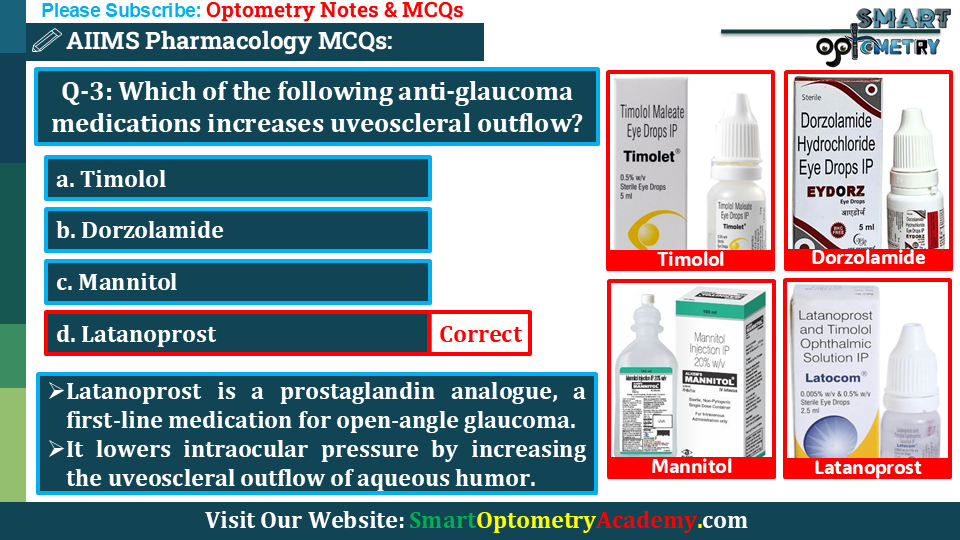
Q-3: Which of the following anti-glaucoma medications increases uveoscleral outflow? (AIIMS Optometry PYQs)
A Timolol
B Dorzolamide
C Mannitol
D Latanoprost
💡 Explanation (Answer: D)
Latanoprost is a prostaglandin F2-alpha (PGF2-alpha) analog that lowers intraocular pressure by selectively stimulating FP prostanoid receptors in the ciliary body. This stimulation remodels the extracellular matrix between ciliary muscle bundles, significantly increasing aqueous humor drainage via the alternative uveoscleral pathway. Other options like timolol and dorzolamide act by reducing aqueous production, while mannitol acts as a systemic osmotic agent.
Q-4: Which type of solution provides quick, sustained, and durable antimicrobial activity? (AIIMS Optometry PYQs)
A Alcohol-based solutions
B Chlorhexidine gluconate
C Povidone-iodine (PVP-I)
D Hydrogen peroxide
💡 Explanation (Answer: A)
Alcohol-based solutions containing 60% to 95% ethanol or isopropanol provide rapid, broad-spectrum antimicrobial activity by denaturing microbial proteins and disrupting cellular membranes. When combined with persistent agents like chlorhexidine, they deliver a highly durable, sustained sterile environment ideal for clinical hand preparation. This makes them the fastest and most reliable option for rapid skin and hand antisepsis.
📚 Everything You Need for Optometry Exams
Secure high scores in clinical, optical, and anatomical domains. Our mock trials and detailed syllabus-mapped notes keep your preparation organized.
Q-5: Which of the following is not true of acute viral conjunctivitis? (AIIMS Optometry PYQs)
A Vision is not affected
B Corneal infiltration is seen
C Antibiotics are the mainstay of treatment
D Pupil remains unaffected
💡 Explanation (Answer: C)
Acute viral conjunctivitis is a self-limiting condition typically caused by adenoviruses, meaning antibiotics are strictly ineffective and are not indicated as a mainstay treatment. Management is primarily supportive, utilizing artificial tears, cold compresses, and symptomatic relief. Normal pupil reactivity and corneal integrity remain unaffected initially, helping differentiate it from deeper, vision-threatening intraocular inflammation.
Q-6: A 36-year-old female develops pain in the eyes after a prone dark room test. Which of the drugs should be avoided? (AIIMS Optometry PYQs)
A Acetazolamide
B Pilocarpine
C Atropine
D Timolol
💡 Explanation (Answer: C)
The prone dark room test is a provocative test used to diagnose primary angle-closure susceptibility, where passive pupillary dilation can precipitate pupillary block. Atropine must be strictly avoided because its potent, long-acting mydriatic effect causes the iris tissue to bunch up in the angle of the anterior chamber. This can trigger a severe, acute, and prolonged attack of angle-closure glaucoma that is highly difficult to reverse medically.
🚀 Govt Job Preparation – Full Course
Gain immediate access to premium learning materials tailored perfectly for upcoming state & central-level Optometry Government Exams. Let’s make learning highly systematic.
Q-7: Ocriplasmin is a recombinant protease used to treat: (AIIMS Optometry PYQs)
A Retinal break
B Diabetic macular edema
C Uveovitreal membrane
D Submacular bleeding
💡 Explanation (Answer: C)
Ocriplasmin is a recombinant, truncated human serine protease used for the non-surgical treatment of symptomatic vitreomacular traction. It works by enzymatically cleaving structural proteins like laminin, fibronectin, and collagen at the vitreoretinal interface to release traction. This enzymatic separation effectively resolves symptomatic uveovitreal or vitreomacular membranes, preventing macular hole formation.
Q-8: Concentration of tropicamide: (AIIMS Optometry PYQs)
A 0.01 (1%)
B 0.02 (2%)
C 0.03 (3%)
D 0.04 (4%)
💡 Explanation (Answer: A)
Tropicamide is a short-acting muscarinic antagonist used clinically to induce mydriasis and mild cycloplegia during routine diagnostic ocular examinations. It is commercially prepared and highly effective at a concentration of 1% (represented as the fractional concentration 0.01). This concentration provides rapid pupillary dilation within 20 to 40 minutes, with recovery occurring within 4 to 6 hours.
📚 Everything You Need for Optometry Exams
Secure high scores in clinical, optical, and anatomical domains. Our mock trials and detailed syllabus-mapped notes keep your preparation organized.
Q-9: Which of the following is used in the treatment of fungal keratomycosis? (AIIMS Optometry PYQs)
A Silver sulfadiazine
B Linezolid
C Vancomycin
D Doxycycline
💡 Explanation (Answer: A)
Topical silver sulfadiazine (1% suspension) possesses strong, direct antifungal activity against filamentous fungi and yeasts, making it effective for treating fungal keratomycosis. It acts by disrupting the fungal cell wall while releasing silver ions that bind to fungal DNA to inhibit replication. The other listed options—linezolid, vancomycin, and doxycycline—are strictly antibacterial agents with no therapeutic efficacy against fungal pathogens.
Q-10: Which of the following does not result in amorphous whorl-like deposits in the cornea? (AIIMS Optometry PYQs)
A Chloroquine
B Amiodarone
C Indomethacin
D None of these
💡 Explanation (Answer: D)
Amorphous, whorl-like epithelial deposits in the cornea, known as cornea verticillata, are caused by systemic medications that accumulate within the lysosomes of corneal epithelial cells. Chloroquine, amiodarone, and indomethacin are all well-documented systemic drugs that produce these characteristic drug-induced lipidosis deposits. Since all three of these options cause this condition, “None of these” is the correct choice.
🚀 Govt Job Preparation – Full Course
Gain immediate access to premium learning materials tailored perfectly for upcoming state & central-level Optometry Government Exams. Let’s make learning highly systematic.
Q-11: Which of the following topical drugs causes heterochromia iridis? (AIIMS Optometry PYQs)
A Latanoprost
B Prednisolone
C Olopatadine
D Timolol
💡 Explanation (Answer: A)
Heterochromia iridis, or increased iris pigmentation, is a well-documented side effect of topical prostaglandin F2-alpha analogs like Latanoprost. The drug stimulates FP prostanoid receptors on stromal melanocytes, upregulating tyrosinase activity to increase melanin synthesis. This hypertrophic change does not increase the number of melanocytes but is most pronounced in eyes with mixed-color irises.
Q-12: Cycloplegics are drugs that cause: (AIIMS Optometry PYQs)
A Contraction of pupil
B Dilation of pupil
C Paralysis of ciliary muscles
D Movement in ciliary muscles
💡 Explanation (Answer: C)
Cycloplegics are competitive muscarinic receptor antagonists that block parasympathetic input to the intraocular muscles. While they cause pupillary dilation by affecting the pupillary sphincter, the term “cycloplegia” specifically refers to the temporary paralysis of the ciliary muscle. This paralysis suspends the eye’s accommodation reflex, preventing the patient from focusing on near objects.
📚 Everything You Need for Optometry Exams
Secure high scores in clinical, optical, and anatomical domains. Our mock trials and detailed syllabus-mapped notes keep your preparation organized.
🔒 Bonus MCQs – Available in App
Unlock these 18 exclusive premium questions + all 15 clinical subjects in the Govt Job Preparation course.
Q-13: In which of the following ways, Hyperosmotic agents work? (AIIMS Optometry Previous Year MCQs)
A They increase the osmolarity of plasma.
B They cause immediate reduction in intraocular pressure.
Q-14: Which of the following is an oral antihistamine commonly used for ocular allergy? (AIIMS Optometry Previous Year MCQs)
A Fexofenadine
B Promethazine
Q-15: Ofloxacin drug is effective against the: (AIIMS Optometry Previous Year MCQs)
A Infections caused by both Gram-positive and Gram-negative bacteria
B Chlamydial diseases only
Q-16: What is the mechanism of action of Unoprostone? (AIIMS Optometry Previous Year MCQs)
A Increases uveoscleral outflow
B Increases aqueous humor production
Q-17: Treatment of corneal ulcer is done by all EXCEPT: (AIIMS Optometry Previous Year MCQs)
A Topical steroids
B Topical antibiotics
Q-18: Which of the following bactericidal drugs acts by inhibiting bacterial cell wall synthesis? (AIIMS Optometry Previous Year MCQs)
A Norfloxacin
B Gentamycin
Q-19: Phospholine iodide is NOT available in which of the following concentrations? (AIIMS Optometry Previous Year MCQs)
A 0.30 percent
B 0.25 percent
Q-20: Which of the following is a type of ocular lubricant? (AIIMS Optometry Previous Year MCQs)
A Hydroxy methyl cellulose
B Sodium hyaluronate
Q-21: Which of the following antihistaminic agents has leukotriene and platelet aggregating factor antagonistic activity? (AIIMS Optometry Previous Year MCQs)
A Levocabastine Hydrochloride
B Pheneramine Maleate
Q-22: With respect to the routes of drug administration in common ocular inflammatory conditions, which of the following is correctly matched? (AIIMS Optometry Previous Year MCQs)
A Scleritis – Topical + Systemic
B Optic neuritis – Systemic + Posterior sub-tenon
Q-23: Which ocular dye is used in photodynamic therapy for treatment of choroidal neovascular membranes? (AIIMS Optometry Previous Year MCQs)
A Verteporfin
B Indocyanine Green
Q-24: Topical Acyclovir eye ointment is an: (AIIMS Optometry Previous Year MCQs)
A Antiviral agent.
B Antihistamine agent.
Q-25: Which of the following statements is correct regarding ocular lubricants? (AIIMS Optometry Previous Year MCQs)
A Ocular lubricants contain organic electrolytes.
B Methyl cellulose is an ocular lubricant.
Q-26: Which of the following are systemic Non-Steroidal Anti-Inflammatory Agents? (AIIMS Optometry Previous Year MCQs)
A Naproxen
B Diclofenac sodium
Q-27: Which of the following is a mydriatic agent? (AIIMS Optometry Previous Year MCQs)
A Benzalkonium
B Dulcolax
C Dapiprazole
D Phenylephrine
Q-28: ______ agents are useful for diagnosis and management in eye care because of their effect on pupil size and accommodation. (AIIMS Optometry Previous Year MCQs)
A Neurogenic
B Antiviral
C Antifungal
D Cycloplegics
Q-29: Which of the following is NOT an antiviral agent? (AIIMS Optometry Previous Year MCQs)
A Gentamycin
B Acyclovir
C Trifluridine
D Flucytosine
Q-30: Which antibacterial protein is secreted from the lacrimal apparatus? (AIIMS Optometry Previous Year MCQs)
A Semen
B Amylase
C Mucus
D Lysozyme
🎯 Accelerate Your Optometry Exam Prep
Access high-yield study resources, smart mock tests, and a high-performance community.
🎯 Enroll in Full Govt Job Preparation Course