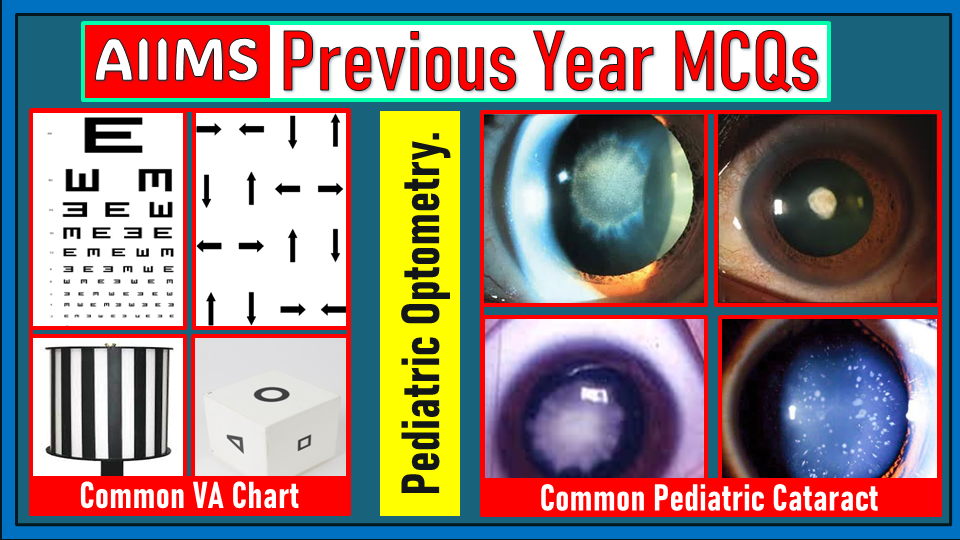
AIIMS Optometry PYQs- Pediatric Optometry
Watch the video explanation, then solve 10 free AIIMS Optometry PYQs on pediatric optometry with detailed answers. 10 bonus MCQs are locked inside the app.
🎥 Watch: AIIMS Optometry Pediatric Optometry PYQs – Full Breakdown
📌 This video covers the same MCQs. After watching, test yourself with the interactive quiz below.
Q-1: Which of the following is a type of detection visual acuity test in neonates? (AIIMS Optometry PYQs)
A Snellen’s E-chart test
B Arrows test
C Catford drum test
D Flook’s symbol test
💡 Explanation (Answer: C)
The Catford drum test assesses visual acuity in neonates by observing optokinetic nystagmus responses to moving targets of varying sizes. It is an objective method suitable for infants who cannot perform subjective recognition tests.
Q-2: The most common type of clinically significant congenital cataract is: (AIIMS Optometry PYQs)
A Sunflower cataract
B Anterior polar cataract
C Zonular cataract
D Blue dot cataract
💡 Explanation (Answer: C)
Zonular cataracts, also known as lamellar cataracts, are the most frequently occurring clinically significant congenital cataracts. They typically affect a specific zone of the lens and often have a genetic predisposition.
🚀 Govt Job Preparation – Full Course
Gain immediate access to premium learning materials tailored perfectly for upcoming state & central-level Optometry Government Exams. Let’s make learning highly systematic.
Q-3: Which visual assessment test is used for infants below 3 months? (AIIMS Optometry PYQs)
A Tumbling E test
B Eye popping test
C LogMAR chart
D Cardiff acuity test
💡 Explanation (Answer: B)
The eye popping test relies on a reflexive widening of the eyelids when room lights are suddenly dimmed, indicating gross visual perception. This behavioral response is useful for very young infants who cannot fixate or follow targets reliably.
Q-4: At what postnatal age should a baby with a history of respiratory distress and sepsis undergo retinal evaluation for ROP? (AIIMS Optometry PYQs)
A 2 weeks
B 4 weeks
C 6 weeks
D 8 weeks
💡 Explanation (Answer: B)
Retinal evaluation for Retinopathy of Prematurity (ROP) is generally recommended at 4 weeks of postnatal age or 31 weeks post-menstrual age, whichever is later. Timely screening ensures early intervention for high-risk infants.
📚 Everything You Need for Optometry Exams
Secure high scores in clinical, optical, and anatomical domains. Our mock trials and detailed syllabus-mapped notes keep your preparation organized.
Q-5: The most common clinical presentation of retinoblastoma is: (AIIMS Optometry PYQs)
A Leucocoria + Heterochromia iridis
B Leucocoria + Pseudohypopyon
C Leucocoria + Hyphaema
D Leucocoria + Strabismus
💡 Explanation (Answer: D)
The most frequent clinical signs of retinoblastoma are leucocoria (white pupillary reflex) followed by strabismus. Recognition of these signs is vital for early diagnosis and preservation of life and vision.
Q-6: Photophobia and watering, combined with a clear and large cornea, point to which diagnosis in infants? (AIIMS Optometry Previous Year MCQs)
A Keratoconus
B Buphthalmos
C Congenital dacryocystitis
D Interstitial keratitis
💡 Explanation (Answer: B)
Buphthalmos, or primary congenital glaucoma, presents with the classic triad of epiphora, photophobia, and blepharospasm. The elevated intraocular pressure causes the immature eye to enlarge, leading to a large, often hazy cornea.
Q-7: A 7-year-old male presents with 6/6 vision in the right eye and hand movements in the left eye. Fundoscopy shows subretinal yellowish exudates and telangiectatic vessels. What is the diagnosis? (AIIMS Optometry Previous Year MCQs)
A Coat’s disease
B Sympathetic ophthalmitis
C Retinopathy of prematurity
D Familial exudative vitreoretinopathy
💡 Explanation (Answer: A)
Coat’s disease is an idiopathic condition characterized by retinal telangiectasia and intraretinal or subretinal exudation, predominantly affecting young males. It often leads to exudative retinal detachment if left untreated.
Q-8: The most common route of spread of retinoblastoma is: (AIIMS Optometry Previous Year MCQs)
A Lymphatics
B Optic nerve
C Direct spread
D Vascular
💡 Explanation (Answer: B)
Retinoblastoma most commonly spreads directly through the optic nerve to the brain. This mode of extension makes optic nerve evaluation critical during enucleation to ensure complete tumor removal.
Q-9: The most common site of blockage in congenital nasolacrimal obstruction is: (AIIMS Optometry Previous Year MCQs)
A Valve of Rosenmüller
B Ampulla of lacrimal sac
C Common canaliculus
D Valve of Hasner
💡 Explanation (Answer: D)
Congenital nasolacrimal duct obstruction is most frequently caused by a membranous block at the Valve of Hasner at the distal end of the duct. Spontaneous resolution is common, but probing may be required if it persists.
Q-10: Amblyopia, which is the result of a significant difference in the refractive errors of the two eyes where one eye has the visual advantage, is known as: (AIIMS Optometry Previous Year MCQs)
A Strabismic amblyopia
B Occlusion amblyopia
C Stimulus deprivation amblyopia
D Anisometropic amblyopia
💡 Explanation (Answer: D)
Anisometropic amblyopia develops when unequal refractive errors cause the brain to chronically suppress the blurred image from the eye with the higher prescription. It is a common cause of amblyopia and requires optical correction and often occlusion therapy.
🔒 Bonus MCQs – Available in App
Unlock these 10 exclusive premium questions + all 15 clinical subjects in the Govt Job Preparation course.
Q-11: A premature baby weighing 1000 gms or less is most likely to suffer from:
A Cataract
B Glaucoma
C Retinopathy of prematurity
Q-12: Which of the following conditions can be identified through pediatric vision screening?
A Amblyopia
B Hearing loss
Q-13: What is the leading cause of preventable blindness in children?
A Vitamin B12 deficiency
B Vitamin A deficiency
Q-14: What is the purpose of the Brückner test?
A To determine the patient’s refractive error
B To assess the symmetry of the patient’s red reflexes
Q-15: The most common cause of bilateral proptosis in children is:
A Lymphoma
B Neuroblastoma
Q-16: Which of the following statements is correct regarding congenital idiopathic nystagmus?
A This develops in late childhood.
B This is always bilateral, usually horizontal and jerky.
Q-17: Which of the following statements is correct regarding the aetiology of pseudostrabismus?
A Epicanthal folds
B All of the above
Q-18: Which eye movement is associated with Dissociated Vertical Deviation (DVD)?
A Upward movement with intorsion
B Downward movement with extorsion
Q-19: This deviation relates to time, with the deviation occurring at regular intervals. Which type of esotropia is being talked about?
A Cyclic esotropia
B Secondary esotropia
Q-20: What is the primary cause of accommodative esotropia?
A Hyperopia (far-sightedness) and activation of the accommodative reflex
B High amount of UV rays entering the eye
🎯 Accelerate Your Optometry Exam Prep
Access high-yield study resources, smart mock tests, and a high-performance community.
🎯 Enroll in Full Govt Job Preparation Course